roadwise.Open study app

South Carolina driving lesson · Sharing the Road

Trucks & buses: following, hills & turns

A 3-minute lesson from the South Carolina course. Read the rules and examples, follow the handbook page references, and check your understanding before you move on.

Read time
3 minutes
Course unit
Sharing the Road
Checkpoint questions
5
Source pages
118, 119, 120

Behind a truck you can't see what's ahead, and the driver can't see you. On hills and at corners, trucks move in ways drivers don't expect. Give them space.

200 feet

How far a large vehicle's rear blind spot can extend

Handbook p. 118 ↗

Know the rule

If you follow too closely, the truck can't see you and you can't see ahead. If it brakes suddenly you have nowhere to go.

Handbook p. 118 ↗

Know the rule

Don't follow a large vehicle too closely, and position your vehicle so the driver can see it in the side mirrors.

Handbook p. 119 ↗

Know the rule

On steep hills, large vehicles must go slowly, about 35 mph, and use the right lane. Avoid the right lane on hills and near truck weigh stations where trucks re-enter faster traffic.

Handbook p. 119 ↗

Know the rule

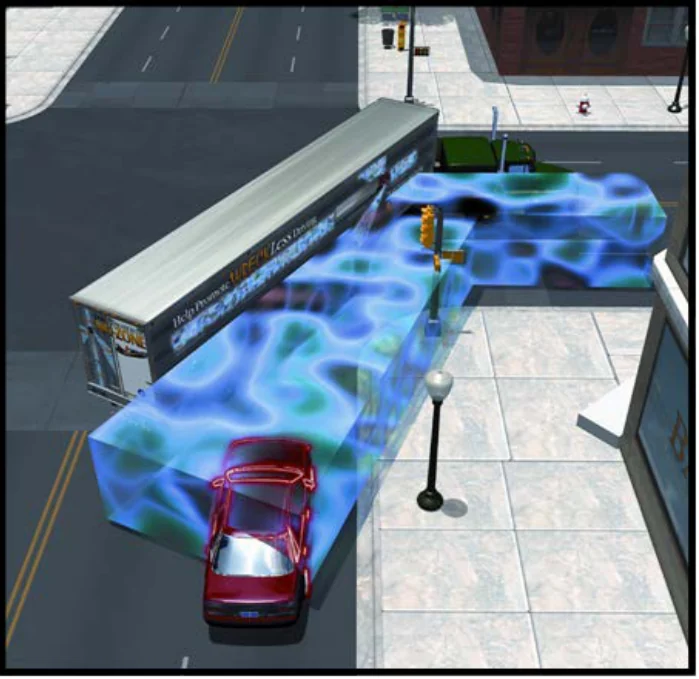
To turn right, a truck or bus may swing wide to the left, sometimes using other lanes. Don't squeeze between it and the curb, and don't turn until it has finished its turn.

Handbook p. 119 ↗
Truck no-zone blind spot
Don't get squeezed between a turning truck and the curb

Keep in mind:

  • Meeting an oncoming truck, keep far right to avoid a sideswipe and wind turbulence
  • Unsure how fast an oncoming truck or bus is going? Don't turn left in its path
  • Always stop behind stop lines; they leave larger vehicles room to turn
  • Never cut off a large vehicle to reach an exit or turn or to beat it into a one-lane work zone
Handbook p. 120 ↗

Put it into practice

A bus ahead signals right, then drifts left toward your lane. Don't try to pass on its right. It's swinging wide to clear the corner. Stay back until it has completed the turn.

Check your understanding

Read the question, decide on an answer, then open it to check the explanation. These are Roadwise study questions based on the source handbook.

When traveling up or down steep hills, large vehicles often travel about:
  1. 35 mph, using the right lane
  2. 55 mph, using the left lane
  3. 15 mph, using any lane
  4. 70 mph, using the right lane

Answer: 35 mph, using the right lane

Large vehicles must drive slowly, approximately 35 mph, on steep hills and use the right lane.
Handbook p. 119 ↗
When you meet a truck coming from the opposite direction, you should:
  1. Move toward the center line
  2. Keep as far as possible to the right side of the roadway
  3. Speed up to pass quickly
  4. Stop until the truck passes

Answer: Keep as far as possible to the right side of the roadway

Keep as far as possible to the right side of the roadway to avoid a collision and reduce wind turbulence.

Handbook p. 120 ↗
If you are unsure how fast an oncoming truck is approaching, you should:
  1. Turn left quickly before it arrives
  2. Assume it is going the speed limit
  3. Not turn left in its path
  4. Flash your lights, then turn

Answer: Not turn left in its path

When in doubt about the speed of an oncoming truck or bus, do not turn left in its path.

Handbook p. 120 ↗
Stop lines at many intersections are set back to give larger vehicles more room to turn.
  1. True
  2. False

Answer: True

Stop lines help set drivers farther back at an intersection to give larger vehicles more turning space.

Handbook p. 120 ↗
Trucks and buses always turn right from directly against the curb, never swinging wide.
  1. True
  2. False

Answer: False

A truck or bus will sometimes swing wide to the left to safely clear the corner when turning right.

Handbook p. 119 ↗
Take the lesson checkpoint in the app

More in Sharing the Road