Roadwise States South Carolina Driving lessons Space cushion & following distance South Carolina driving lesson · Safe Driving Tips
Space cushion & following distance A 3-minute lesson from the South Carolina course. Read the rules and examples, follow the handbook page references, and check your understanding before you move on.
Read time 3 minutes
Course unit Safe Driving Tips
Checkpoint questions 6
Source pages 98, 99, 100, 101 You share the road with cars, trucks and motorcycles. The more space you keep around your vehicle, the more time you have to react. Try to keep a safe cushion in front, beside and behind you.
Space cushion The space you keep between your vehicle and other road users, giving you time to react.
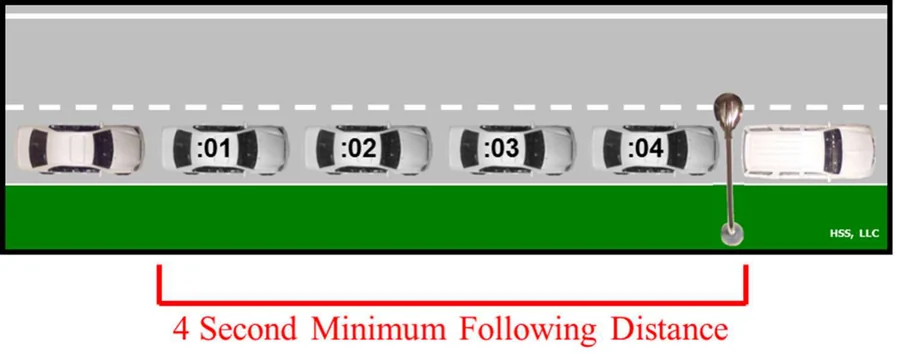
Handbook p. 98 ↗ Counting your following distance: Watch the rear of the vehicle ahead pass a sign, pole or other fixed point Count: "one thousand one, one thousand two, one thousand three, one thousand four" If you reach the point before "one thousand four", you're too close Slow down and count again at another point until you're no closer than 4 seconds Handbook p. 99 ↗ 4-second minimum following distance Increase your following distance: On slippery roads At night, in fog, or in bad weather Behind vehicles that must stop at railroad crossings (transit buses, school buses, hazmat) Behind large vehicles: trucks, buses, RVs and vehicles pulling trailers Handbook p. 100 ↗ Space to the side: Don't drive next to other vehicles for long; you may be in their blind spot Don't crowd the centerline; keep as much space as possible from oncoming traffic Make room for vehicles entering the roadway by changing lanes or adjusting speed Give extra space to pedestrians, especially children and the elderly, and to bicyclists When a tractor trailer passes, move to the outside part of your lane, away from it Handbook p. 100 ↗ Know the rule
To keep the driver behind you at a safe distance, keep a steady speed, signal in advance, and leave more space in front before you slow or turn.
Handbook p. 101 ↗ Put it into practice
A school bus is ahead of you on a rural road that crosses railroad tracks. The bus must stop at the crossing, so add to your 4-second following distance now and you won't have to brake hard when it stops.
A useful reminder Four seconds is the minimum. Add more for slick roads, night, fog and big vehicles.
Check your understanding Read the question, decide on an answer, then open it to check the explanation. These are Roadwise study questions based on the source handbook.
What is the recommended minimum following distance in ideal conditions? 1 second 2 seconds 10 seconds 4 seconds Answer: 4 seconds
You should always try to keep a minimum following distance of 4 seconds between your vehicle and the one ahead.
Handbook p. 99 ↗ To check your following distance, you count seconds from when the vehicle ahead passes a fixed point until: You reach that point The vehicle ahead turns You apply your brakes The vehicle ahead brakes Answer: You reach that point
Count the seconds it takes you to reach the same sign, pole, or stationary point the vehicle ahead just passed.
Handbook p. 99 ↗ You should increase your following distance in which situation? On a clear, dry highway with light traffic On slippery roads When driving under the speed limit When using cruise control Answer: On slippery roads
You need more space in front of your vehicle on slippery roads.
Handbook p. 99 ↗ You should increase your following distance when following vehicles required to stop at railroad crossings, such as: Motorcycles and scooters Tow trucks and pickups School buses and hazmat vehicles Taxis and delivery vans Answer: School buses and hazmat vehicles
Increase following distance behind vehicles required to stop at railroad crossings, such as buses or hazmat carriers.
Handbook p. 100 ↗ You should avoid driving next to other vehicles for long periods because: You may sit in their blind spot It wastes fuel It is illegal in SC It increases unnecessary following distance Answer: You may sit in their blind spot
Driving next to other vehicles for long periods may put you in their blind spot and reduces the space you need to react.
Handbook p. 100 ↗ When passed by a tractor trailer, you should: Move toward the center line Move to the outside portion of your lane, away from the truck Brake hard until it passes Speed up to stay beside it Answer: Move to the outside portion of your lane, away from the truck
When a passing vehicle is a tractor trailer, move to the outside portion of your lane space away from it.
Handbook p. 101 ↗ Previous lesson Stopping distance Next lesson Communicating: lights, horn & signals More in Safe Driving Tips About the source Roadwise’s South Carolina course uses the driver handbook edition supplied with this study pack. This lesson cites source pages 98, 99, 100, 101. The linked PDF is a third-party mirror of the handbook, rather than a government-hosted page.
Open the handbook source PDF · View the source edition
For current application requirements, fees, appointments, and the format that applies to your age or license type, check South Carolina’s DMV. Roadwise provides study material and does not issue permits or licenses.