Roadwise States South Carolina Driving lessons Communicating: lights, horn & signals South Carolina driving lesson · Safe Driving Tips
Communicating: lights, horn & signals A 3-minute lesson from the South Carolina course. Read the rules and examples, follow the handbook page references, and check your understanding before you move on.
Read time 3 minutes
Course unit Safe Driving Tips
Checkpoint questions 6
Source pages 101, 102, 103 Other road users can only avoid you if they know where you are and what you'll do next. Use your lights, horn and signals to tell them, and use them correctly.
Know the rule
It's your responsibility to make your vehicle visible to other road users.
Handbook p. 101 ↗ Turn on your headlights, especially: On rainy, snowy or foggy days: use low beams and slow down When it starts to get dark When driving away from a rising or setting sun Handbook p. 101 ↗ Give a light tap on the horn when: Pedestrians or bicyclists seem to be moving into your lane You're passing a driver who starts to turn into your lane A driver isn't paying attention or may have trouble seeing you Handbook p. 102 ↗ Know the rule
Use your horn only to communicate. Using it inappropriately can scare or anger others, and don't use it near blind pedestrians.
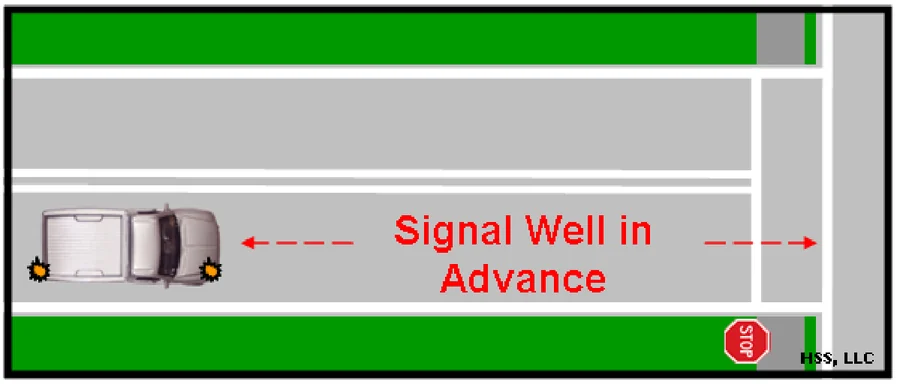
Handbook p. 102 ↗ 100 feet State law: signal at least this far before changing lanes, turning or merging
Handbook p. 102 ↗ Signal well in advance Know the rule
Cancel your signal once your move is complete, so you don't confuse other drivers.
Handbook p. 102 ↗ Signal before reducing speed when: Turning off a road that has no separate turning or exit lanes Parking or turning before an intersection Handbook p. 103 ↗ Put it into practice
You plan to turn into a driveway just before an intersection. Signal at least 100 feet ahead so drivers behind you know you'll slow before the intersection. Otherwise they may expect you to turn at the intersection, or not to slow at all.
A useful reminder Signal 100 feet or more before every turn, lane change or merge. It's state law.
Check your understanding Read the question, decide on an answer, then open it to check the explanation. These are Roadwise study questions based on the source handbook.
SC law requires you to use a turn signal how far before changing lanes or turning? 25 feet or more 10 feet or more 500 feet or more 100 feet or more Answer: 100 feet or more
It is state law that you must use a turn signal 100 feet or more before changing lanes, turning, or merging.
Handbook p. 102 ↗ After completing a turn or lane change, you should: Cancel your turn signal Leave the signal on for a few extra seconds Turn the signal off before completing the maneuver Switch to hazard lights Answer: Cancel your turn signal
Make sure you cancel your signals once your action is completed to avoid confusing other drivers.
Handbook p. 102 ↗ Besides rain, snow, or fog, when does the manual say using headlights is especially important? Only after 10 p.m. When it begins to get dark Only on interstate highways When the car ahead flashes its lights Answer: When it begins to get dark
Headlights are especially important on rainy, snowy, or foggy days and when it begins to get dark or when driving away from a rising or setting sun.
Handbook p. 101 ↗ A light tap on your horn is appropriate when: You want to greet another driver You are stuck in slow traffic A pedestrian seems to be stepping into your lane You want to warn a blind pedestrian Answer: A pedestrian seems to be stepping into your lane
A light tap on the horn may be used when pedestrians or bicyclists appear to be moving into your lane.
Handbook p. 101 ↗ You should avoid using your horn near: Distracted drivers Bicyclists entering your lane Pedestrians in a crosswalk Blind pedestrians Answer: Blind pedestrians
You should not use your horn when near blind pedestrians.
Handbook p. 102 ↗ You should signal before reducing speed when: Driving at a constant highway speed Turning off a road that has no separate turning lane Approaching a green light Accelerating from a stop Answer: Turning off a road that has no separate turning lane
Signal before reducing speed when turning off a roadway that does not have separate turning or exiting lanes.
Handbook p. 103 ↗ Previous lesson Space cushion & following distance Next lesson Avoiding collisions & handling skids More in Safe Driving Tips About the source Roadwise’s South Carolina course uses the driver handbook edition supplied with this study pack. This lesson cites source pages 101, 102, 103. The linked PDF is a third-party mirror of the handbook, rather than a government-hosted page.
Open the handbook source PDF · View the source edition
For current application requirements, fees, appointments, and the format that applies to your age or license type, check South Carolina’s DMV. Roadwise provides study material and does not issue permits or licenses.