roadwise.Open study app

South Carolina driving lesson · Safe Driving Tips

Adjusting speed: curves, wet roads & floods

A 3-minute lesson from the South Carolina course. Read the rules and examples, follow the handbook page references, and check your understanding before you move on.

Read time
3 minutes
Course unit
Safe Driving Tips
Checkpoint questions
6
Source pages
95, 96, 97

Speed management means adjusting your speed for road and traffic conditions, keeping enough following distance, and obeying the speed limit. The posted limit is a maximum, not a target.

Know the rule

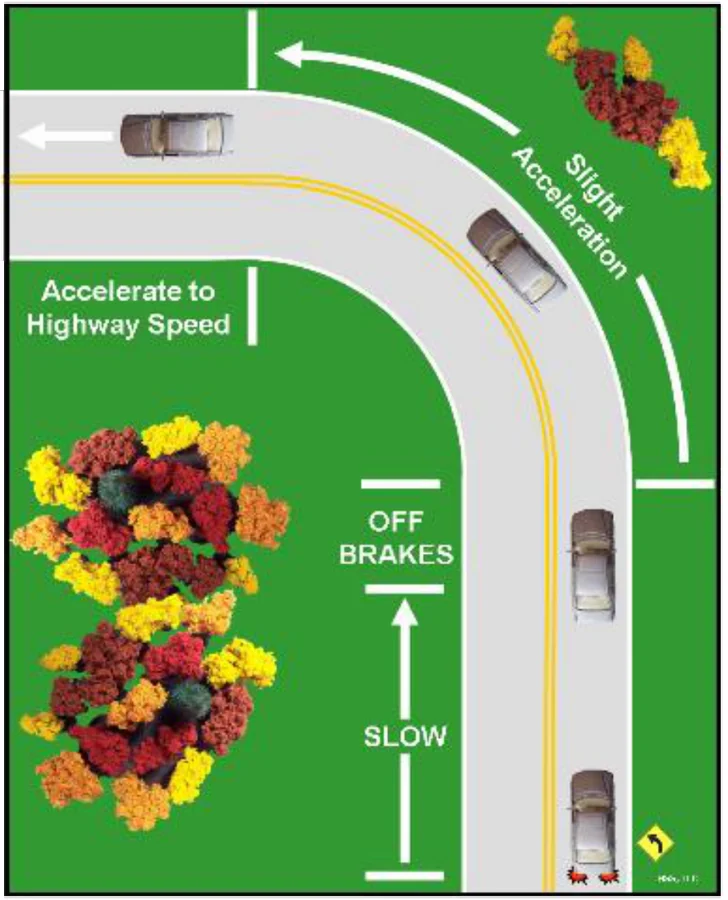
Reduce speed before entering a curve, to a speed that lets you apply slight, constant acceleration through it.

Handbook p. 95 ↗

Know the rule

Slow down even more in a curve when traction is poor, when following other vehicles, and when you can't see the end of the curve.

Handbook p. 95 ↗

Know the rule

Hard braking after you enter a curve could make the tires lose traction.

Handbook p. 95 ↗
Highway entrance ramp acceleration lane
Slow before the curve, accelerate slightly through it

Know the rule

Reduce speed at the first sign of rain, snow, sleet or ice. On slippery roads tires grip less, stopping takes longer, and turning without skidding is harder.

Handbook p. 96 ↗

Hydroplaning

When the steering tires ride on a layer of water on top of the road surface, similar to water skis.

Handbook p. 96 ↗

Know the rule

The best way to avoid hydroplaning is to slow down in the rain or on roads with pooled water or puddles.

Handbook p. 96 ↗

Know the rule

Flash floods can come rapidly and unexpectedly, within a few minutes or hours of excessive rainfall.

Handbook p. 97 ↗
6 inches

Water that reaches the bottom of most passenger cars, causing loss of control or stalling

Handbook p. 97 ↗
2 feet

Moving water that can carry away most vehicles, including SUVs and pickups

Handbook p. 97 ↗

Flooded roadways:

  • Don't drive through flooded areas; turn around and find another route
  • Be cautious, especially at night when visibility is limited
  • Even shallow-looking water can hide dips and hazards, or have washed away the road
  • If there's no other route, go to higher ground and wait for the water to go down
Handbook p. 97 ↗

Put it into practice

Heavy rain has left water across a low road on your way home, and it looks only a few inches deep. Don't try it. Six inches reaches the bottom of most cars, and the water may hide a washed-out road. Turn around and take another route.

Check your understanding

Read the question, decide on an answer, then open it to check the explanation. These are Roadwise study questions based on the source handbook.

You should reduce speed before entering a curve to:
  1. The posted speed limit
  2. About 10 mph under the posted limit
  3. Whatever speed traffic behind you is going
  4. One that lets you gently accelerate through it

Answer: One that lets you gently accelerate through it

Reduce speed before entering a curve to a speed that allows slight and constant acceleration through it.
Handbook p. 95 ↗
Hydroplaning occurs when:
  1. Steering tires ride on a layer of water on the road
  2. A tire suddenly deflates
  3. The brakes overheat
  4. The engine stalls in the rain

Answer: Steering tires ride on a layer of water on the road

Hydroplaning occurs when the steering tires ride on a layer of water on top of the road surface.

Handbook p. 96 ↗
The best way to avoid hydroplaning is to:
  1. Brake hard and often
  2. Slow down on wet roads
  3. Increase your speed to skim over water
  4. Use cruise control to hold speed steady

Answer: Slow down on wet roads

The best way to avoid traction loss from hydroplaning is to slow down when driving in the rain or on wet roads.

Handbook p. 96 ↗
About how much water will reach the bottom of most passenger cars?
  1. One inch
  2. Three feet
  3. Six inches
  4. Four feet

Answer: Six inches

Six inches of water will reach the bottom of most passenger cars, causing loss of control or stalling.

Handbook p. 97 ↗
How much moving water can carry away most vehicles, including SUVs and pickups?
  1. Six inches
  2. One foot
  3. Ten feet
  4. Two feet

Answer: Two feet

Two feet of moving water can carry away most vehicles, including SUVs and pickup trucks.

Handbook p. 97 ↗
If you see a flooded roadway ahead, you should:
  1. Turn around and find another route
  2. Drive through slowly since it's usually safe
  3. Cross slowly if the water looks shallow
  4. Follow another vehicle through the water

Answer: Turn around and find another route

If you see a flooded roadway, turn around and find another route rather than attempting to cross.

Handbook p. 97 ↗
Take the lesson checkpoint in the app

More in Safe Driving Tips