roadwise.Open study app

South Carolina driving lesson · Special Driving Situations

Night driving

A 3-minute lesson from the South Carolina course. Read the rules and examples, follow the handbook page references, and check your understanding before you move on.

Read time
3 minutes
Course unit
Special Driving Situations
Checkpoint questions
6
Source pages
126, 127

At night you can see only as far as your headlights reach, so driving is harder and more dangerous. Use your beams correctly, protect your eyes from glare, and leave extra space.

Know the rule

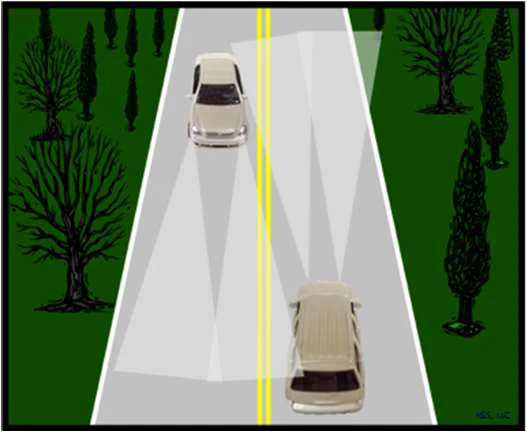
Use high beams when there are no oncoming vehicles. High beams let you see twice as far as low beams.

Handbook p. 126 ↗
500 feet

Dim your high beams when an oncoming vehicle is this far away or more

Handbook p. 126 ↗

Know the rule

If an oncoming vehicle has its high beams on, glance toward the right side of the road so you aren't distracted or momentarily blinded.

Handbook p. 126 ↗
Night driving visibility
Dim your high beams for oncoming traffic
200 feet

Use low beams when following a vehicle less than this far ahead

Handbook p. 127 ↗

Know the rule

In fog, rain or snow, use low beams. High beams cause glare and make it harder to see. Some vehicles have fog lights for fog, snow or rain.

Handbook p. 127 ↗

More night tips:

  • Don't look directly into oncoming headlights; keep searching the road ahead
  • Search beyond your headlights for dark shapes on the road
  • Glance left and right to find the pavement edge and hazards from the sides
  • Don't wear sunglasses or colored lenses at night or on overcast days
Handbook p. 127 ↗

Add to your following distance

Add to your following distance
ConditionAdd at least
Night driving1 extra second
Unfamiliar roads at night2 extra seconds
Handbook p. 127 ↗

Put it into practice

You're on high beams on a dark highway when headlights appear over a rise ahead. Switch to low beams while the car is still 500 feet or more away. If its driver doesn't dim, look toward the right edge of your lane.

Check your understanding

Read the question, decide on an answer, then open it to check the explanation. These are Roadwise study questions based on the source handbook.

You should dim your high beams when you are how far from an oncoming vehicle?
  1. 100 feet or more
  2. 500 feet or more
  3. 1,000 feet or more
  4. 200 feet or more

Answer: 500 feet or more

Dim your high beams when you are 500 feet or more away from any oncoming vehicle.
Handbook p. 126 ↗
You should use low beams when following another vehicle less than how many feet in front of you?
  1. 50 feet
  2. 500 feet
  3. 200 feet
  4. 1,000 feet

Answer: 200 feet

Use your low beams when following another vehicle that is less than 200 feet in front of you.

Handbook p. 127 ↗
In fog, rain, or snow, you should use:
  1. High beams
  2. Parking lights only
  3. No headlights at all
  4. Low beams

Answer: Low beams

In fog, rain, or snow, use your low beams; high beams can cause glare and make it harder to see.

Handbook p. 127 ↗
High beams let you see:
  1. Twice as far as low beams
  2. Half as far as low beams
  3. The same distance as low beams
  4. Three times as far as low beams

Answer: Twice as far as low beams

High beams let you see twice as far as low beams.

Handbook p. 126 ↗
For night driving, you should increase your following distance by:
  1. At least ten additional seconds
  2. No change is needed
  3. At least one additional second
  4. At least half a second

Answer: At least one additional second

Increase your following distance by adding at least one additional second for night driving conditions.

Handbook p. 127 ↗
On unfamiliar roadways at night, you should increase your following distance by at least:
  1. Thirty additional seconds
  2. Half a second
  3. No additional time is needed
  4. Two additional seconds

Answer: Two additional seconds

Add at least two additional seconds for driving on unfamiliar roadways at night.

Handbook p. 127 ↗
Take the lesson checkpoint in the app

More in Special Driving Situations