roadwise.Open study app

South Carolina driving lesson · Special Driving Situations

Towing: hooking up & loading a trailer

A 3-minute lesson from the South Carolina course. Read the rules and examples, follow the handbook page references, and check your understanding before you move on.

Read time
3 minutes
Course unit
Special Driving Situations
Checkpoint questions
4
Source pages
133, 134, 135, 136

Trailers are towed billions of miles every year. Driver error contributes to the large majority of crashes involving vehicle-trailer combinations, so hooking up and loading correctly matter as much as driving.

Know the rule

Your judgment and common sense are key: make sure you hook up, load and operate the vehicle-trailer combination properly.

Handbook p. 134 ↗

Connecting a trailer, every time:

  • Learn the proper hookup for your vehicle and trailer
  • Attach the coupler to the hitch-ball correctly
  • Connect the safety chains
  • Plug in the lights
  • Don't pause to do something else; finish the hookup first
  • Before leaving, check that the coupler and hitch-ball are properly connected
  • Have clean, undamaged mirrors on both sides
Handbook p. 134 ↗

Know the rule

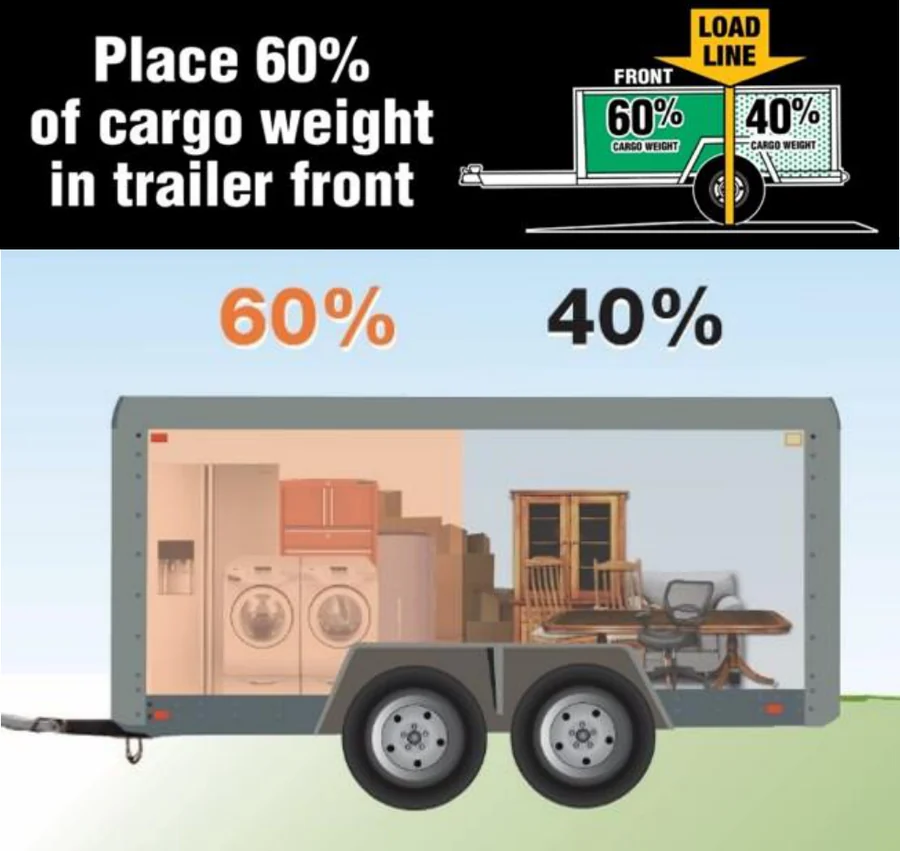
Load the trailer heavier in the front to reduce sway. Failing to do so is a leading cause of vehicle-trailer mishaps.

Handbook p. 135 ↗
60% / 40%

Cargo weight in the front (nearest the tow vehicle) / in the back

Handbook p. 135 ↗
Trailer load distribution
Place 60% of cargo weight in the trailer's front

Know the rule

If the trailer sways or whips, steer straight and reduce speed gradually. Don't brake, and never speed up. Stop completely off the road when safe, check that it's loaded heavier in front, and reload if needed.

Handbook p. 135 ↗

Loading tips:

  • Keep heavy items on the trailer floor, not stacked on other items
  • Pack cargo tightly
  • Secure partial loads with tiedowns or straps and packing material
  • Don't overload; exceeding the maximum gross weight can damage or break trailer parts
Handbook p. 136 ↗

Put it into practice

You're loading a trailer with a washer, dryer and some chairs. Put the heavy appliances on the floor at the front, near the tow vehicle, so about 60% of the weight is up front. Strap everything down tightly.

Check your understanding

Read the question, decide on an answer, then open it to check the explanation. These are Roadwise study questions based on the source handbook.

When loading a trailer, what percentage of the cargo weight should go in the front?
  1. 40 percent
  2. 60 percent
  3. 50 percent
  4. 90 percent

Answer: 60 percent

Sixty percent of the cargo weight of a trailer should go in the front, nearest the towing vehicle.
Handbook p. 135 ↗
If a trailer begins to sway or whip, you should:
  1. Apply the brakes hard immediately
  2. Increase your speed to stabilize it
  3. Steer straight and slow gradually
  4. Turn sharply to correct the sway

Answer: Steer straight and slow gradually

If the trailer begins to sway, steer straight and reduce speed gradually; do not apply the brakes or speed up.

Handbook p. 135 ↗
Failure to load a trailer heavier in the front is a leading cause of:
  1. Engine overheating
  2. Vehicle-trailer mishaps
  3. Brake fade on hills
  4. Excess tire wear

Answer: Vehicle-trailer mishaps

Failure to load the trailer heavier in the front is a leading cause of vehicle-trailer mishaps.

Handbook p. 135 ↗
Before leaving with a trailer, what should you check about the hookup?
  1. That the trailer lights stay unplugged
  2. That the coupler and hitch-ball are connected
  3. That safety chains are removed for turns
  4. That the trailer is loaded heavier in back

Answer: That the coupler and hitch-ball are connected

Before leaving, check the connection to be sure the coupler and hitch-ball are properly connected.

Handbook p. 134 ↗
Take the lesson checkpoint in the app

More in Special Driving Situations