roadwise.Open study app

Rhode Island driving lesson · Sharing the Road Safely

Sharing the Road with Large Trucks

A 3-minute lesson from the Rhode Island course. Read the rules and examples, follow the handbook page references, and check your understanding before you move on.

Read time
3 minutes
Course unit
Sharing the Road Safely
Checkpoint questions
6
Source pages
52

Big trucks can't stop, turn or see like cars. Their blind spots are huge, and a crash with one is rarely a fair fight. Stay out of their 'no zones', don't tailgate, and give them room to turn.

4 times

NHTSA: big trucks are this much more likely than other vehicles to get into collisions

Handbook p. 52 ↗

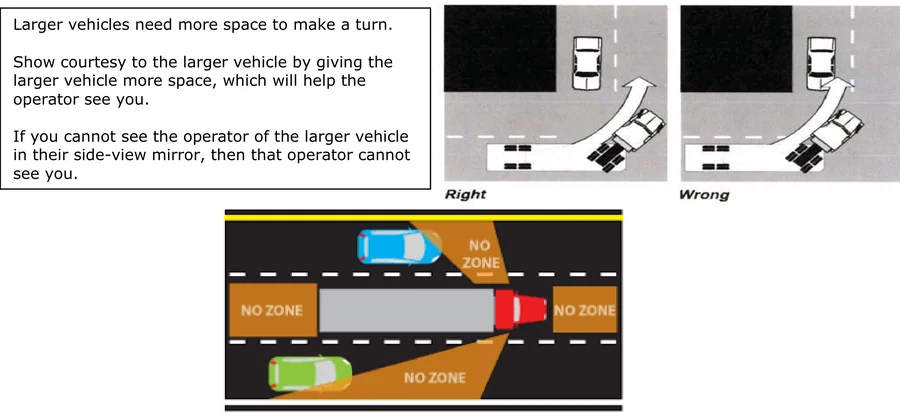
A truck driver's three major blind spots:

  • The front of the truck
  • The left and right front sides
  • Behind the truck
Handbook p. 52 ↗
50+ ft

Length of the blind spot behind a truck pulling a trailer

Handbook p. 52 ↗

No zones

The blind spots around a large truck where the driver can't see you.

Handbook p. 52 ↗
Large vehicle blind spots / courtesy
Truck no zones, and giving a truck room for a wide right turn

Know the rule

Don't cruise beside a truck's right side. If you end up there, pull ahead or fall back quickly, and grip the wheel firmly—airflow between the vehicles can pull them together.

Handbook p. 52 ↗

Know the rule

Never tailgate a truck. Stay at least 50 feet back if you expect the driver to see you; you're far enough back when you can see the truck's side-view mirrors.

Handbook p. 52 ↗

Know the rule

If you can't see the truck driver in their side-view mirror, the driver can't see you.

Handbook p. 52 ↗

Know the rule

Semi-trailers make wide turns, especially in urban areas. Larger vehicles need more space to turn—give it to them, and watch the lights and markings on large vehicles.

Handbook p. 52 ↗

Put it into practice

A tractor-trailer ahead signals right and swings left to start its turn. Don't squeeze into the gap on its right. Stay back where you can see its mirrors and let it complete the turn.

Check your understanding

Read the question, decide on an answer, then open it to check the explanation. These are Roadwise study questions based on the source handbook.

According to NHTSA, how much more likely are big trucks to be involved in collisions than passenger vehicles?
  1. 2 times more likely
  2. 10 times more likely
  3. 4 times more likely
  4. Trucks are less likely to be involved

Answer: 4 times more likely

NHTSA warns that big trucks are four times more likely than vehicles to get into collisions.
Handbook p. 52 ↗
How long can the blind spot behind a truck pulling a trailer extend?
  1. About 10 feet
  2. About 20 feet
  3. Over 200 feet
  4. Over 50 feet

Answer: Over 50 feet

If the truck is pulling a trailer, the blind spot behind it can be over 50 feet long.

Handbook p. 52 ↗
How can you tell you have enough following distance behind a semi-tractor-trailer?
  1. You can see the truck's side-view mirrors
  2. You are within 10 feet of its rear bumper
  3. You can no longer see its taillights
  4. You can read the truck's license plate

Answer: You can see the truck's side-view mirrors

You know you have enough distance behind a truck when you can see the side-view mirrors of the truck you're following.

Handbook p. 52 ↗
What are the truck blind spots called in the handbook?
  1. Dead zones
  2. No zones
  3. Safe zones
  4. Squeeze zones

Answer: No zones

Truck blind spots are also known as 'no zones,' and it is up to other drivers to avoid them.

Handbook p. 52 ↗
What courtesy is recommended when sharing the road with a large truck?
  1. Give the truck more space so its operator can see you
  2. Follow closely so the truck driver notices you sooner
  3. Pass on the right whenever possible
  4. Stay beside the truck so the driver can see you

Answer: Give the truck more space so its operator can see you

Show courtesy to larger vehicles by giving them more space, which helps the operator see you.

Handbook p. 52 ↗
How many major blind spots does a large truck have, per the handbook?
  1. Two
  2. As many as five, depending on trailer length
  3. Three
  4. One

Answer: Three

The handbook lists three major blind spots for truck drivers.

Handbook p. 52 ↗
Take the lesson checkpoint in the app

More in Sharing the Road Safely