Roadwise States Rhode Island Driving lessons Following Distance, Point of No Return & Lane Positions Rhode Island driving lesson · Defensive Driving Systems
Following Distance, Point of No Return & Lane Positions A 2-minute lesson from the Rhode Island course. Read the rules and examples, follow the handbook page references, and check your understanding before you move on.
Read time 2 minutes
Course unit Defensive Driving Systems
Checkpoint questions 6
Source pages 50, 51 Space in front of you is time to react. The three-second rule is an easy way to measure it at any speed. Knowing your point of no return and choosing the right spot within your lane add even more margin.
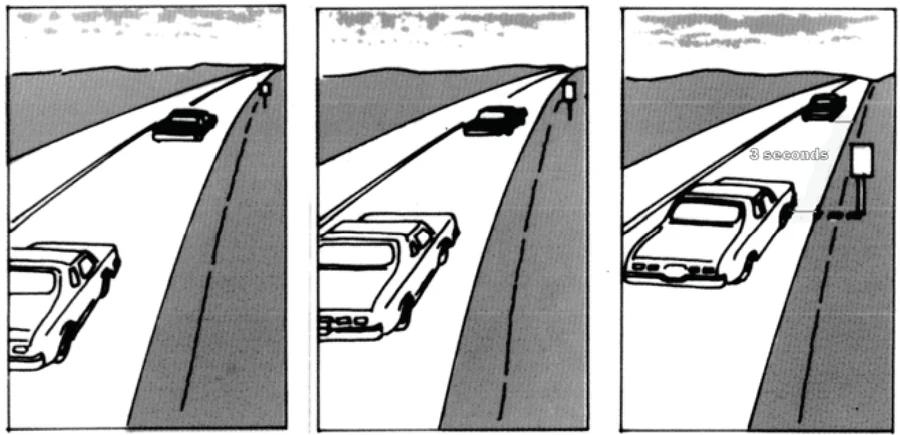
3 seconds Minimum following distance behind another vehicle in good conditions
Handbook p. 50 ↗ How to count your following distance: Watch the car ahead pass a fixed point (sign, pole, tree, pavement line) Count 'one-thousand-one, one-thousand-two, one-thousand-three' If your front bumper reaches the point first, you're too close Slow down and count again Handbook p. 51 ↗ Measuring a three-second following distance Know the rule
In adverse weather or road conditions, add one more second for EACH imperfect condition.
Handbook p. 51 ↗ Know the rule
The three-second rule cannot always guarantee time to stop, but it works in most situations.
Handbook p. 50 ↗ Point of no return The distance needed to bring your vehicle to a complete stop without entering the intersection, given your speed and road condition. Braking must happen at that point.
Handbook p. 51 ↗ Put it into practice
It's raining and foggy—two imperfect conditions. Instead of three seconds, leave five seconds behind the car ahead.
Check your understanding Read the question, decide on an answer, then open it to check the explanation. These are Roadwise study questions based on the source handbook.
How many seconds of following distance does the standard car-following rule recommend? Three seconds Two seconds Four seconds One second Answer: Three seconds
The Three-Second Rule recommends counting three seconds between a fixed point and your vehicle passing it.
Handbook p. 50 ↗ How should you adjust your following distance for each imperfect weather or road condition? Subtract a second to compensate for slower traffic Add an additional second for each imperfect condition Keep it the same regardless of conditions Double it only in snow, but leave it unchanged in rain Answer: Add an additional second for each imperfect condition
Increase your following distance by an additional second for each imperfect weather or road condition.
Handbook p. 51 ↗ Which lane position is the safest under normal driving conditions with no hazards on either side? Lane position 2, three to six inches from the left line Lane position 3, near the right line Lane position 1, the middle of the lane Straddling the center line Answer: Lane position 1, the middle of the lane
Lane position 1, the middle of the lane, is safest under normal conditions with no hazards on either side.
Handbook p. 51 ↗ Which lane position should you use if a hazard exists to the right of the vehicle, or you intend to turn left? Lane position 1, the center Lane position 3, near the right line It doesn't matter which position you use Lane position 2, three to six inches from the left line Answer: Lane position 2, three to six inches from the left line
Lane position 2, three to six inches from the left line, is used when hazards are on the right or you plan to turn left.
Handbook p. 51 ↗ What is the 'point of no return' as described in the handbook? The distance needed to stop before entering an intersection The exact spot a train cannot be stopped The point where you must commit to a turn The distance behind a truck considered a blind spot Answer: The distance needed to stop before entering an intersection
The point of no return is the distance needed to bring your vehicle to a complete stop before entering the intersection.
Handbook p. 51 ↗ What should you do if your vehicle's front bumper reaches a fixed point before you finish counting to three? Speed up slightly to pass the vehicle ahead Reduce your speed and recount to three Ignore it since three seconds is only a guideline Flash your headlights at the vehicle ahead Answer: Reduce your speed and recount to three
If your front bumper passes the point before you finish counting to three, you're following too closely — reduce speed and recount.
Handbook p. 51 ↗ Previous lesson The Smith System Next lesson Sharing the Road with Large Trucks More in Defensive Driving Systems About the source Roadwise’s Rhode Island course uses the driver handbook edition supplied with this study pack. This lesson cites source pages 50, 51. The linked PDF is a third-party mirror of the handbook, rather than a government-hosted page.
Open the handbook source PDF · View the source edition
For current application requirements, fees, appointments, and the format that applies to your age or license type, check Rhode Island’s DMV. Roadwise provides study material and does not issue permits or licenses.