A 3-minute lesson from the Oregon course. Read the rules and examples, follow the handbook page references, and check your understanding before you move on.
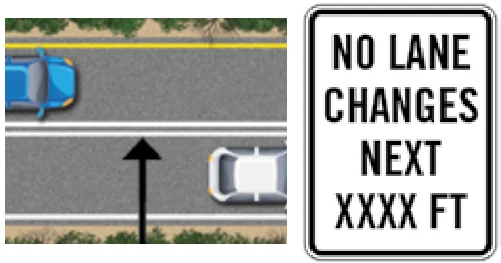
White markings organize traffic going your way: lane lines, edge lines, turn lanes, crosswalks and stop lines. Red markings are newer and belong to transit. How a white line is drawn — solid, wide, broken, dotted or double — tells you whether you may cross it.
White markings
Separate lanes of traffic flowing in the same direction and mark the right edge of travel lanes. Also used for crosswalks, stop lines, symbols and words.
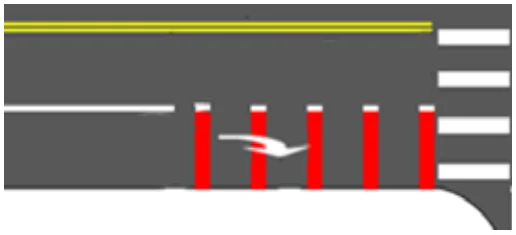
Show where transit-only vehicles — like buses, light rail trains (LRT) or bikes — may travel continuously. Not all Transit Only lanes are red, so look for signs.
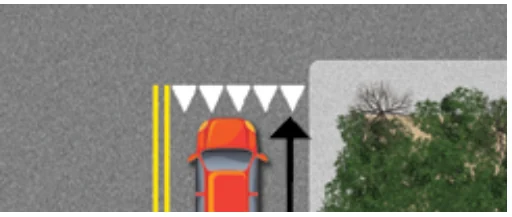
Approaching a freeway exit, the broken lane line on your right turns into a dotted line. Your lane is about to become exit only. If you don't want to exit, move left with caution now.
Check your understanding
Read the question, decide on an answer, then open it to check the explanation. These are Roadwise study questions based on the source handbook.
A solid white line along the right edge of the road is used as:
An edge line, also called a fog line
A no-passing indicator
A bike lane divider
A bus-only lane marking
Answer: An edge line, also called a fog line
A solid white line is used for an edge or fog line to help drivers stay on the road.