roadwise.Open study app

Oregon driving lesson · Lane Travel & Speed

The Basic Rule, Variable Speeds and Racing

A 3-minute lesson from the Oregon course. Read the rules and examples, follow the handbook page references, and check your understanding before you move on.

Read time
3 minutes
Course unit
Lane Travel & Speed
Checkpoint questions
6
Source pages
28, 29

A speed limit is the most you may drive in ideal conditions. Oregon's basic rule asks more of you: your speed must also fit the conditions right now. In rain, fog or heavy traffic, the legal speed can be well below the posted number.

Basic rule

You must drive at a speed that is reasonable and cautious for existing conditions. It applies on all roads at all times.

Handbook p. 28 ↗

To obey the basic rule, consider:

  • Other traffic, pedestrians and people riding bicycles
  • The surface and width of the road
  • Hazards at intersections
  • Weather and visibility
  • Any other conditions that affect safety
Handbook p. 29 ↗

Know the rule

The basic rule never lets you exceed the speed limit. Driving at a speed unsafe for conditions — even below the limit — violates the basic rule.

Handbook p. 29 ↗

Know the rule

Digital variable speed signs use road, weather, traffic and visibility sensors to lower speeds when conditions require. They may also show the reason for the reduced speed.

Handbook p. 28 ↗

Two kinds of variable speed signs

Two kinds of variable speed signs
SignLooks likeEnforcement
Variable advisory speedYellow; says “advisory speed”Not a limit; enforceable via the basic rule
Variable speed limitBlack and white; says “speed limit”Enforced like any speed limit sign
Handbook p. 28 ↗

Variable speeds improve safety by:

  • Improving line of sight: in fog, heavy rain or snow, slower speeds give more time to react to hazards
  • Providing more time to stop on sharp curves, steep hills or in construction zones
  • Giving a larger space cushion, which helps avoid collisions
Handbook p. 28 ↗

Know the rule

If you drive slower than the normal speed of traffic, use the right lane or drive as close as possible to the right curb or edge, unless you're preparing to turn left.

Handbook p. 29 ↗

Know the rule

If traffic backs up behind your slow vehicle, pull off the road at the first safe area and let it pass.

Handbook p. 29 ↗

Racing

Any acceleration or speed contest, or making a speed record. Racing is illegal on any road.

Handbook p. 29 ↗

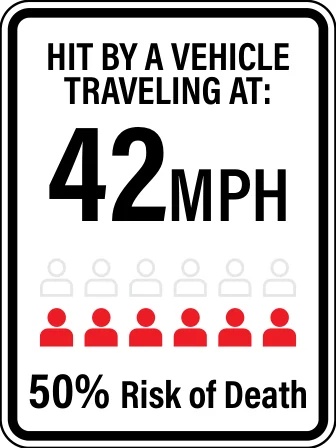
Pedestrian hit by a vehicle traveling at:

Pedestrian hit by a vehicle traveling at:
SpeedRisk of death
23 mph10%
42 mph50%
58 mph90%
Handbook p. 29 ↗
Pedestrian fatality risk by vehicle speed (42 mph)
42 mph: 50% risk of death

Put it into practice

The limit is 55 mph but dense fog cuts your view to a few car lengths. Driving 50 is under the limit yet can still violate the basic rule. Slow to a speed that lets you stop within the distance you can see.

Check your understanding

Read the question, decide on an answer, then open it to check the explanation. These are Roadwise study questions based on the source handbook.

Oregon's 'basic rule' law requires you to drive at a speed that is:
  1. Always at the posted speed limit
  2. As fast as safely possible
  3. Within 5 mph of the flow of surrounding traffic
  4. Reasonable for current conditions

Answer: Reasonable for current conditions

The basic rule requires a speed reasonable for current conditions.
Handbook p. 28 ↗
Under the basic rule, can you ever be cited for driving below the posted speed limit?
  1. Yes, if it is unsafe for conditions
  2. No, driving under the limit is always legal
  3. Only if you are in the left lane
  4. Only on freeways

Answer: Yes, if it is unsafe for conditions

Driving too slow for conditions can still violate the basic rule.

Handbook p. 29 ↗
Does the basic rule ever allow you to exceed the posted speed limit?
  1. Yes, in ideal weather conditions
  2. No, never
  3. Yes, if traffic is flowing faster
  4. Yes, on rural highways only

Answer: No, never

The basic rule never permits exceeding the posted limit.

Handbook p. 29 ↗
If you are driving slower than the normal speed of traffic, you should:
  1. Use the left lane to let others pass on the right
  2. Stay in the center lane
  3. Use the right lane or right edge of the road
  4. Drive in any lane you prefer

Answer: Use the right lane or right edge of the road

Slower drivers should use the right lane or right edge.

Handbook p. 29 ↗
Variable advisory speed signs (yellow) recommend a speed but:
  1. Are never enforceable in any way
  2. Police may still enforce them through the basic rule
  3. Always carry a mandatory fine if exceeded
  4. Become legal limits when flashing

Answer: Police may still enforce them through the basic rule

Advisory signs aren't limits, but the basic rule can still apply.

Handbook p. 28 ↗
Unlike advisory speed signs, variable speed limit signs (black and white) are:
  1. Only suggestions, never enforced
  2. Used only in construction zones
  3. Enforceable like any posted speed limit
  4. Enforceable only in bad weather

Answer: Enforceable like any posted speed limit

Variable speed limit signs are enforceable like normal speed limits.

Handbook p. 28 ↗
Take the lesson checkpoint in the app

More in Lane Travel & Speed