roadwise.Open study app

Oregon driving lesson · Lane Travel & Speed

Driving on the Right and Speed Limits

A 3-minute lesson from the Oregon course. Read the rules and examples, follow the handbook page references, and check your understanding before you move on.

Read time
3 minutes
Course unit
Lane Travel & Speed
Checkpoint questions
6
Source pages
26, 27

Keeping right is the foundation of two-way traffic, and Oregon lists the few times you may leave the right side. Oregon also sets speed limits in law for certain places. Those limits apply even where no sign is posted.

Drive on the right side of the road except when:

  • Passing another vehicle going in the same direction as you
  • Driving to the left of center to pass an obstruction
  • A road is marked for one-way traffic
  • A road has three marked lanes and the center lane is a passing lane
  • Emergency personnel or others directing traffic tell you to
Handbook p. 26 ↗

Know the rule

On a road with no center line and traffic moving in opposite directions, give at least half the road to oncoming traffic.

Handbook p. 26 ↗

Know the rule

If you must drive left of the center line to go around a road hazard or for any other reason, you must yield to oncoming traffic.

Handbook p. 26 ↗

Yielding

Slowing down or stopping to allow another vehicle or pedestrian to continue safely.

Handbook p. 26 ↗

Know the rule

Stop before you enter or cross a road from an alley, driveway or parking lot not controlled by signs or signals. Yield to approaching vehicles and pedestrians.

Handbook p. 26 ↗

Know the rule

Change lanes only when you can do so safely, and avoid frequent lane changes.

Handbook p. 26 ↗

Speed limit

The maximum speed considered safe for the area under ideal driving conditions. Oregon also has the basic rule, which can require going slower.

Handbook p. 27 ↗

Speed limits set in law (posted or not)

Speed limits set in law (posted or not)
SpeedWhere it applies
15 mphAlleys; narrow residential areas
20 mphAny business district; within a school speed zone
25 mphResidential districts; public parks
25 mphOcean shores, if vehicles are permitted
55 mphAll other roads and highways, unless posted
VariesInterstate highways
Handbook p. 27 ↗

Know the rule

These statutory limits apply unless a different speed is posted.

Handbook p. 27 ↗
Speed limit
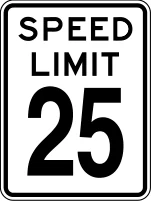
Speed Limit 25

Put it into practice

You drive into a city park with no speed sign in sight. The law still sets the limit at 25 mph in public parks. In the downtown business district next door it drops to 20 mph, and in the alley behind the shops it's 15 mph.

Check your understanding

Read the question, decide on an answer, then open it to check the explanation. These are Roadwise study questions based on the source handbook.

What is Oregon's default speed limit on roads and highways not otherwise defined by law, unless posted differently?
  1. 45 mph
  2. 50 mph
  3. 65 mph
  4. 55 mph

Answer: 55 mph

55 mph is the default when no other limit applies.
Handbook p. 27 ↗
What is the speed limit when driving in an alley?
  1. 15 mph
  2. 10 mph
  3. 20 mph
  4. 25 mph

Answer: 15 mph

Alleys carry a 15 mph limit.

Handbook p. 27 ↗
What is the speed limit within a business district?
  1. 15 mph
  2. 20 mph
  3. 25 mph
  4. 30 mph

Answer: 20 mph

Business districts carry a 20 mph limit.

Handbook p. 27 ↗
What is the speed limit in a residential district?
  1. 20 mph
  2. 30 mph
  3. 25 mph
  4. 15 mph

Answer: 25 mph

Residential districts carry a 25 mph limit.

Handbook p. 27 ↗
On a road with no center line where traffic moves in both directions, you must:
  1. Use the entire road until a vehicle approaches
  2. Stay only on the far right shoulder
  3. Give at least half the road to oncoming traffic
  4. Yield two-thirds of the road

Answer: Give at least half the road to oncoming traffic

Drivers must leave at least half the road for oncoming traffic.

Handbook p. 26 ↗
Before entering or crossing a road from an alley, driveway, or uncontrolled parking lot, you must:
  1. Only slow down, no stop required
  2. Proceed if no signal is present
  3. Stop only for sidewalk pedestrians
  4. Stop and yield to traffic and pedestrians

Answer: Stop and yield to traffic and pedestrians

A full stop and yield is required before entering the road.

Handbook p. 26 ↗
Take the lesson checkpoint in the app

More in Lane Travel & Speed