A 3-minute lesson from the Oregon course. Read the rules and examples, follow the handbook page references, and check your understanding before you move on.
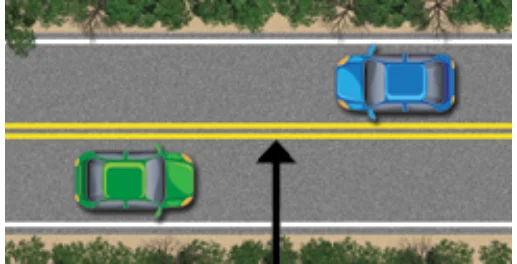
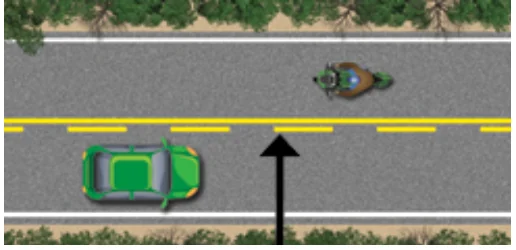
Oregon's pavement markings follow national standards. Yellow lines always mean traffic on the other side is going the opposite way, or they mark the left edge of your roadway. Whether a yellow line is solid or broken tells you if you may pass.
Know the rule
Obey all pavement markings unless a police officer or road worker is redirecting traffic.
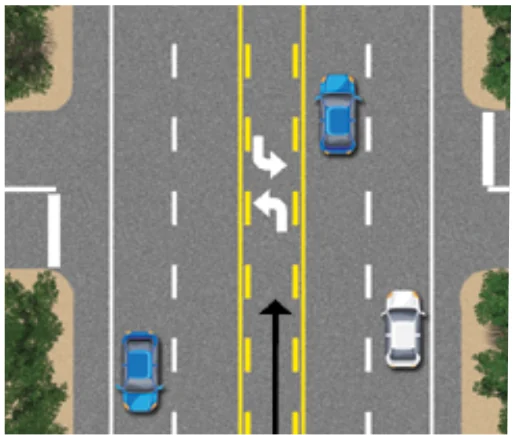
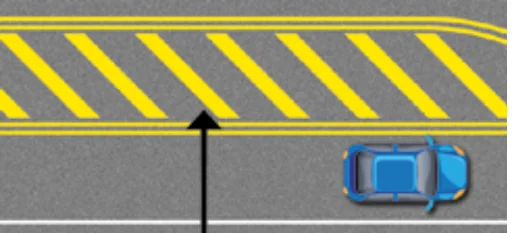
Separate traffic moving in opposite directions (center line) and mark the left edge of one-way roads and ramps, two-way left turn lanes and painted medians.
Painted median (double solid yellow on both sides): you may turn left across it after oncoming traffic clears, but you may not use it as a turn lane, and traveling in it is illegal.
You're on a two-lane road behind a slow truck. The center line is solid yellow on your side and broken on the other. You may not pass. Drivers coming the other way, with the broken line on their side, may.
Check your understanding
Read the question, decide on an answer, then open it to check the explanation. These are Roadwise study questions based on the source handbook.
A broken yellow center line on a two-way road indicates:
Passing is banned both ways
Only oncoming traffic may pass
The road is one-way
Passing is allowed in both directions
Answer: Passing is allowed in both directions
A broken yellow center line allows passing both ways.