roadwise.Open study app

Oregon driving lesson · Signs & Signals

Traffic Signals

A 3-minute lesson from the Oregon course. Read the rules and examples, follow the handbook page references, and check your understanding before you move on.

Read time
3 minutes
Course unit
Signs & Signals
Checkpoint questions
6
Source pages
23, 24

Traffic signals control the right of way and keep traffic flowing smoothly. Each color and shape — circle, arrow, steady or flashing — has its own meaning. Knowing exactly what each allows is heavily tested.

Know the rule

If a signal is dark, such as during a power failure, stop as if there were stop signs in all directions. If a signal is out of order and flashes yellow or red, obey the flashing signal.

Handbook p. 23 ↗
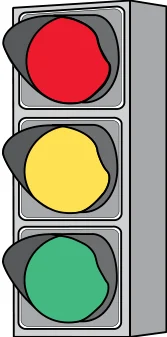
Traffic signal head
Traffic signal

Red and steady yellow

Red and steady yellow
SignalWhat you do
Steady red circleStop and stay stopped until it changes
Flashing red or dark signalTreat it the same as a stop sign
Steady red arrowStop until it changes; same turns on red as red circle
Steady yellow circleStop before the intersection; if unsafe, go carefully
Handbook p. 23 ↗

Turns on a steady red (or red arrow) after a complete stop, unless a sign or officer says otherwise:

  • Entering a two-way road: you may turn right
  • Entering a one-way road: you may turn right or left in the direction of the one-way road
Handbook p. 23 ↗
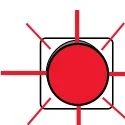
Flashing red or dark signal
Flashing red

Flashing yellow and green

Flashing yellow and green
SignalWhat you do
Flashing yellowSlow down and proceed with caution
Steady yellow arrowAbout to turn red: stop, or if unsafe, go carefully
Flashing yellow arrowTurn after yielding to pedestrians and oncoming traffic
Steady green circleAll movements allowed unless a sign prohibits
Steady green arrowYou have the right of way for the arrow's movement
Handbook p. 24 ↗

Know the rule

On a steady green circle, left turns must first yield to pedestrians and oncoming traffic, and right turns must first yield to pedestrians.

Handbook p. 24 ↗

Know the rule

With a flashing yellow arrow, oncoming traffic has a steady green signal — that's why you must yield before turning.

Handbook p. 24 ↗
Flashing yellow light
Flashing yellow
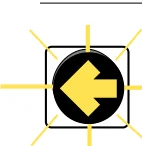
Flashing yellow arrow

Put it into practice

You're stopped at a red light on a one-way street, waiting to turn left onto another one-way street heading left. After a complete stop, and if no sign prohibits it, you may turn left on red after yielding to traffic and pedestrians.

Check your understanding

Read the question, decide on an answer, then open it to check the explanation. These are Roadwise study questions based on the source handbook.

If a traffic signal is completely dark due to a power failure, you should:
  1. Proceed with caution without stopping
  2. Treat it as a yield sign
  3. Wait for a police officer before moving
  4. Treat it as an all-way stop

Answer: Treat it as an all-way stop

A dark signal is treated as a stop sign in all directions.
Handbook p. 23 ↗
On a two-way road at a steady red light, after a complete stop, you may generally:
  1. Turn left
  2. Turn right
  3. Go straight
  4. Turn either direction freely

Answer: Turn right

A right turn on red is allowed after a complete stop on a two-way road.

Handbook p. 23 ↗
Entering a one-way road at a red light, you may, after a complete stop:
  1. Only turn right, never left
  2. Not turn at all
  3. Turn right or left with the one-way traffic
  4. Turn right only, if a sign permits

Answer: Turn right or left with the one-way traffic

Either direction is allowed onto a one-way road after stopping.

Handbook p. 23 ↗
A steady red arrow means:
  1. Stop until it changes, except allowed turns on red
  2. Stop, then turn that way when clear
  3. Yield then proceed
  4. Stop only if pedestrians are present

Answer: Stop until it changes, except allowed turns on red

Red arrows work like steady red signals, including allowed turns.

Handbook p. 23 ↗
If you cannot stop safely when a signal turns steady yellow, you should:
  1. Brake hard even if you stop in the intersection
  2. Speed up to beat the red light
  3. Drive carefully through the intersection
  4. Stop past the stop line and wait

Answer: Drive carefully through the intersection

If you can't stop safely, continue carefully through.

Handbook p. 23 ↗
A flashing yellow arrow means you may make the indicated movement, but first you must:
  1. Wait for a steady green arrow
  2. Stop completely before proceeding
  3. Yield only to cross traffic
  4. Yield to pedestrians and oncoming traffic

Answer: Yield to pedestrians and oncoming traffic

You may proceed after yielding to pedestrians and oncoming traffic.

Handbook p. 24 ↗
Take the lesson checkpoint in the app

More in Signs & Signals