Roadwise States Oregon Driving lessons Warning Signs: Pedestrians, Curves and Crossroads Oregon driving lesson · Signs & Signals
Warning Signs: Pedestrians, Curves and Crossroads A 3-minute lesson from the Oregon course. Read the rules and examples, follow the handbook page references, and check your understanding before you move on.
Read time 3 minutes
Course unit Signs & Signals
Checkpoint questions 6
Source pages 18, 19 Yellow warning signs tell you about known possible hazards or changes in road conditions ahead. Not every hazard gets a sign, so you are ultimately responsible for recognizing and reacting correctly to changing conditions, signed or not.
Warning sign A yellow sign that alerts you to a known possible hazard or a change in road conditions ahead.
Handbook p. 18 ↗ Pedestrian Crossing Know the rule
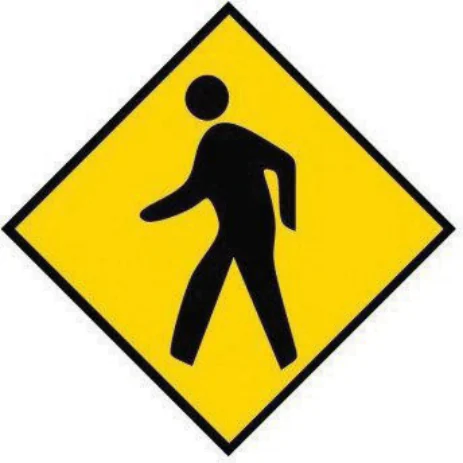
Pedestrian Crossing: be alert for people crossing your path. A flashing yellow beacon on the sign means a pedestrian is crossing, has recently crossed or is about to cross.
Handbook p. 18 ↗ Multiuse Path Crossing Know the rule
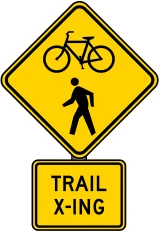
Multiuse Path Crossing: people riding bicycles and pedestrians regularly cross the road in this area.
Handbook p. 18 ↗ Know the rule
In-Street Pedestrian Crossing: this sign may appear at a crosswalk. Stop when a pedestrian is in the crosswalk.
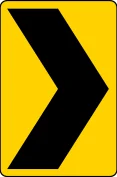
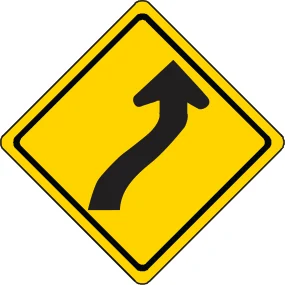
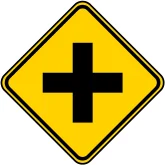
Handbook p. 18 ↗ Curve and turn signs Curve: there is a curve ahead Sharp Turn: there is a sharp turn in the road ahead Chevron: a sharp curve or change in the road's direction is at the sign Handbook p. 18 ↗ Chevron More road-shape signs Winding Road: the road has a series of turns or curves Reversing Curves: the road ahead curves to the right, then left Crossroad: a four-way intersection is ahead; cross traffic may enter the road Side Road: a “T” intersection is ahead; traffic may enter from the left or right Handbook p. 19 ↗ Reversing Curves Crossroad Put it into practice
A yellow diamond with a pedestrian symbol has its beacon flashing, but you don't see anyone. Slow down and look carefully — the flashing light means someone is crossing, has just crossed or is about to cross.
A useful reminder Curve means ahead; Chevron means right here, at the sign.
Check your understanding Read the question, decide on an answer, then open it to check the explanation. These are Roadwise study questions based on the source handbook.
What color are warning signs in Oregon? A flashing yellow beacon on a Pedestrian Crossing sign indicates: The crosswalk signal is about to turn red Only school children may cross The signal ahead is broken Pedestrians are crossing, just crossed, or about to cross Answer: Pedestrians are crossing, just crossed, or about to cross
The flashing beacon alerts you to pedestrian activity at the crossing.
Handbook p. 18 ↗ An In-Street Pedestrian Crossing sign at a crosswalk means you should: Stop when a pedestrian is in the crosswalk Slow down only, no need to stop Yield only if the pedestrian is in your lane Stop only if a pedestrian waves Answer: Stop when a pedestrian is in the crosswalk
Stop for any pedestrian using that crosswalk.
Handbook p. 18 ↗ A Chevron warning sign means: Traffic is merging from the side shown A sharp curve or direction change is at the sign A series of turns or curves is ahead A divided highway begins ahead Answer: A sharp curve or direction change is at the sign
A Chevron sign marks a sharp curve or change in the direction of the road at the sign.
Handbook p. 18 ↗ A Reversing Curves warning sign means the road ahead: Curves left, right, then left Has a single sharp curve Curves to the right, then to the left Ends in a T intersection Answer: Curves to the right, then to the left
Reversing curves means a right curve followed by a left curve.
Handbook p. 19 ↗ A Crossroad warning sign indicates: A railroad crossing is ahead A one-way street begins A side road enters from the right only A four-way intersection is ahead Answer: A four-way intersection is ahead
Crossroad signs warn of an upcoming four-way intersection.
Handbook p. 19 ↗ Previous lesson Lane-Use, Transit and HOV Signs Next lesson Warning Signs: Lanes, Stops and Road Conditions About the source Roadwise’s Oregon course uses the driver handbook edition supplied with this study pack. This lesson cites source pages 18, 19. The linked PDF is a third-party mirror of the handbook, rather than a government-hosted page.
Open the handbook source PDF · View the source edition
For current application requirements, fees, appointments, and the format that applies to your age or license type, check Oregon’s DMV. Roadwise provides study material and does not issue permits or licenses.