A 3-minute lesson from the Oregon course. Read the rules and examples, follow the handbook page references, and check your understanding before you move on.
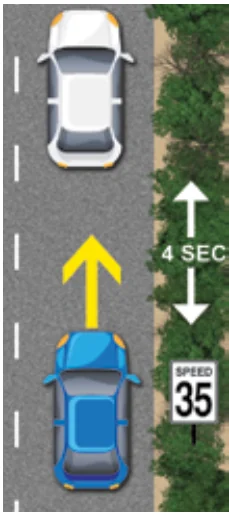
When another driver does something sudden, the only way to be sure you have time to react is space. Keep a cushion of space ahead, to each side and behind you. The gap ahead matters most, and you measure it in seconds, not car lengths.
Space cushion
The space you keep between your vehicle and the vehicles around you — ahead, to each side and behind — so you have time to react.
Your speed decides how much time you have to act and how long it takes to stop. The faster you go, the less time you have to spot hazards, judge other traffic and react.
When stopping behind another vehicle, stop where you can see its rear tires meet the road. After traffic starts to move, return to a safe following distance.
You're on a 45 mph road behind a pickup. It passes a mileage post and you reach it at 'one thousand two.' That meets the 2-second minimum, but above 30 mph you should have 4 seconds or more — drop back.
Check your understanding
Read the question, decide on an answer, then open it to check the explanation. These are Roadwise study questions based on the source handbook.
How does the handbook define a safe following distance?
1 to 2 seconds
2 to 4 seconds
5 to 6 seconds
One car length per 10 mph
Answer: 2 to 4 seconds
A safe following distance is generally 2 to 4 seconds.
To check your following distance, you count seconds from when the vehicle ahead passes a fixed point until you reach it. You are following too closely if you reach the mark before counting:
Four seconds
One second
Six seconds
Two seconds
Answer: Two seconds
Reaching the mark before 2 seconds means you're too close.