roadwise.Open study app

Oregon driving lesson · Space Cushion & Passing

Looking Ahead, Curves and Changing Lanes

A 3-minute lesson from the Oregon course. Read the rules and examples, follow the handbook page references, and check your understanding before you move on.

Read time
3 minutes
Course unit
Space Cushion & Passing
Checkpoint questions
5
Source pages
38

Good drivers see trouble early. Scanning far ahead and to the sides lets you slow smoothly instead of swerving at the last second. Curves and lane changes are where a missed glance hurts most, so each has its own routine.

Know the rule

Scan ahead for trouble spots as far as you can see, so you avoid last-minute moves.

Handbook p. 38 ↗

Scanning

Taking in the entire scene, including the sides of the road, to spot pedestrians, hazards, vehicles that may enter your path, and signs routing you elsewhere.

Handbook p. 38 ↗

Clues that the driver ahead may slow down or stop

  • A person riding a bicycle or a pedestrian on the road ahead
  • Brake lights coming on
  • Blinking turn signals
Handbook p. 38 ↗

Driving through a curve

  • Slow down before you enter the curve
  • Use the speed shown below a curve sign as a guide, if posted
  • Look through the curve to where you want to go, then check approaching vehicles' lane position
  • Stay right of the center line and in the middle of your lane
  • Watch for bicyclists, pedestrians or slow vehicles hidden around the curve
  • Increase speed gradually as you come out of the curve
Handbook p. 38 ↗

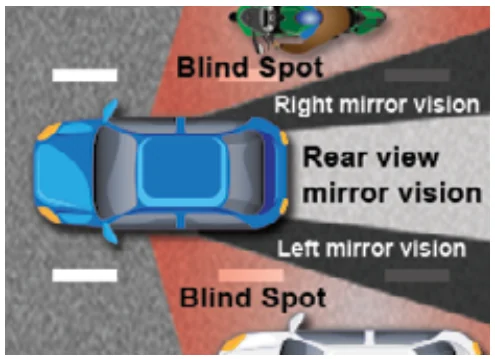
Blind spot

The area around your vehicle that you can't see from the driver's seat, even using your mirrors.

Handbook p. 38 ↗

Know the rule

Avoid driving in another driver's blind spot whenever possible.

Handbook p. 38 ↗

Before you change lanes

  • Use your turn signal to show you plan to change lanes
  • Check your side and rearview mirrors for traffic approaching from behind
  • Glance over your left shoulder if moving left, or your right shoulder if moving right
Handbook p. 38 ↗
Blind spots and mirror vision zones
Mirror views and blind spots

Put it into practice

You want to move into the right lane. Signal, check the rearview and right mirror, then glance over your right shoulder. A car sitting in your blind spot shows up only in that glance — wait for it to clear.

Check your understanding

Read the question, decide on an answer, then open it to check the explanation. These are Roadwise study questions based on the source handbook.

Before changing lanes to the right, which way should you glance over your shoulder?
  1. Over your left shoulder
  2. Over your right shoulder
  3. No glance is needed if your mirrors are clear
  4. Only a glance at the rearview mirror

Answer: Over your right shoulder

Glance over your right shoulder when moving right (left shoulder when moving left) to check for vehicles your mirrors miss.
Handbook p. 38 ↗
How should you handle your speed on a curve?
  1. Brake firmly in the middle of the curve
  2. Keep your speed steady and brake after the curve
  3. Slow down before you enter the curve
  4. Speed up as you enter to hold your lane

Answer: Slow down before you enter the curve

Slow down before entering a curve, then increase speed gradually as you come out of it.

Handbook p. 38 ↗
What is a driver's blind spot?
  1. The area you can't see from the seat, even with mirrors
  2. The area directly in front of your hood
  3. The area lit only by your high beams
  4. The area shown in your rearview mirror

Answer: The area you can't see from the seat, even with mirrors

The blind spot is the area around your vehicle you can't see from the driver's seat even using your mirrors.

Handbook p. 38 ↗
Which of these is a clue that the driver ahead may be about to slow down or stop?
  1. A wide, empty shoulder on the right
  2. A pedestrian on the road ahead
  3. A vehicle passing you on the left
  4. A speed limit sign showing a higher speed

Answer: A pedestrian on the road ahead

Clues include a bicyclist or pedestrian on the road ahead, brake lights coming on, or blinking turn signals.

Handbook p. 38 ↗
As you come out of a curve, you should increase your speed gradually.
  1. True
  2. False

Answer: True

The handbook says to increase speed gradually as you come out of a curve.

Handbook p. 38 ↗
Take the lesson checkpoint in the app

More in Space Cushion & Passing