roadwise.Open study app

Oklahoma driving lesson · Signs, Signals and Markings

Pavement markings and lane control signals

A 3-minute lesson from the Oklahoma course. Read the rules and examples, follow the handbook page references, and check your understanding before you move on.

Read time
3 minutes
Course unit
Signs, Signals and Markings
Checkpoint questions
5
Source pages
27, 32

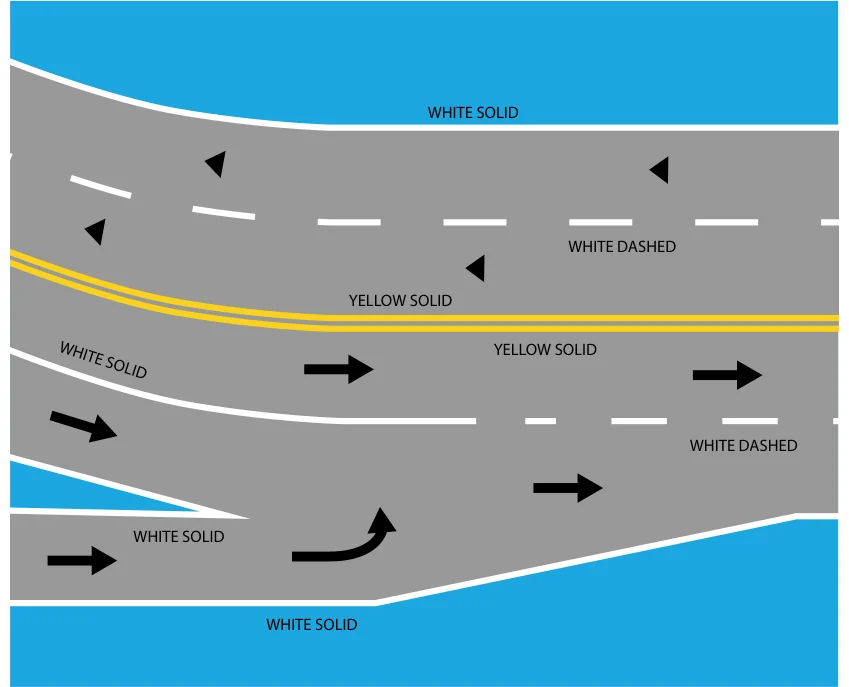
Pavement markings regulate traffic. The color tells you direction: yellow lines separate traffic moving in opposite directions, white lines separate traffic moving the same way. Whether a line is solid or dashed tells you whether you may pass.

Yellow and white markings show you:

  • Which lane you should be using
  • Where visibility is limited and passing is dangerous
  • Where traffic is traveling toward you in the next lane
  • Where you may safely wait for an opportunity to make a left turn
Handbook p. 27 ↗

Line meanings

Line meanings
LineTraffic on each sidePassing
Yellow dashesOpposite directionsPermitted when safe
White dashesSame directionPermitted when safe
Solid yellowOpposite directionsDo not pass
Solid whiteSame directionHazardous (e.g. near intersection/merge)
Handbook p. 32 ↗
Pavement line types legend
White solid, white dashed and yellow solid lines on a divided road

Know the rule

A solid yellow line on your left tells you that you're on the proper side of the road, and that crossing it is dangerous because of approaching vehicles or obstacles in the median.

Handbook p. 32 ↗

Know the rule

Single or double solid yellow lines mean DO NOT PASS. You may cross the line to turn left.

Handbook p. 32 ↗

Two-lane, two-way center lines:

  • Yellow broken line: passing permitted
  • Solid yellow line in your lane: do not pass
  • Solid line only in the right lane: no passing for traffic in the right lane
  • Double solid lines: no passing in either direction; cross only to turn left
Handbook p. 27 ↗

Lane control signals (over a lane)

Lane control signals (over a lane)
SignalMeaning
RedDon't use the lane
YellowClear the lane
Flashing yellowLeft turn permitted
GreenLane open for traffic
Handbook p. 27 ↗

Put it into practice

On a two-lane highway the center line is solid on your side and dashed on the other side. You may not pass, even though drivers coming the other way may. You may cross only to turn left.

Check your understanding

Read the question, decide on an answer, then open it to check the explanation. These are Roadwise study questions based on the source handbook.

What does a single solid yellow line in your lane mean?
  1. Do not pass
  2. Passing is allowed when safe
  3. You are on a one-way street
  4. Merge left ahead

Answer: Do not pass

A solid yellow line in your lane means do not pass, though you may cross it to turn left.
Handbook p. 32 ↗
Yellow dashed lines mean passing is permitted when it's safe, on a two-way road.
  1. True
  2. False

Answer: True

Yellow dashes indicate opposite-direction traffic where passing is permitted when safe.

Handbook p. 32 ↗
White dashed lines on a roadway mean what?
  1. Same-direction traffic; passing allowed when safe
  2. Traffic moves in opposite directions
  3. Passing is never permitted
  4. You are in a bike lane

Answer: Same-direction traffic; passing allowed when safe

White dashes separate same-direction lanes; passing between them is permitted when safe.

Handbook p. 32 ↗
A solid white line near an intersection or merge area means what?
  1. Passing is completely prohibited
  2. You must merge immediately
  3. Same direction; passing is hazardous
  4. This lane is for turning only

Answer: Same direction; passing is hazardous

A solid white line separates traffic moving in the same direction, but passing is hazardous, as near an intersection or merge area.

Handbook p. 32 ↗
You may cross a solid double yellow center line only to make a left turn.
  1. True
  2. False

Answer: True

Double solid yellow lines mean do not pass, but you may cross them to turn left.

Handbook p. 32 ↗
Take the lesson checkpoint in the app

More in Signs, Signals and Markings