roadwise.Open study app

Oklahoma driving lesson · Signs, Signals and Markings

Railroad crossing signs and Quiet Zones

A 3-minute lesson from the Oklahoma course. Read the rules and examples, follow the handbook page references, and check your understanding before you move on.

Read time
3 minutes
Course unit
Signs, Signals and Markings
Checkpoint questions
6
Source pages
22, 23, 56

Railroad crossings are marked by an advance warning sign, and at the crossing itself by crossbucks, often with flashing lights, gates or a stop sign. Each device tells you exactly how much caution you need and when you must stop.

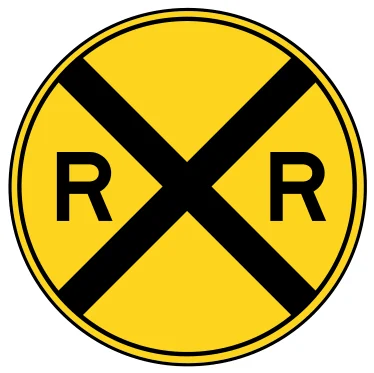
Railroad advance warning sign

Round, yellow and black. You're approaching tracks: slow down and be prepared to stop within 15-50 feet of the first track.

Handbook p. 22 ↗
Railroad crossing ahead
Railroad advance warning sign

Know the rule

If your view is blocked in either direction, drive very slowly until you can see down the track. If you see a train coming, STOP.

Handbook p. 22 ↗

Know the rule

School buses, church buses, motor coaches and vehicles hauling explosives or flammable liquids must stop at railroad crossings. Don't pass a vehicle required to stop at a crossing except on a multi-lane highway.

Handbook p. 22 ↗

Crossbuck

The X-shaped sign at most crossings. Treat it like a YIELD sign: slow down, look, listen and be prepared to yield to a train.

Handbook p. 56 ↗

Know the rule

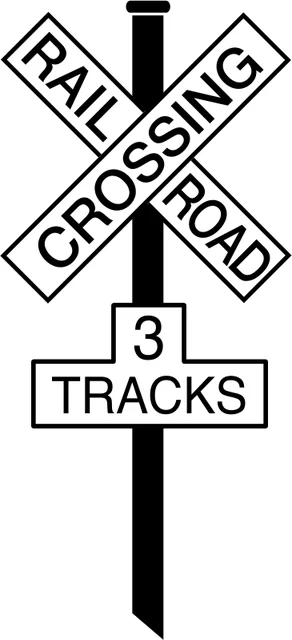
If there is more than one track, a sign below the crossbuck shows the number of tracks. Knowing it tells you when to wait and when to go.

Handbook p. 22 ↗
Railroad crossbuck with multiple tracks plaque
Crossbuck with number-of-tracks sign

Know the rule

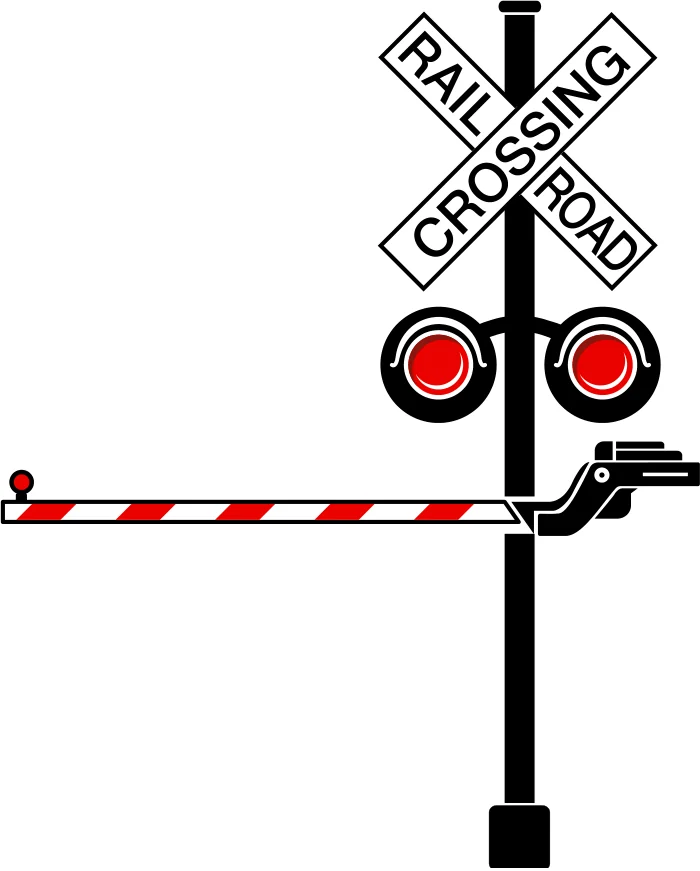
Flashing lights on a crossbuck mean a train is coming. Always stop and remain stopped until the train has passed; with more than one track, be sure all tracks are clear.

Handbook p. 23 ↗

Know the rule

At a crossing with flashing lights and a gate, stop when the lights begin flashing and before the gate comes down. Remain stopped until the gates are raised and the lights stop flashing.

Handbook p. 23 ↗
Railroad crossing signals and gate
Crossbuck with flashing lights and gate

Know the rule

An R X R and a stop line may be painted on the pavement before a crossing: always stay behind the stop line while waiting. At a crossing with a stop sign, stop completely and look both ways.

Handbook p. 56 ↗
Over 1,200

Oklahoma public highway-rail crossings with gates, lights or bells

Handbook p. 56 ↗

Quiet Zone

An area where trains do not blow their horn during normal operation, identified by a 'No Train Horn' sign at the crossing.

Handbook p. 23 ↗

Know the rule

In a Quiet Zone the horn may still be sounded for emergencies or other safety reasons, and crossings may have supplemental safety features. Engineers still reserve the right to blow the horn.
Handbook p. 23 ↗

Put it into practice

You're behind a school bus on a two-lane road as it nears a crossing. The bus must stop, and you may not pass it. Stop behind it and wait.

Check your understanding

Read the question, decide on an answer, then open it to check the explanation. These are Roadwise study questions based on the source handbook.

What does a sign below a railroad crossbuck showing a number indicate?
  1. The train's speed limit
  2. The distance to the next crossing
  3. How many tracks are there
  4. The number of trains per day

Answer: How many tracks are there

A number sign below a crossbuck tells you how many tracks are present, so you know to check them all.

Handbook p. 22 ↗
Which of these vehicles is legally required to stop at every railroad crossing?
  1. A private passenger car
  2. A motorcycle
  3. A pickup truck
  4. A school bus

Answer: A school bus

School buses, church buses, motor coaches and vehicles hauling hazardous materials must stop at railroad crossings.

Handbook p. 22 ↗
What is a Quiet Zone at a railroad crossing?
  1. An area where trains are legally required to stop completely
  2. An area where trains skip the horn
  3. A crossing with no warning devices at all
  4. A crossing only used at night

Answer: An area where trains skip the horn

Quiet Zones have supplemental safety measures so trains skip the horn during normal operation.

Handbook p. 23 ↗
In a Quiet Zone, can a train's horn still be sounded?
  1. No, the horn is permanently disabled
  2. Only between 6 a.m. and 6 p.m.
  3. Yes, for emergencies
  4. Only if the crossing gates fail

Answer: Yes, for emergencies

Engineers still reserve the right to sound the horn for emergencies even inside a Quiet Zone.

Handbook p. 23 ↗
What shape and color is the advance railroad warning sign?
  1. Diamond, orange and black
  2. Round, yellow and black
  3. Rectangle, blue and white
  4. Octagon, red and white

Answer: Round, yellow and black

The advance railroad warning sign is round, yellow with black markings.

Handbook p. 22 ↗
How should you treat a railroad crossbuck sign with no lights or gates?
  1. Ignore it if you don't see a train immediately
  2. Treat it as an ordinary guide sign
  3. The same as a YIELD sign
  4. Stop only if another car is stopped there

Answer: The same as a YIELD sign

Crossbucks without lights or gates should be treated like a yield sign.

Handbook p. 56 ↗
Take the lesson checkpoint in the app

More in Signs, Signals and Markings