roadwise.Open study app

North Dakota driving lesson · Signs, Signals & Markings

Railroad crossings

A 3-minute lesson from the North Dakota course. Read the rules and examples, follow the handbook page references, and check your understanding before you move on.

Read time
3 minutes
Course unit
Signs, Signals & Markings
Checkpoint questions
6
Source pages
22

Approach every railroad crossing as if a train is coming. A crossing may have advance warning signs, pavement markings, crossbucks and signal lights. Some have all four, others only one.

Know the rule

When you see railroad warning devices, look, listen and slow down. You may have to stop.

Handbook p. 22 ↗
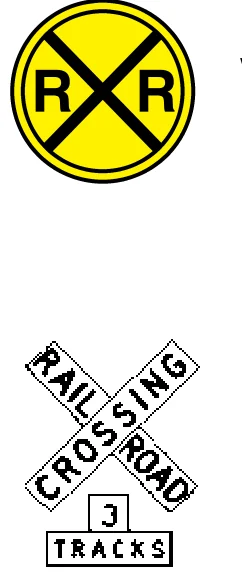
Railroad crossing ahead
Advance warning sign, and crossbuck with number-of-tracks sign

Railroad crossing devices:

  • Advance warning sign: a crossing is ahead, so slow down and be ready to stop
  • Crossbuck: marks the crossing; a sign below shows the number of tracks if there's more than one
  • Pavement markings: may be used with the crossbuck
  • Flashing red lights, with or without bells, and gates at some crossings
Handbook p. 22 ↗
15 feet

Stop at least this far before the crossing when a train is crossing

Handbook p. 22 ↗

Know the rule

Never cross while the red lights are flashing, and never drive around lowered gates. Never stop or park on the tracks for any reason. If you must stop, stop before the crossing.

Handbook p. 22 ↗

Know the rule

At multiple tracks, another train can approach from the opposite direction once the first train clears. Make sure all tracks are clear.

Handbook p. 22 ↗

Know the rule

School buses, vehicles carrying explosives or flammable liquids (such as gasoline trucks), and buses carrying passengers must stop within 50 feet and not less than 15 feet from the tracks. Don't pass them while they're stopped.

Handbook p. 22 ↗

Types of crossings

Types of crossings
TypeWhat's there
PassiveNo traffic control device; the decision is yours
ActiveFlashing red lights, with or without bells, or with gates
Handbook p. 22 ↗

Know the rule

Passive crossings have yellow circular advance warning signs, pavement markings and a crossbuck to help you recognize them.

Handbook p. 22 ↗

Know the rule

If your vehicle is stuck on the tracks, get out. Walk toward the oncoming train and away from the tracks at a 45-degree angle, because debris spreads in the direction the train is moving. Call the ENS number, then 911.

Handbook p. 22 ↗

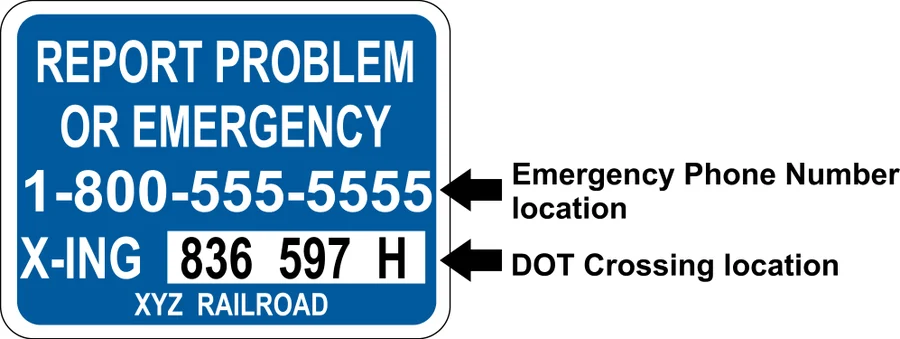
Emergency Notification System (ENS)

Emergency phone numbers posted on crossing posts or metal control boxes. Call to report something blocking the tracks, or lights or gates that aren't working.

Handbook p. 22 ↗
Railroad crossing emergency notification sign
ENS sign with the emergency number and crossing ID

Put it into practice

Your car stalls on the tracks and you see a train coming from your left. Get everyone out and walk quickly toward the train's side, away from the tracks at a 45-degree angle. Then call the ENS number on the crossing sign, and 911.

Check your understanding

Read the question, decide on an answer, then open it to check the explanation. These are Roadwise study questions based on the source handbook.

How far before a railroad crossing must certain vehicles, such as school buses, stop?
  1. Within 25 feet of the tracks
  2. Within 100 feet and not less than 50 feet
  3. Right at the tracks, no set distance
  4. Within 50 feet and not less than 15 feet from the tracks

Answer: Within 50 feet and not less than 15 feet from the tracks

School buses and vehicles carrying explosives or flammable liquids must stop within 50 feet and not less than 15 feet from the tracks.

Handbook p. 22 ↗
What is a 'passive' railroad crossing?
  1. A crossing that is permanently closed
  2. A crossing with no traffic control device
  3. A crossing only used by freight trains
  4. A crossing with flashing lights and gates

Answer: A crossing with no traffic control device

A passive crossing has no traffic control device; the decision to stop or proceed rests entirely with the driver.

Handbook p. 22 ↗
When a train is crossing, how far from the crossing must you stop?
  1. At least 5 feet
  2. At least 50 feet
  3. At least 15 feet
  4. At least 100 feet

Answer: At least 15 feet

The handbook says that when a train is crossing, you must stop at least 15 feet before the crossing.

Handbook p. 22 ↗
If your vehicle becomes stuck on railroad tracks with a train approaching, what should you do?
  1. Run in the same direction the train is traveling, right next to the tracks
  2. Push the vehicle off the tracks yourself before leaving
  3. Evacuate, walking toward the train, away from the tracks
  4. Stay in the vehicle and try to restart it

Answer: Evacuate, walking toward the train, away from the tracks

You should evacuate and walk in the direction of the oncoming train and away from the tracks at a 45-degree angle, since debris spreads in the train's direction of travel.
Handbook p. 22 ↗
Active railroad crossings use devices such as flashing red lights and gates to regulate traffic.
  1. True
  2. False

Answer: True

Active crossings have installed traffic control devices, including flashing red lights, with or without bells and gates.

Handbook p. 22 ↗
At a multiple-track crossing, once one train has passed, it is safe to assume no other train is coming.
  1. True
  2. False

Answer: False

When approaching multiple tracks, remember an additional train can be approaching from the opposite direction even after the first has cleared.

Handbook p. 22 ↗
Take the lesson checkpoint in the app

More in Signs, Signals & Markings