roadwise.Open study app

North Dakota driving lesson · Signs, Signals & Markings

Pavement markings

A 3-minute lesson from the North Dakota course. Read the rules and examples, follow the handbook page references, and check your understanding before you move on.

Read time
3 minutes
Course unit
Signs, Signals & Markings
Checkpoint questions
6
Source pages
20, 21

Lines on the pavement control traffic just like signs and signals. Yellow center lines separate traffic moving in opposite directions. White stop lines and crosswalks show where to stop at intersections.

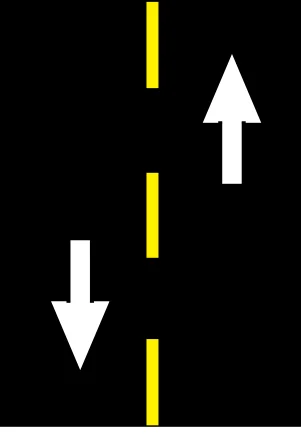
Broken yellow center line (two-way road)
Broken yellow center line

Know the rule

Broken yellow center lines are used on two-lane, two-way roads. You may cross them only to turn left or to pass another vehicle.

Handbook p. 20 ↗
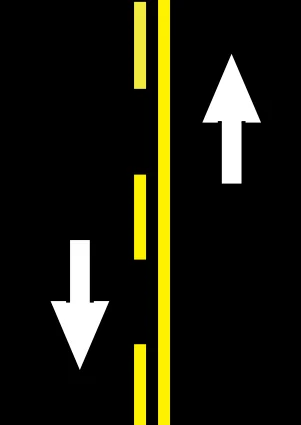
Solid and broken yellow lines
One solid and one broken yellow line

Know the rule

One solid line with one broken line means no passing for drivers in the lane next to the solid line. The solid line may be crossed only to turn left.

Handbook p. 20 ↗
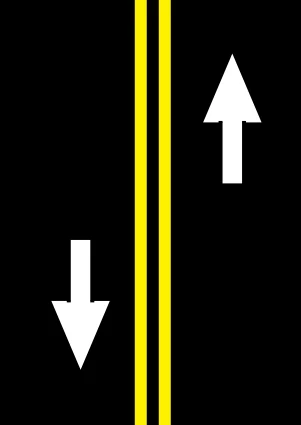
Solid yellow center line
Two solid yellow lines

Know the rule

Two solid yellow lines on a two-lane road mean no passing in either direction. You may cross the centerline only as part of a left turn.

Handbook p. 20 ↗

Know the rule

On a multi-lane, two-way road without a divider, you may cross the centerline only as part of a left turn. A divided roadway has a divider separating the traffic flows.

Handbook p. 20 ↗
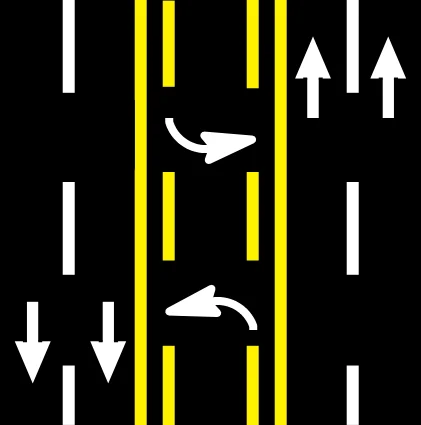
Multi-lane road markings with turn arrows
Two-way left turn lane

Two-way left turn lane

A center lane reserved only for left-turning vehicles from either direction. Passing or overtaking in it is not permitted.

Handbook p. 21 ↗

Know the rule

Where an intersection has special left- and right-turn lanes, you must use the left-turn lane to turn left and the right-turn lane to turn right. Some intersections have more than one turn lane.

Handbook p. 21 ↗

Markings at stop intersections:

  • Stop lines: wide white lines showing where to stop before entering the intersection
  • Stop line and crosswalk lines together: stop before crossing the stop line
  • Crosswalk lines: a pair of white lines or longitudinal lines where people walk; don't block them
  • No lines: stop before the crosswalk (sidewalk area), or before entering the intersection
Handbook p. 21 ↗

Put it into practice

You're behind a slow tractor on a two-lane road. The line on your side is solid and the line on the far side is broken. You may not pass. Wait until the line on your side is broken and passing is safe.

Check your understanding

Read the question, decide on an answer, then open it to check the explanation. These are Roadwise study questions based on the source handbook.

What do broken yellow center lines on a two-lane, two-way road allow?
  1. Crossing only in a business district
  2. Crossing only to make a U-turn
  3. No crossing under any circumstance
  4. Crossing to turn left or to pass another vehicle

Answer: Crossing to turn left or to pass another vehicle

You may cross broken yellow center lines only to turn left or to pass another vehicle.
Handbook p. 20 ↗
Two solid yellow lines on a two-lane road mean what?
  1. No passing in either direction
  2. A reversible lane is ahead
  3. Passing allowed in one direction only
  4. No parking allowed nearby

Answer: No passing in either direction

Two solid yellow lines mean no passing in either direction; the centerline may be crossed only to make a left turn.

Handbook p. 20 ↗
At a busy intersection with a special right-turn lane, where must you make your right turn from?
  1. The special right-turn lane
  2. The through lane closest to the curb
  3. Any lane, after signaling
  4. The shoulder

Answer: The special right-turn lane

Where there are specially designated turn lanes, a driver who wishes to turn right must use the special right-turn lane.

Handbook p. 21 ↗
At an unmarked crosswalk with no lines at an intersection, what must you do?
  1. Stop only if a pedestrian is present
  2. Proceed without stopping if no pedestrians are visible
  3. Stop before the crosswalk area or intersection
  4. Yield only to oncoming traffic

Answer: Stop before the crosswalk area or intersection

At an unmarked crosswalk you must stop before entering the crosswalk area, or before entering the intersection if there is no crosswalk.

Handbook p. 21 ↗
One solid yellow line paired with one broken yellow line means what for the vehicle in the solid-line lane?
  1. Passing is allowed at any time
  2. Passing is only allowed at night
  3. No passing is allowed
  4. No passing is allowed under any circumstance, even to turn

Answer: No passing is allowed

One solid line with one broken line means no passing in the lane next to the solid line; the solid line may be crossed only to turn left.

Handbook p. 20 ↗
When crosswalk lines and a stop line are both present, you should stop beyond the crosswalk line for a better view.
  1. True
  2. False

Answer: False

You must stop before the stop line when stop lines and crosswalk lines are used together, not beyond the crosswalk.

Handbook p. 21 ↗
Take the lesson checkpoint in the app

More in Signs, Signals & Markings