roadwise.Open study app

North Carolina driving lesson · Signals, Signs & Pavement Markings

Guide signs, pavement markings & traffic officers

A 3-minute lesson from the North Carolina course. Read the rules and examples, follow the handbook page references, and check your understanding before you move on.

Read time
3 minutes
Course unit
Signals, Signs & Pavement Markings
Checkpoint questions
6
Source pages
44, 46

Guide signs tell you where you are and where to go. Pavement markings show which lanes go which way and where you may pass. And when an officer directs traffic, the officer outranks every sign and signal.

Route numbers and markers:

  • Odd-numbered highways generally run north and south
  • Even-numbered highways generally run east and west
  • U.S. highway markers are shield shaped
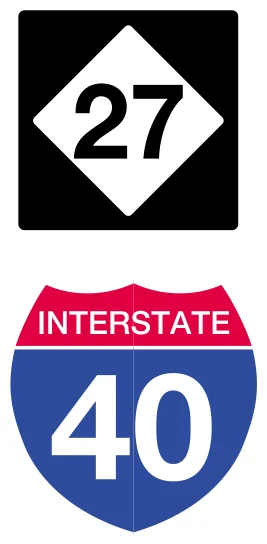
  • N.C. route markers are diamond shaped
  • N.C. secondary road signs are rectangular
  • Interstates are marked by a red, white and blue shield
Handbook p. 44 ↗
State route marker and Interstate route marker
N.C. route marker (diamond) and Interstate shield

Know the rule

Signs for a nearby hospital, Highway Patrol station or telephone are blue and white. Rectangular guide signs may be green, brown or blue and give directions and distances.

Handbook p. 44 ↗

Know the rule

If you're lost, don't stop in the road to read a sign. When safe, move to the shoulder and work out your route.

Handbook p. 44 ↗

Pavement lines

Pavement lines
LineMeaning
YellowSeparates traffic moving in opposite directions
WhiteSeparates traffic moving in the same direction
Broken yellow centerPassing with care allowed both ways (2-lane road)
Double solid yellowNo crossing to pass in either direction
Solid white edgeRight edge of the road
Solid yellow edgeLeft edge on divided highways
Handbook p. 46 ↗

Know the rule

On a two-lane road you may pass with care if the broken yellow line is on your side. If you see a yellow edge line on your right and white on your left, you're going the wrong way.

Handbook p. 46 ↗

Know the rule

A center two-way left-turn lane is only for left turns from both directions. Never use it to pass or to merge into traffic.

Handbook p. 46 ↗

Reflective pavement markers

Reflective pavement markers
ColorMeaning
White and yellowMake lines visible at night in the rain
RedWrong-way movement
BlueNearby fire hydrant or water supply
Handbook p. 46 ↗

Know the rule

Obey a traffic officer's signals instead of normal signals or signs. Stop: one hand raised, palm toward you, plus a long whistle blast. Go: a hand motion plus a series of short blasts. At night the officer may use a flashlight.

Handbook p. 46 ↗

Put it into practice

You're on I-95 and wonder which way you're headed. Odd numbers generally run north-south, so I-95 is a north-south route. I-40, an even number, runs east-west.

Check your understanding

Read the question, decide on an answer, then open it to check the explanation. These are Roadwise study questions based on the source handbook.

Odd-numbered North Carolina highways generally run in which direction?
  1. East and west
  2. In a loop around cities
  3. There is no pattern
  4. North and south

Answer: North and south

Odd-numbered highways generally run north and south.
Handbook p. 44 ↗
Even-numbered North Carolina highways generally run in which direction?
  1. East and west
  2. North and south
  3. In a loop around cities
  4. There is no pattern

Answer: East and west

Even-numbered highways generally run east and west.

Handbook p. 44 ↗
What shape is used for U.S. highway route markers?
  1. A diamond
  2. A shield
  3. A circle
  4. A hexagon

Answer: A shield

Route markers for U.S. highways are in the shape of a shield.

Handbook p. 44 ↗
What do yellow lines on a roadway indicate?
  1. Travel lanes moving in the same direction
  2. A bicycle lane only
  3. A construction zone
  4. Travel lanes moving in opposite directions

Answer: Travel lanes moving in opposite directions

Yellow lines separate travel lanes moving in opposite directions.

Handbook p. 46 ↗
What does a double-solid yellow center line mean?
  1. You cannot cross it to pass in either direction
  2. Passing is allowed with care in one direction only
  3. It marks a bicycle lane
  4. Passing is allowed if the road ahead is clear

Answer: You cannot cross it to pass in either direction

When continuous, double, solid yellow lines are the center lines, you cannot cross them to pass in either direction.

Handbook p. 46 ↗
How does a traffic officer typically signal drivers to stop?
  1. Waving the hand with short whistle blasts
  2. One raised hand, palm out, with a long whistle
  3. Pointing at the driver with both hands
  4. Crossing both arms over the chest

Answer: One raised hand, palm out, with a long whistle

Traffic officers signal drivers to stop by holding up one hand with the palm facing the vehicle and a long whistle blast.

Handbook p. 46 ↗
Take the lesson checkpoint in the app

More in Signals, Signs & Pavement Markings