roadwise.Open study app

North Carolina driving lesson · Signals, Signs & Pavement Markings

Sign shapes & regulatory signs

A 3-minute lesson from the North Carolina course. Read the rules and examples, follow the handbook page references, and check your understanding before you move on.

Read time
3 minutes
Course unit
Signals, Signs & Pavement Markings
Checkpoint questions
6
Source pages
43, 45

Shape and color let you recognize a sign at a glance, even before you can read it. Signs come in three types: regulatory, warning and guide/informational. Regulatory signs state laws you must obey.

Shapes to know

Shapes to know
ShapeMeaning
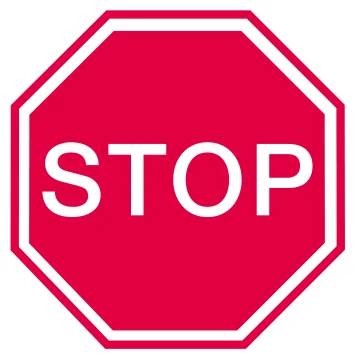
Octagon (8 sides)Stop sign only; white STOP on red
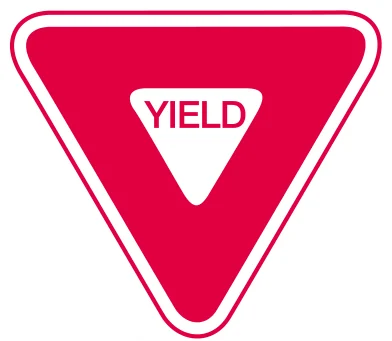
Triangle, point downYield; red and white
Rectangle or squareSpeed limits and other regulations
PennantNo-passing zone warning
DiamondCaution or warning
Pentagon (5 sides)School zone or school crossing
CircleRailroad crossing advance warning
Handbook p. 43 ↗
Stop
Stop sign
6 to 50 feet

Usual distance of a stop sign from the intersection

Handbook p. 43 ↗

Know the rule

At a stop sign, come to a FULL stop and don't move until the way is clear.

Handbook p. 43 ↗

Know the rule

When a sign or signal requires you to stop, stop at the marked stop line. With no stop line or crosswalk, stop before entering the intersection where you can see the intersecting street.

Handbook p. 43 ↗
Yield
Yield sign

Know the rule

At a yield sign, slow down and yield the right of way. Stop and wait if needed to avoid interfering with traffic on the intersecting street.

Handbook p. 43 ↗

Know the rule

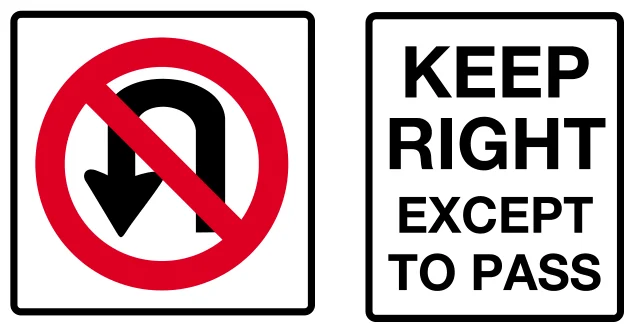
Rectangular and square regulatory signs are normally black and white or red and white, with messages like NO U-TURN or KEEP RIGHT EXCEPT TO PASS. Disobeying them is unsafe and illegal.

Handbook p. 43 ↗
No U-turn and Keep Right Except to Pass signs
NO U-TURN and KEEP RIGHT EXCEPT TO PASS

Know the rule

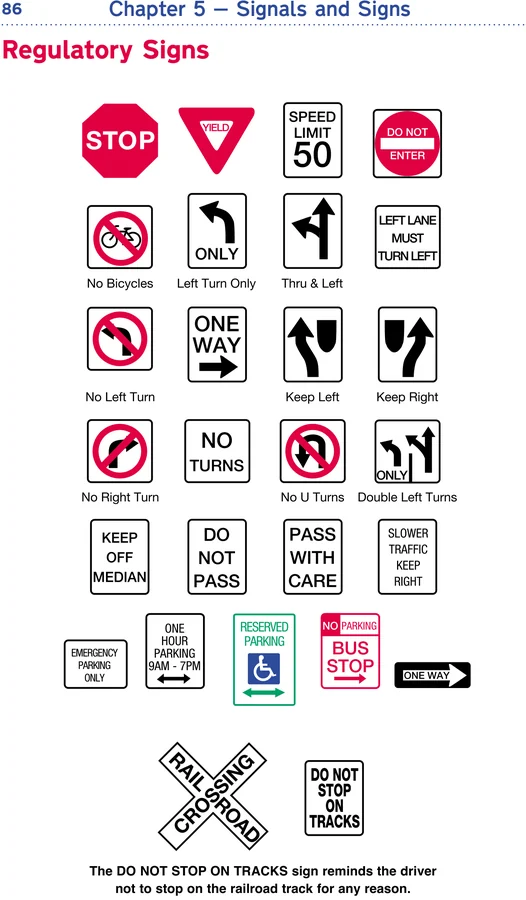
The handicap parking sign reserves a space for those who qualify and display a handicap plate or dashboard placard.

Handbook p. 43 ↗

Know the rule

The DO NOT STOP ON TRACKS sign reminds you not to stop on a railroad track for any reason.

Handbook p. 45 ↗
Regulatory signs reference chart
Regulatory signs

Put it into practice

You approach a yield sign at a busy cross street. You don't have to stop if the street is clear, but you must slow down, and if cars are coming, stop and wait for them to pass.

Check your understanding

Read the question, decide on an answer, then open it to check the explanation. These are Roadwise study questions based on the source handbook.

Which shape is used exclusively for the stop sign?
  1. The triangle
  2. The octagon (eight-sided shape)
  3. The diamond
  4. The pentagon

Answer: The octagon (eight-sided shape)

The octagonal shape is used for stop signs only.

Handbook p. 43 ↗
What shape and orientation is the yield sign?
  1. A triangle with the point at the top
  2. A circle
  3. A triangle with the point at the bottom
  4. A rectangle

Answer: A triangle with the point at the bottom

The yield sign is triangular shaped with the point at the bottom.

Handbook p. 43 ↗
What color is the background of a stop sign?
  1. Red, with the word STOP printed in white
  2. Yellow, with black letters
  3. White, with red letters
  4. Orange, with black letters

Answer: Red, with the word STOP printed in white

The word STOP is printed in white on a red background.

Handbook p. 43 ↗
About how far from an intersection is a stop sign usually posted?
  1. 1 to 5 feet
  2. Six to 50 feet
  3. 100 to 200 feet
  4. 500 feet

Answer: Six to 50 feet

The stop sign is usually posted six to 50 feet from the intersection.

Handbook p. 43 ↗
What must you do if there is no stop line or marked crosswalk at a stop sign?
  1. Proceed, since there is no line
  2. Stop only if a vehicle is approaching
  3. Stop where you can see the cross street
  4. Stop exactly beside the sign

Answer: Stop where you can see the cross street

If there is no stop line or marked crosswalk, the driver must stop before entering the intersection where they have a view of the intersecting street.

Handbook p. 43 ↗
The octagon shape is used exclusively for stop signs.
  1. True
  2. False

Answer: True

The octagonal shape is used for stop signs only.

Handbook p. 43 ↗
Take the lesson checkpoint in the app

More in Signals, Signs & Pavement Markings