North Carolina driving lesson · Signals, Signs & Pavement Markings
Traffic signals
A 3-minute lesson from the North Carolina course. Read the rules and examples, follow the handbook page references, and check your understanding before you move on.
Signals, signs and markings keep traffic flowing smoothly and orderly. Traffic signals control drivers and pedestrians at some intersections and mid-block crosswalks, and every color and arrow has a precise meaning.
Circular green
Know the rule
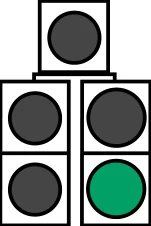
Circular green: proceed cautiously straight or turn. Turning vehicles must yield to oncoming traffic and pedestrians.
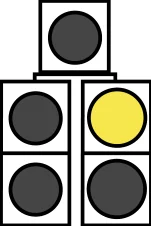
Circular yellow: caution, the light is about to turn red. Stop unless you're too close to stop safely; then go through cautiously. Never speed up to beat the red.
If a traffic light is out or malfunctioning, treat the intersection as if it had a stop sign on all approaches, unless an officer is directing traffic or another control device is working.
You're stopped at a red light, want to turn right, and see no NO TURN ON RED sign. After a full stop, wait for a pedestrian starting across in front of the stopped traffic, then turn. Failing to yield could cost $100 to $500.
Check your understanding
Read the question, decide on an answer, then open it to check the explanation. These are Roadwise study questions based on the source handbook.
What does a circular green traffic signal permit you to do?
Stop and wait for a gap
Proceed straight or turn, with caution
Proceed straight only, never turn
Turn only after a full stop
Answer: Proceed straight or turn, with caution
A circular green signal means you are permitted to proceed cautiously straight through or make a turn.