roadwise.Open study app

North Carolina driving lesson · Sharing the Road

Bicycles

A 3-minute lesson from the North Carolina course. Read the rules and examples, follow the handbook page references, and check your understanding before you move on.

Read time
3 minutes
Course unit
Sharing the Road
Checkpoint questions
6
Source pages
19, 46, 47

Bicycles are vehicles under NC law. Cyclists may ride among other traffic, and sometimes need the full lane. Expect them on all roads except where expressly prohibited, and pass them as you would any vehicle.

Know the rule

Bicyclists must obey the same traffic laws as other drivers, including DWI laws.

Handbook p. 46 ↗

Know the rule

Cyclists may ride in bike lanes, on paved shoulders or in regular travel lanes, choosing based on road conditions, hazards and conflicts with right-turning traffic.

Handbook p. 46 ↗

Like drivers, bicyclists must:

  • Ride on the right side of the road
  • Stop for stop signs and red lights
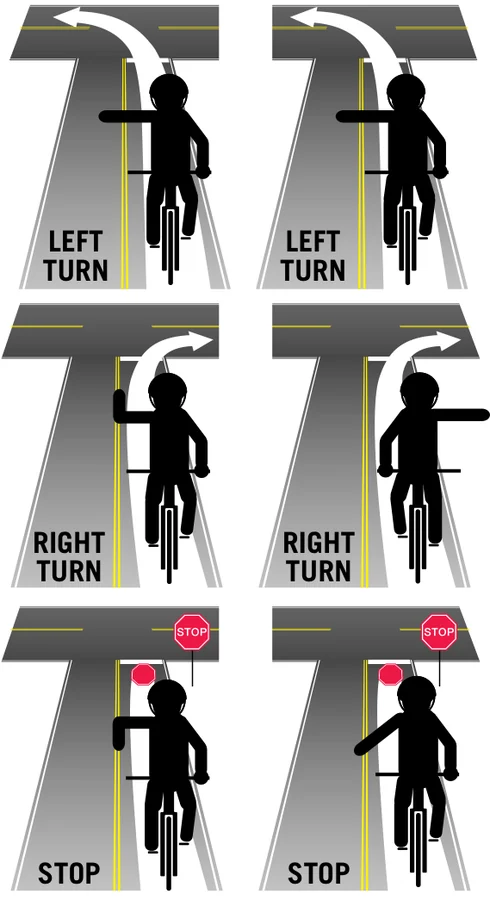
  • Give hand signals
Handbook p. 46 ↗
Bicycle hand signals (left turn, right turn, stop)
Bicycle hand signals: driver's manual signals and variations cyclists use

Know the rule

Pass a bicyclist only with abundant clearance and no oncoming traffic in the opposing lane. The safest way is to change lanes, and you must follow the vehicle passing laws.

Handbook p. 47 ↗

Know the rule

Bicyclists must ride with the flow of traffic, never facing it. Motorists often don't look toward wrong-way riders.

Handbook p. 47 ↗

Required bicycle lights at night

Required bicycle lights at night
LightVisible at least
Front light300 feet
Rear red light or reflector200 feet
Handbook p. 47 ↗

Bicycle helmet and seat rules:

  • All riders and passengers under 16 must wear an approved helmet
  • Riders and passengers under 16 must sit on a saddle seat
  • Passengers under 40 pounds or under 40 inches tall ride in a bicycle restraining seat
Handbook p. 47 ↗

Know the rule

Bicycles are narrow and ride at the right of the lane, so they're easy to miss. Avoid left-cross, drive-out and right-hook collisions.

Handbook p. 47 ↗
4 points

Failure to yield right of way to a bicycle, motor scooter or motorcycle

Handbook p. 19 ↗

Put it into practice

A cyclist is riding near the right side of a two-lane road and a car is coming the other way. Wait behind the bike until the oncoming lane is clear, then change lanes to pass with plenty of room.

Check your understanding

Read the question, decide on an answer, then open it to check the explanation. These are Roadwise study questions based on the source handbook.

How does North Carolina law classify bicycles for traffic law purposes?
  1. As pedestrians
  2. As exempt from most traffic laws
  3. As vehicles subject to traffic laws
  4. As sidewalk users only

Answer: As vehicles subject to traffic laws

State law considers bicycles to be vehicles, and bicyclists must obey the same traffic laws, including DWI laws.
Handbook p. 46 ↗
What is the safest way for a driver to pass a bicyclist?
  1. Stay in your lane and squeeze past slowly
  2. Sound the horn and pass immediately
  3. Straddle the center line without changing lanes
  4. Change lanes when there's no oncoming traffic

Answer: Change lanes when there's no oncoming traffic

The safest way to pass a bicyclist is to change lanes, with abundant clearance and no oncoming traffic.

Handbook p. 47 ↗
At night, how far must a bicycle's required front light be visible?
  1. 300 feet
  2. 100 feet
  3. 500 feet
  4. 200 feet

Answer: 300 feet

The law requires a bicycle to have a front light visible for at least 300 feet at night.

Handbook p. 47 ↗
At night, how far must a bicycle's rear red light or reflector be visible?
  1. 300 feet
  2. 200 feet
  3. 50 feet
  4. 500 feet

Answer: 200 feet

A bicycle must have a red light or reflector on the rear visible for at least 200 feet at night.

Handbook p. 47 ↗
Who must wear an approved bicycle helmet in North Carolina?
  1. Only the operator, at any age
  2. Only riders on public roads
  3. Riders and passengers under 16
  4. Only passengers under 16

Answer: Riders and passengers under 16

All bicycle riders and passengers under age 16 must wear an approved protective bicycle helmet.

Handbook p. 47 ↗
What weight or height threshold requires a bicycle passenger to be seated in a restraining seat?
  1. Under 40 lbs or under 40 inches
  2. Under 60 lbs or under 50 inches
  3. Under 20 lbs or under 30 inches
  4. Under 50 lbs or under 48 inches

Answer: Under 40 lbs or under 40 inches

A passenger weighing less than 40 pounds or less than 40 inches in height must be seated in a bicycle restraining seat.

Handbook p. 47 ↗
Take the lesson checkpoint in the app

More in Sharing the Road