roadwise.Open study app

New York driving lesson · Sharing the Road

Trucks, buses & other large vehicles

A 4-minute lesson from the New York course. Read the rules and examples, follow the handbook page references, and check your understanding before you move on.

Read time
4 minutes
Course unit
Sharing the Road
Checkpoint questions
5
Source pages
74, 75

In more than 60 percent of fatal crashes involving cars and big trucks, the car driver, not the truck driver, contributes to the cause, and four out of five times it's the car driver who dies. Knowing a big vehicle's limits keeps you out of these crashes.

The bigger the vehicle:

  • The bigger its blind spots
  • The longer it takes to stop
  • The more room it needs to maneuver
  • The longer it takes you to pass it
Handbook p. 74 ↗
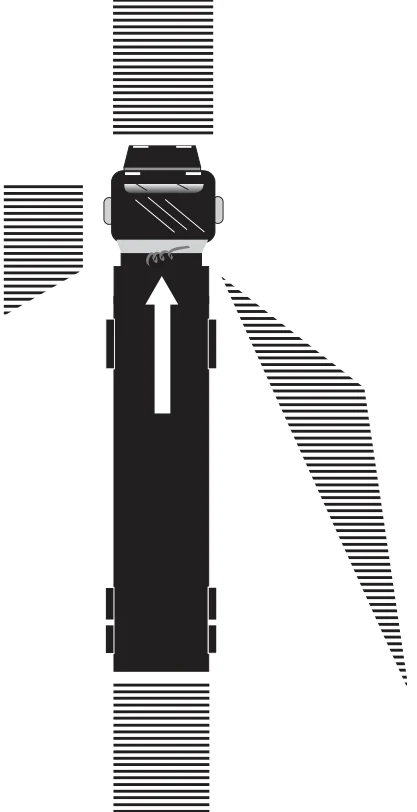
Following a truck too closely
A tractor-trailer's blind spots ("no zones"): front, both sides and behind
20 feet

Blind spot in front of tractors with long hoods

Handbook p. 74 ↗

Know the rule

Large vehicles have deep blind spots behind them and larger blind spots on both sides than cars. If you linger beside or behind a truck, the driver can't see you, and your view of traffic is blocked. Avoid these "no zones."

Handbook p. 74 ↗

Know the rule

Tractor-trailers take much longer to stop because air brakes add delay passing braking power from tractor to trailer. Leave plenty of space; if you're in front of a truck, signal turns or lane changes early and avoid sudden moves.

Handbook p. 74 ↗

Average total stopping distance at 55 mph

Average total stopping distance at 55 mph
VehicleDistance
Passenger car193 ft
Tractor-trailer with cool brakes256 ft
Tractor-trailer with hot brakes430 ft
Tractor-trailer, empty249 ft
Tractor unit only243 ft
Handbook p. 75 ↗

To avoid collisions with large vehicles:

  • Don't cut in front abruptly; when exiting, slow down a few seconds and exit behind it
  • After passing, don't pull in front until you can see its whole front in your mirror
  • Watch turn signals: trucks swing left before making wide right turns
  • Don't linger near a turning truck; you may be in the wide area it needs
Handbook p. 74 ↗

Know the rule

Passing takes longer and needs more space than passing a car. Trucks usually slow on upgrades but can speed up a lot on downgrades, which lengthens your pass. Look far ahead before you commit.

Handbook p. 75 ↗

Know the rule

Never pass close behind a truck that is backing up; wait until it's finished. Trying to pass puts you in a blind spot.

Handbook p. 75 ↗

Know the rule

An oncoming tractor-trailer looks slower and smaller than it is and will reach you sooner than you expect. On a two-way highway, move as far right as possible.

Handbook p. 75 ↗

Know the rule

When stopped behind a truck or bus, especially facing uphill, leave space: it may roll back slightly when it starts, and the gap lets you pull around it.

Handbook p. 75 ↗

Put it into practice

You're behind a tractor-trailer at a light. It signals right but drifts into the left part of its lane. Don't squeeze into the gap on its right: it's swinging wide to make the turn, and you'd be in its blind spot and path.

Check your understanding

Read the question, decide on an answer, then open it to check the explanation. These are Roadwise study questions based on the source handbook.

In fatal crashes between cars and big trucks, who most often contributes to causing the crash?
  1. The truck driver, more than 60 percent of the time
  2. The car driver, more than 60 percent of the time
  3. Both drivers equally, in nearly all cases
  4. Neither driver — mechanical failure is the leading cause

Answer: The car driver, more than 60 percent of the time

In more than 60 percent of fatal car/truck crashes, the car driver, not the truck driver, contributed to the cause.
Handbook p. 74 ↗
Why do tractor-trailers take longer to stop than passenger cars at the same speed?
  1. Air brakes delay braking to the trailer
  2. Their drivers react more slowly
  3. Federal law limits their braking force
  4. Their loads shift forward when braking

Answer: Air brakes delay braking to the trailer

For tractor-trailers, brake delay from air brakes transmitting power from tractor to trailer adds distance to stop.

Handbook p. 74 ↗
How large can the blind spot in front of a tractor with a long hood be?
  1. 10 feet
  2. 5 feet
  3. 20 feet
  4. 50 feet

Answer: 20 feet

Tractors with long hoods can have a blind spot of 20 feet in front of the vehicle.

Handbook p. 74 ↗
A tractor-trailer ahead signals a right turn but first moves to the left. What is most likely happening?
  1. It's changing lanes to the left
  2. It's swinging wide for a right turn
  3. It's pulling over to stop
  4. Its signal was left on by mistake

Answer: It's swinging wide for a right turn

Trucks make wide right turns, so they move to the left before turning right; watch their turn signals.

Handbook p. 74 ↗
According to the handbook's chart, about what is a passenger car's average total stopping distance at 55 mph?
  1. 256 feet
  2. 430 feet
  3. 350 feet
  4. 193 feet

Answer: 193 feet

The chart shows 193 ft for a passenger car versus 256 ft for a tractor-trailer with cool brakes and 430 ft with hot brakes.

Handbook p. 75 ↗
Take the lesson checkpoint in the app

More in Sharing the Road