Bicyclists have the same rights and responsibilities on the road as drivers, but no protection in a crash and they're often hard to see. Give them room, expect sudden moves around road hazards, and learn the bike lanes and markings built for them.
Know the rule
Bicyclists have the right to share the road and travel in the same direction as motor vehicles. Before turning, parallel parking, opening a door or leaving a curb, turn your head to check blind spots for bicyclists, skaters and scooters.
Handbook p. 68 ↗Know the rule
Reduce speed and give room when you pass a bicyclist: air pressure from a fast-passing vehicle can knock a rider off balance. Pass as you would any vehicle, when it's safe to move into the next lane.
Handbook p. 68 ↗Bicyclists must:
- Use a bike lane if there is one; otherwise ride near the right curb, road edge or right shoulder
- They need not stay right when preparing for a left turn or avoiding hazards
- Come to a full stop before entering a road from a driveway, alley or over a curb
- Never ride more than two side-by-side in a single lane
- Not ride on a sidewalk where local law prohibits it
- Signal turns, lane changes and stops with hand signals
- Keep at least one hand on the handlebars and not carry items that prevent control
- Report a bike crash causing death or serious injury to DMV within 10 days (MV-104C)
Bicyclists and bicycle passengers who must wear an approved helmet
Handbook p. 69 ↗Know the rule
Never carry an infant under one year old as a passenger; it's against the law. Child passengers aged 1 to 4 must ride in attached bicycle safety seats, and no one may carry a passenger unless the bike has a passenger seat.
Handbook p. 69 ↗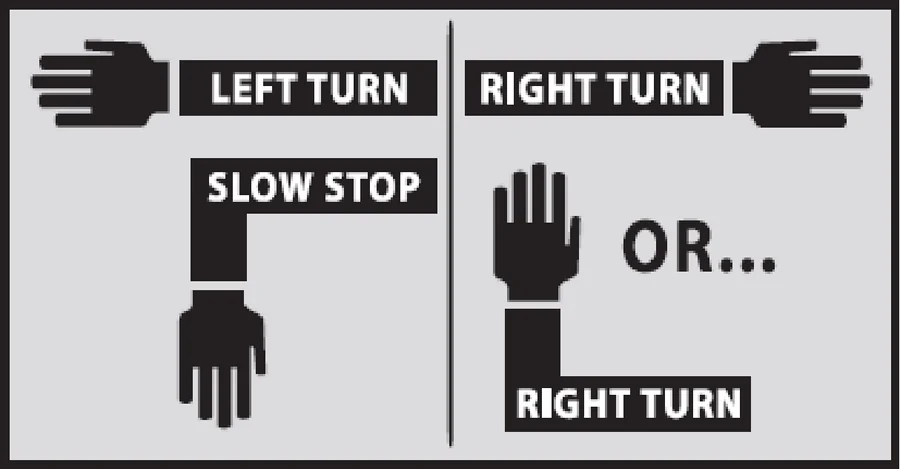
Required bicycle equipment
| Item | Requirement |
|---|---|
| Brakes | Adequate brakes |
| Horn or bell | Heard at least 100 feet away |
| Headlight (at night) | Visible at least 500 feet ahead |
| Red taillight (at night) | Visible at least 300 feet behind |
| Side visibility (at night) | One light visible 200 feet away on each side |
| Reflectors (bikes sold by dealers) | Spoke or tire, rear, and pedal reflectors |
Tips for drivers:
- Yield to bicyclists as you would other drivers, and don't underestimate their speed
- Turning right on red: stop completely and look left-right-left and behind for a bike at your right rear
- Look before getting out of a parked car; don't open your door into a bicyclist's path
- Expect a cyclist to react to road hazards like a motorcyclist, with sudden changes of speed or position
- Expect that they may not follow the rules of the road
Bicycle facilities (drivers may not use them):
- Bicycle lane: a marked lane for bicycles
- 2-way cycle track: a marked bike lane for travel in both directions
- Bike box: a marked area ahead of the stop line at an intersection, giving cyclists extra space
- Green painted bike lanes: used to make cyclists more visible in some busy areas
Know the rule
In-line skaters, skateboarders and non-motorized scooter riders are vulnerable too. Exercise due care, especially when they're on the roadside, in a bike lane, near intersections and at crosswalks.
Handbook p. 70 ↗Put it into practice
You're stopped at a red light, planning to turn right on red. Before you go, look left, right, left again and over your right shoulder. A cyclist may be coming up in the bike lane on your right, and you must yield.