Roadwise States New Mexico Driving lessons Stopping distance & sight distance New Mexico driving lesson · Communicating & Managing Space
Stopping distance & sight distance A 3-minute lesson from the New Mexico course. Read the rules and examples, follow the handbook page references, and check your understanding before you move on.
Read time 3 minutes
Course unit Communicating & Managing Space
Checkpoint questions 6
Source pages 25, 26 To stop for something in your path, you must see it in time. Stopping takes much longer and farther than most people think, so you should never drive faster than the distance you can see ahead.
Know the rule
If you can't see 400 feet ahead, you may not be driving safely at 50 mph. If you can't see 200 feet ahead, you may not be driving safely at 30 mph.
Handbook p. 25 ↗ Know the rule
At night you must be closer to see an object. Drive so you can stop within the distance your headlights show.
Handbook p. 25 ↗ About 400 ft How far your headlights let you see: drive at a speed that lets you stop within it, about 50 mph
Handbook p. 26 ↗ Know the rule
In very heavy rain, snow or thick fog you may not see much more than 200 feet ahead; then you cannot safely drive faster than 30 mph.
Handbook p. 26 ↗ Know the rule
If a downpour is so heavy you can't see well enough to drive, pull off the road in a safe place and wait until it clears.
Handbook p. 26 ↗ Know the rule
At a hill or curve you can't see over or around, adjust your speed so you can stop for a stalled vehicle, even on a road you know well.
Handbook p. 26 ↗ Know the rule
Parked vehicles can block your view, and people may step out from between them. Give parked vehicles as much room as you can.
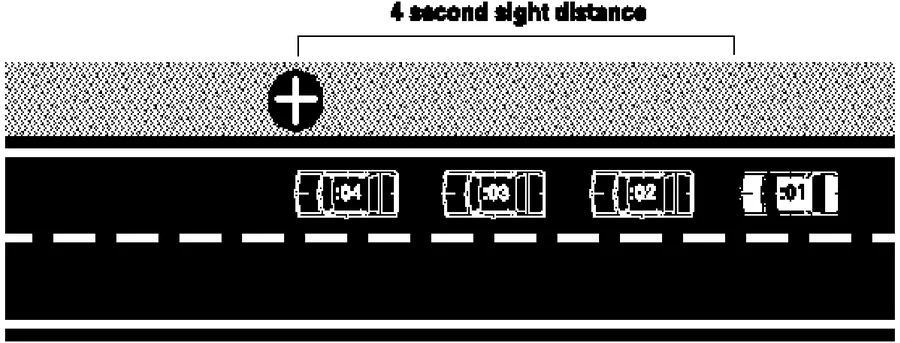
Handbook p. 26 ↗ Four Second Sight Distance Rule Pick a fixed object as far ahead as you can clearly see and count four seconds. If you reach it before "four-one-thousand," you're going too fast for your sight distance.
Handbook p. 26 ↗ Four-second sight distance: counting to a fixed object ahead Know the rule
Use the Four Second Sight Distance Rule at night too, so you aren't "overdriving your headlights."
Handbook p. 26 ↗ Put it into practice
In thick fog you can see only about 150 feet. Since 200 feet of visibility already limits you to 30 mph, you should drive well under 30 mph, or pull off safely and wait.
A useful reminder 400 ft ↔ 50 mph, 200 ft ↔ 30 mph. Headlights show about 400 ft.
Check your understanding Read the question, decide on an answer, then open it to check the explanation. These are Roadwise study questions based on the source handbook.
About how far does it take to stop from 50 mph, given good tires, brakes and dry pavement? About 800 feet About 200 feet About 400 feet About 100 feet Answer: About 400 feet
At 50 mph, it can take about 400 feet to react and bring your vehicle to a stop.
Handbook p. 25 ↗ About how far does it take to stop from 30 mph, given good tires, brakes and dry pavement? About 400 feet About 50 feet About 600 feet About 200 feet Answer: About 200 feet
At 30 mph, it can take about 200 feet to stop — almost half a city block.
Handbook p. 25 ↗ About how far ahead can your headlights let you see at night? About 1,000 feet About 800 feet About 400 feet About 100 feet Answer: About 400 feet
Your headlights will let you see about 400 feet ahead, so you should drive at a speed that lets you stop within that distance.
Handbook p. 25 ↗ In very heavy rain, snow or fog limiting sight to about 200 feet, what's the fastest you should safely drive? About 50 mph About 45 mph About 60 mph About 30 mph Answer: About 30 mph
When you cannot see farther than about 200 feet, you cannot safely drive faster than 30 mph.
Handbook p. 26 ↗ How do you use the Four-Second Sight Distance Rule? Count four seconds behind the car ahead Multiply your speed by four Look four blocks ahead of your vehicle Count to four as you approach a fixed object Answer: Count to four as you approach a fixed object
Pick a stationary object ahead and count to four; if you reach it before finishing the count, slow down.
Handbook p. 26 ↗ You're driving in dense fog and can only see about 150 feet ahead. What speed is appropriate? The posted speed limit About 50 mph About 45 mph, using high beams Well under 30 mph Answer: Well under 30 mph
If you can't see farther than about 200 feet, you can't safely drive faster than 30 mph — less if visibility is worse.
Handbook p. 26 ↗ Previous lesson Wildlife & keeping pace with traffic Next lesson Following, merging & crossing space More in Communicating & Managing Space About the source Roadwise’s New Mexico course uses the driver handbook edition supplied with this study pack. This lesson cites source pages 25, 26. The linked PDF is a third-party mirror of the handbook, rather than a government-hosted page.
Open the handbook source PDF · View the source edition
For current application requirements, fees, appointments, and the format that applies to your age or license type, check New Mexico’s MVD. Roadwise provides study material and does not issue permits or licenses.