A 3-minute lesson from the New Jersey course. Read the rules and examples, follow the handbook page references, and check your understanding before you move on.
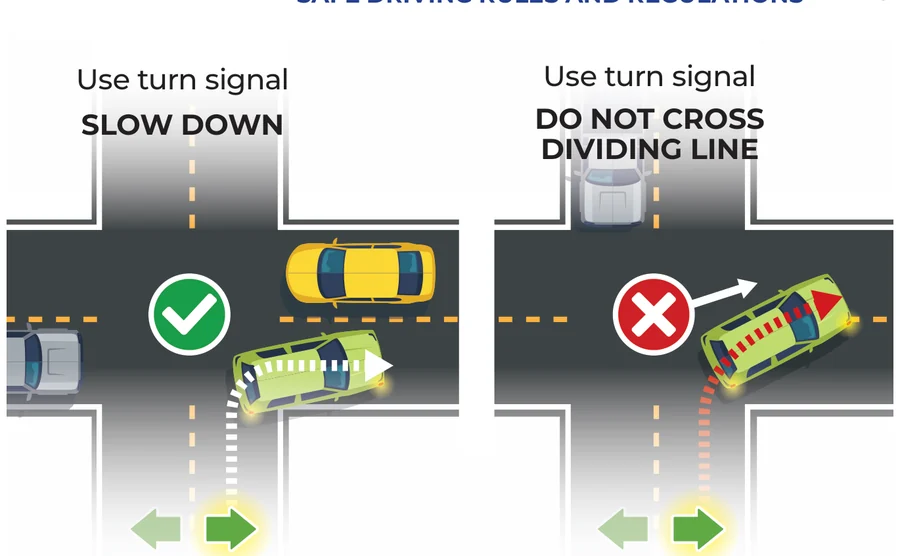
A correct turn starts well before the corner: the right lane position, a signal at least 100 feet out, and a tight path that doesn't swing into other lanes. New Jersey allows right turns on red, but only after a full stop.
Know the rule
Unless a No Turn on Red sign is posted, you may turn right on a red light after a full stop and a check for traffic. Yield to all oncoming traffic and pedestrians first.
From a two-way road onto a two-way road, approach close to the center line, don't cross lane markings, and keep to the right of the new road's center line.
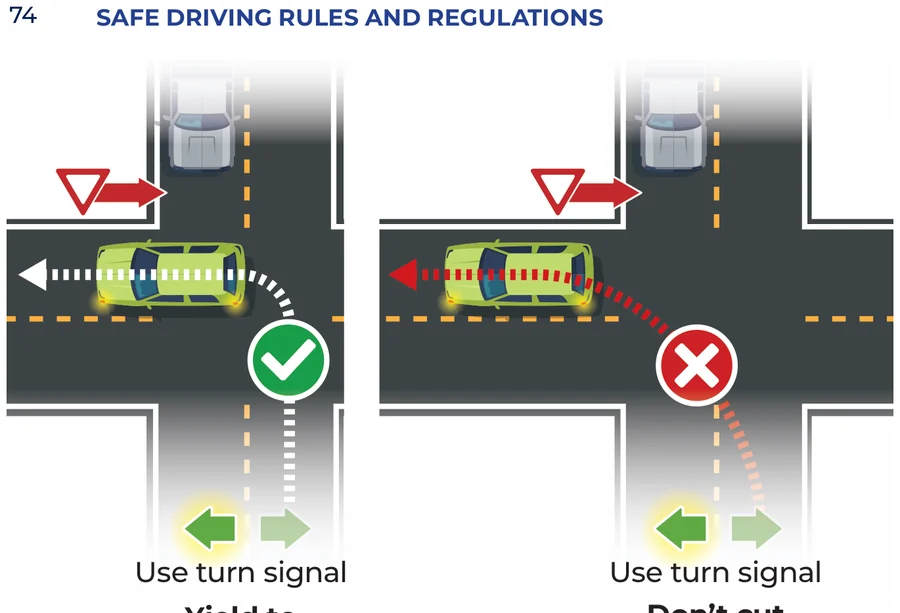
From a two-way road onto a four-lane highway, turn before reaching the center of the intersection into the lane nearest the center line (the passing lane), then move right when traffic permits.
You're stopped at a red light, want to turn right, and see no NO TURN ON RED sign. After a full stop, wait for the pedestrian in the crosswalk and the cyclist coming through on green, then turn into the nearest lane.
Check your understanding
Read the question, decide on an answer, then open it to check the explanation. These are Roadwise study questions based on the source handbook.
Unless a sign prohibits it, when is a right turn on red permitted in New Jersey?
After fully stopping and yielding the right-of-way
At any time without stopping
After slowing down and checking that the lane is clear
Only on one-way streets
Answer: After fully stopping and yielding the right-of-way
A right turn on red is authorized after the motorist comes to a full stop, checks for traffic, and yields to oncoming traffic and pedestrians.