roadwise.Open study app

New Jersey driving lesson · Safe Driving Rules

Stop rules: signals, railroads, and school buses

A 4-minute lesson from the New Jersey course. Read the rules and examples, follow the handbook page references, and check your understanding before you move on.

Read time
4 minutes
Course unit
Safe Driving Rules
Checkpoint questions
6
Source pages
76, 77, 78, 79

Signs, signals and traffic rules tell you when to stop. The most serious stops are for trains and school buses, where the law sets exact distances. Learn the full list of places you must stop.

Know the rule

Most crashes at traffic signals happen in the first few seconds after the light changes, so proceed carefully on a new green.

Handbook p. 76 ↗

Know the rule

When yellow follows green, stop before the intersection unless you are too close to stop safely. If the light changes while you're in the intersection, go through with caution.

Handbook p. 76 ↗

Stale green light

A light that has been green for some time. Be ready for it to turn yellow and then red, and slow down to stop.

Handbook p. 76 ↗

You must stop

  • At a stop sign, or a flashing or steady red light
  • At a yellow after green, unless too close to stop safely
  • When a traffic officer orders you to
  • At a yield sign when traffic doesn't allow a safe merge
  • For a school bus loading or unloading children, or with red lights flashing
  • When coming out of an alley, private driveway or building
  • At a bridge span about to open for boat traffic
  • For a blind pedestrian with a white or metallic cane or guide dog, or a guide dog instructor
  • For a pedestrian or motorized wheelchair/mobility device in a crosswalk or at an intersection
Handbook p. 78 ↗
At least 15 feet

Where to stop from a railroad crossing when lights flash, bells ring, gates lower or a flagger signals

Handbook p. 78 ↗

Know the rule

Never cross until the gates are raised, the bells have stopped and the red lights have stopped flashing. Most trains need more than a mile to stop at 60 mph or more.

Handbook p. 78 ↗

Know the rule

School buses, buses and vehicles carrying hazardous materials must always stop at railroad crossings; be ready to stop behind them even if no train is signaled.

Handbook p. 78 ↗

Know the rule

Never stop on railroad tracks; be sure there is room on the other side. If warning devices activate while you're on the tracks, keep going to the other side.

Handbook p. 78 ↗
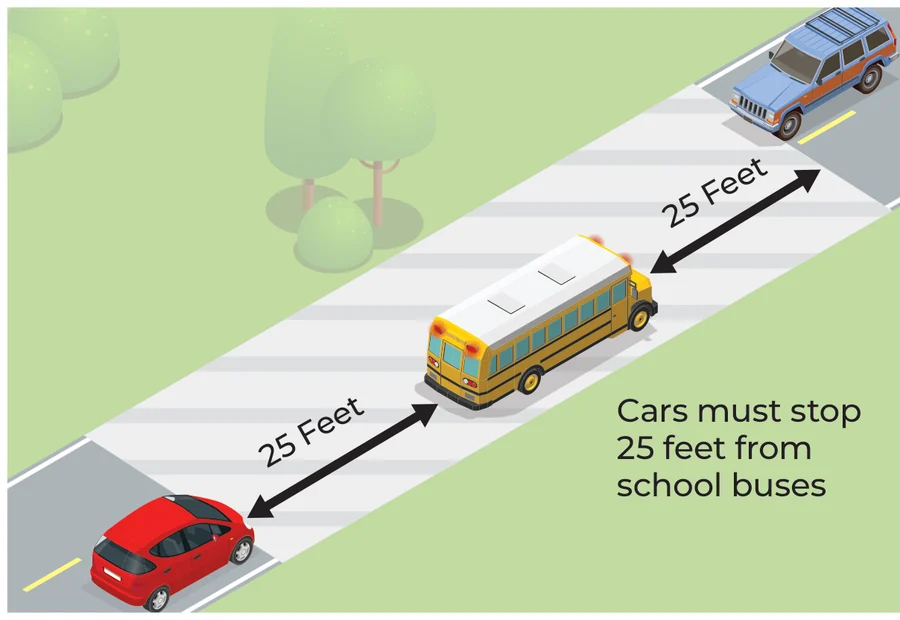
At least 25 feet

Stop from a school bus with flashing red lights on a two-lane road, a multi-lane road divided only by lines, or a private road

Handbook p. 79 ↗

Know the rule

On a dual-lane highway, if you're on the other side of a safety island or raised median, slow to 10 mph instead of stopping.

Handbook p. 79 ↗

Know the rule

Yellow (amber) lights come on before the bus stops; red lights when it has stopped. Behind a bus, don't rely on the lights. Go only after the signals are off, and watch for children.

Handbook p. 79 ↗

Know the rule

If a school bus is stopped directly in front of a school to load or unload, you may pass from either direction at no more than 10 mph.

Handbook p. 79 ↗
Stopping distance from a school bus
Stop at least 25 feet from a school bus with red lights flashing

Put it into practice

On a four-lane road with only painted lines between directions, a school bus coming toward you stops with red lights flashing. You must stop at least 25 feet away too. Only a raised median or safety island would let you pass at 10 mph.

Check your understanding

Read the question, decide on an answer, then open it to check the explanation. These are Roadwise study questions based on the source handbook.

How far from a railroad crossing must a motorist stop when there are flashing red lights, ringing bells, or lowered gates?
  1. At least 50 feet
  2. At least 5 feet
  3. At least 15 feet
  4. At least 100 feet

Answer: At least 15 feet

A motorist must stop at least 15 feet from a railroad crossing when warning devices are active.
Handbook p. 78 ↗
On a two-lane road, how far away must a motorist stop for a school bus that has activated its flashing red lights?
  1. At least 15 feet
  2. At least 50 feet
  3. At least 10 feet
  4. At least 25 feet

Answer: At least 25 feet

State law requires stopping at least 25 feet away from a school bus with flashing red lights on a two-lane road.

Handbook p. 79 ↗
A motorist is on a divided highway separated by a raised median from a stopped school bus with flashing red lights. What must they do?
  1. Slow to 10 mph rather than stop
  2. Stop at least 25 feet away like all other traffic
  3. No action is needed at all
  4. Stop at least 50 feet away

Answer: Slow to 10 mph rather than stop

On a dual-lane highway, if on the other side of a safety island or raised median from the bus, a motorist should slow to 10 mph instead of stopping.

Handbook p. 79 ↗
A school bus is stopped directly in front of a school to load or unload children. At what speed may a motorist pass?
  1. No more than 25 mph
  2. No more than 10 mph
  3. Must come to a complete stop and wait
  4. No more than 15 mph

Answer: No more than 10 mph

If a school bus has stopped directly in front of a school, a motorist may pass at a speed of no more than 10 mph.

Handbook p. 79 ↗
Under what circumstance are certain vehicles, like school buses or hazmat carriers, always required to stop at railroad crossings?
  1. Even if signals don't show a train coming
  2. Only during rush hour
  3. Only if a police officer is present
  4. They are exempt from stopping at all times

Answer: Even if signals don't show a train coming

School buses, buses, or vehicles carrying hazardous materials must always stop at railroad crossings, even without signal warnings.

Handbook p. 78 ↗
Most crashes at traffic signals happen in the first few seconds after the light changes.
  1. True
  2. False

Answer: True

The manual notes most signal-related crashes occur in the first few seconds after a light change.

Handbook p. 76 ↗
Take the lesson checkpoint in the app

More in Safe Driving Rules