Roadwise States New Jersey Driving lessons Highways, parkways, and turnpikes New Jersey driving lesson · Safe Driving Rules
Highways, parkways, and turnpikes A 4-minute lesson from the New Jersey course. Read the rules and examples, follow the handbook page references, and check your understanding before you move on.
Read time 4 minutes
Course unit Safe Driving Rules
Checkpoint questions 5
Source pages 70, 71, 72, 73, 74 Highways, parkways and turnpikes are high-speed divided roads (up to 65 mph) with no direct intersections. You get on with an acceleration lane and off with a deceleration lane, so smooth merging and early planning matter most.
Know the rule
Yield to traffic already on the main road before moving into the proper lane.
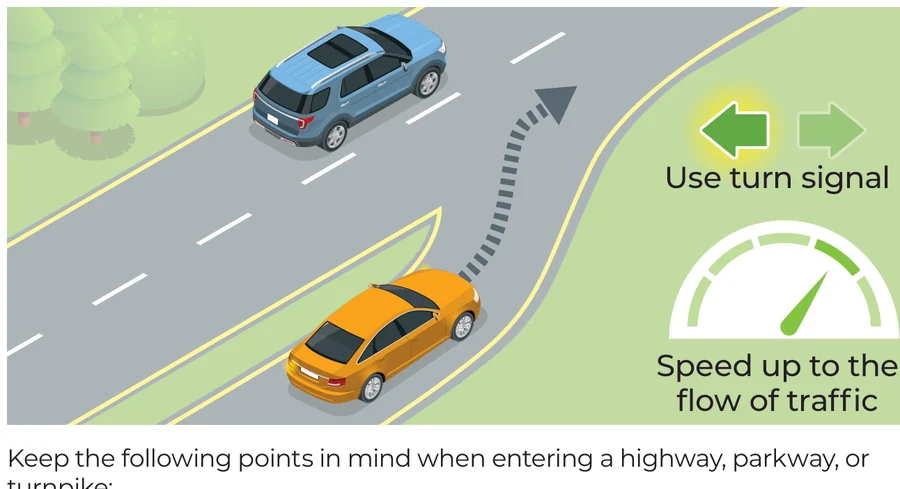
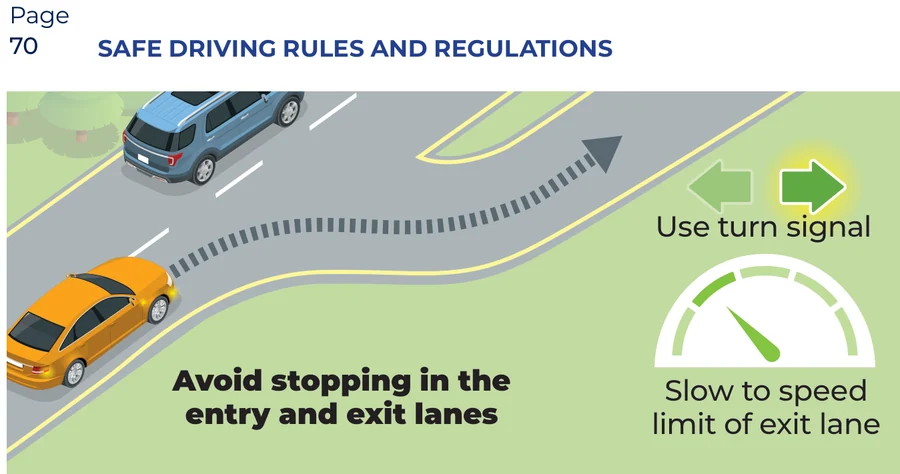
Handbook p. 70 ↗ Entering a highway Obey any posted advisory speed on the entrance ramp Speed up to the flow of traffic in the acceleration lane Avoid coming to a complete stop in the acceleration lane Yield to traffic and enter the right-hand lane when safe Handbook p. 71 ↗ Signal and speed up to the flow of traffic when merging Leaving a highway Watch for exit signs; most exits are on the right Start slowing once you enter the deceleration lane Obey the deceleration lane's posted advisory speed For a left exit, follow signs to the proper lane If you miss your exit, go on to the next one Never back up on an exit ramp or deceleration lane Handbook p. 72 ↗ Signal, and slow to the exit lane's speed limit Weave lane A lane that is both an entrance and an exit. The driver entering from the ramp must yield the right-of-way to the driver leaving the expressway.
Handbook p. 72 ↗ Know the rule
On highways through cities, drive in the left or center lane to avoid merge conflicts during rush hour, and look for your exit early.
Handbook p. 73 ↗ Know the rule
When you see a disabled vehicle ahead, reduce speed and add space, which may mean changing lanes. Watch for pedestrians, tow trucks and police.
Handbook p. 73 ↗ If your own vehicle becomes disabled Pull off as far as possible onto the shoulder or median Turn on emergency flashers and raise the hood Stay in the vehicle with your seat belt on and doors locked Use a cell phone to call for help, or ask anyone who stops to call Do not get into a stranger's vehicle Handbook p. 73 ↗ Know the rule
At construction areas adjust speed and position to keep space around you. Approaching toll booths, slow early; green lights mark open booths. Watch for E-ZPass lanes and merge smoothly after the booth.
Handbook p. 73 ↗ Know the rule
Slow down before entering a curve and don't drift into another lane; check Curve Ahead signs and recommended speeds.
Handbook p. 74 ↗ Know the rule
Interchanges often use cloverleaf turns. Watch for entrance and exit signs and drive slowly in the loop, obeying the posted speed.
Handbook p. 74 ↗ Put it into practice
You're on the entrance ramp to the Garden State Parkway and traffic is heavy. Use the acceleration lane to match the flow, signal, and slide into a gap in the right lane. Don't stop at the end of the ramp unless you truly must.
Check your understanding Read the question, decide on an answer, then open it to check the explanation. These are Roadwise study questions based on the source handbook.
What is the maximum speed generally posted on New Jersey highways, parkways, and turnpikes? 65 mph 55 mph 75 mph 60 mph Answer: 65 mph
Highways, parkways, and turnpikes are described as high-speed roadways with limits of up to 65 mph.
Handbook p. 70 ↗ When entering a highway from an acceleration lane, what should a motorist avoid doing? Speeding up to match traffic flow Stopping in the acceleration lane Signaling before merging Yielding to traffic already on the highway Answer: Stopping in the acceleration lane
Motorists should avoid coming to a complete stop in the acceleration lane when entering a highway.
Handbook p. 71 ↗ A weave lane serves as both an entrance and exit for an expressway at the same location. Who must yield in this situation? The motorist leaving the expressway must yield to the entering motorist Both vehicles have equal right-of-way and must negotiate The entering motorist must yield to the one leaving Neither vehicle needs to yield Answer: The entering motorist must yield to the one leaving
In a weave lane, the motorist entering from the ramp must yield the right-of-way to the motorist leaving the expressway.
Handbook p. 72 ↗ If a motorist misses their exit on a highway, parkway, or turnpike, what should they do? Back up carefully on the shoulder Stop and wait for help Make a U-turn if traffic allows Go to the next exit Answer: Go to the next exit
If a motorist misses an exit, they should proceed to the next exit rather than backing up.
Handbook p. 71 ↗ What should a motorist do first if their own vehicle becomes disabled on a highway? Get out immediately and start walking for help Stop in the travel lane and turn on headlights Wait inside without doing anything Pull off onto the shoulder or median Answer: Pull off onto the shoulder or median
A motorist whose vehicle becomes disabled should pull off as far as possible onto the shoulder or median and turn on emergency flashers.
Handbook p. 73 ↗ Previous lesson Right-of-way and intersections Next lesson Turning at intersections More in Safe Driving Rules About the source Roadwise’s New Jersey course uses the driver handbook edition supplied with this study pack. This lesson cites source pages 70, 71, 72, 73, 74. The linked PDF is a third-party mirror of the handbook, rather than a government-hosted page.
Open the handbook source PDF · View the source edition
For current application requirements, fees, appointments, and the format that applies to your age or license type, check New Jersey’s MVC. Roadwise provides study material and does not issue permits or licenses.