Roadwise States New Hampshire Driving lessons Rural roads and night driving New Hampshire driving lesson · Basic Driving
Rural roads and night driving A 3-minute lesson from the New Hampshire course. Read the rules and examples, follow the handbook page references, and check your understanding before you move on.
Read time 3 minutes
Course unit Basic Driving
Checkpoint questions 6
Source pages 25 Rural roads and darkness both limit what you can see and how much grip or room you have. Slow down, leave more space, and use your lights correctly.
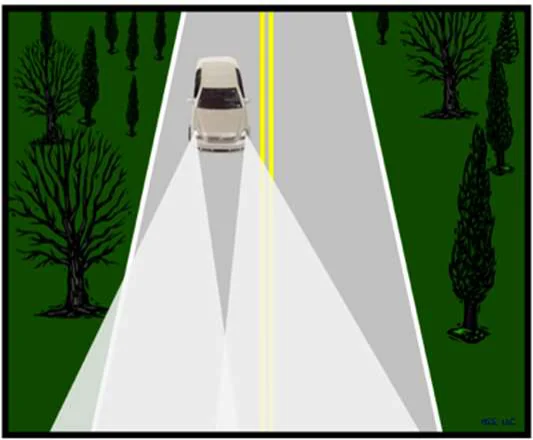
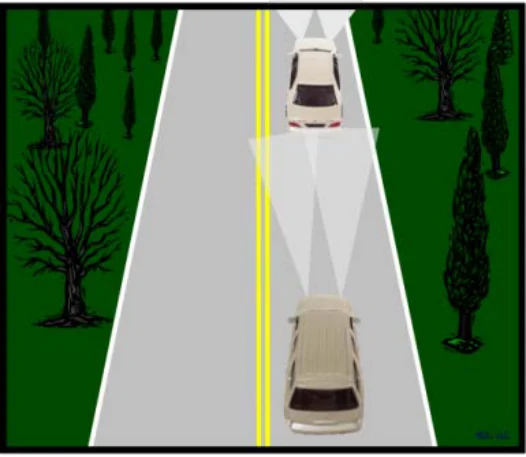
Headlight use at night: Use high beams when no vehicles are coming; dim them for all approaching traffic Use low beams when following another vehicle Use low beams in fog, rain or snow; high beams cause glare (fog lights may help) Handbook p. 25 ↗ Headlight beams when meeting oncoming traffic Headlight beams when following another vehicle Know the rule
If an oncoming driver has high beams on, look toward the right side of the road, at the fog line or road edge, not into their lights.
Handbook p. 25 ↗ More night tips: Search beyond your headlights for dark shapes such as pedestrians or animals Glance left and right occasionally to find the pavement edge and side hazards Don't wear sunglasses or tinted lenses at night or on overcast days Handbook p. 25 ↗ Put it into practice
You meet a single-lane bridge on a country road and an oncoming pickup reaches it first. Let it cross; generally the first driver to the bridge has the right-of-way.
A useful reminder Fog, rain or snow at night: LOW beams. High beams bounce back as glare.
Check your understanding Read the question, decide on an answer, then open it to check the explanation. These are Roadwise study questions based on the source handbook.
On a narrow or single-lane bridge, who generally has the right-of-way? The first driver to reach the bridge The vehicle on the right The vehicle traveling downhill The larger vehicle Answer: The first driver to reach the bridge
Generally, the first driver to reach a narrow or single-lane bridge has the right-of-way.
Handbook p. 25 ↗ When approaching an uncontrolled rural intersection, what should a driver do? Maintain speed since no signs are posted Slow down and be prepared to stop for crossing traffic Accelerate through before other traffic arrives Yield only to vehicles on the left Answer: Slow down and be prepared to stop for crossing traffic
Uncontrolled rural intersections require slowing down and being ready to stop.
Handbook p. 25 ↗ When should a driver use high beams at night? Only on interstate highways Anytime it's dark, regardless of traffic Only when following another vehicle Whenever there are no oncoming vehicles Answer: Whenever there are no oncoming vehicles
Use high beams when there are no oncoming vehicles, and dim them for approaching traffic.
Handbook p. 25 ↗ What should a driver do if an oncoming vehicle is using its high beams? Stop the vehicle immediately Look directly at the oncoming headlights Flash their own high beams back repeatedly Look toward the right side of the road Answer: Look toward the right side of the road
Looking to the right side of the road avoids being distracted or blinded by oncoming high beams.
Handbook p. 25 ↗ How much should a driver increase their following distance for night driving on an unfamiliar road? At least one additional second No additional time is needed At least two additional seconds At least five additional seconds Answer: At least two additional seconds
Add at least two additional seconds of following distance for unfamiliar night roads.
Handbook p. 25 ↗ When following another vehicle at night, drivers should use high beams to see farther ahead. True False Answer: False
Use low beams when following another vehicle at night.
Handbook p. 25 ↗ Previous lesson Backing and road conditions Next lesson Vehicle warning systems About the source Roadwise’s New Hampshire course uses the driver handbook edition supplied with this study pack. This lesson cites source pages 25. The linked PDF is a third-party mirror of the handbook, rather than a government-hosted page.
Open the handbook source PDF · View the source edition
For current application requirements, fees, appointments, and the format that applies to your age or license type, check New Hampshire’s DMV. Roadwise provides study material and does not issue permits or licenses.