Roadwise States New Hampshire Driving lessons Lane changes, highways, and passing New Hampshire driving lesson · Basic Driving
Lane changes, highways, and passing A 3-minute lesson from the New Hampshire course. Read the rules and examples, follow the handbook page references, and check your understanding before you move on.
Read time 3 minutes
Course unit Basic Driving
Checkpoint questions 6
Source pages 23, 24 Changing lanes, merging and passing all mean moving into space other traffic may want. Do it in a set order: check, signal, check again, move. And pass only where signs, markings and conditions allow.
Before changing lanes: Check your mirrors Check blind spots with head checks Find a gap, signal, and look again in the direction of the lane change Adjust speed and steer into the lane Handbook p. 23 ↗ Know the rule
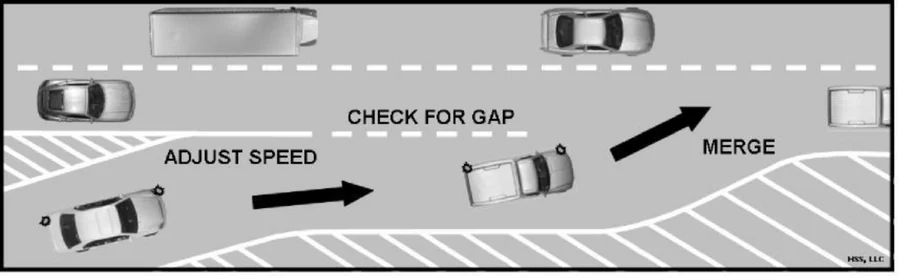
Entering a multi-lane highway: use the acceleration lane to reach the speed of traffic, find a gap and merge.
Handbook p. 23 ↗ Merging: adjust speed, check for a gap, merge Exiting a roadway: Move to the lane closest to the exit early, to avoid a quick lane change Keep your speed while on the main roadway Check the posted speed for the deceleration lane Signal, move into the deceleration lane, and slow to exit speed Handbook p. 23 ↗ Know the rule
Pass only where signs or markings permit and conditions are favorable. On multi-lane roads the left-most lane is for passing slower vehicles.
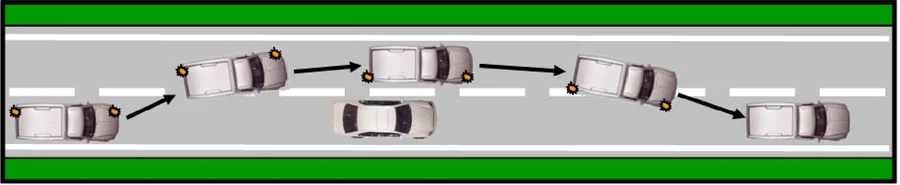
Handbook p. 24 ↗ Do NOT pass: When an oncoming vehicle is approaching When a curve or hill blocks your view At intersections Before a highway-railroad crossing or a bridge On the shoulder, paved or not Handbook p. 24 ↗ Passing steps: Check for oncoming traffic Check mirrors and/or do a head check Signal when it's safe; steer smoothly into the passing lane Keep passing until the whole front of the passed vehicle shows in your rearview mirror Signal, then steer smoothly back into the lane Handbook p. 24 ↗ Passing: move out, pass, return once the vehicle shows in your mirror When being passed: Stay in your lane Keep a constant speed Never speed up to prevent someone from passing Handbook p. 24 ↗ Put it into practice
You're passing a slow truck on a two-lane road. Don't cut back as soon as your rear clears it. Wait until you can see the truck's entire front in your rearview mirror, signal, then move back.
A useful reminder Never pass on the shoulder, whether it's paved or not.
Check your understanding Read the question, decide on an answer, then open it to check the explanation. These are Roadwise study questions based on the source handbook.
What should a driver check before changing lanes, besides the mirrors? The speedometer reading Blind spots, using head checks The vehicle directly ahead only The lane lines behind the car Answer: Blind spots, using head checks
Drivers must check blind spots with head checks in addition to mirrors before changing lanes.
Handbook p. 23 ↗ Where is passing never allowed, regardless of lines or signs? On a straight section of highway On the shoulder On a four-lane divided highway In the left lane of a multi-lane road Answer: On the shoulder
Never pass on the shoulder, whether paved or not.
Handbook p. 24 ↗ When should a driver stop passing and consider it complete? As soon as the driver's door passes the other vehicle's bumper After signaling for 3 seconds When both vehicles are side by side When the whole front vehicle shows in the rearview mirror Answer: When the whole front vehicle shows in the rearview mirror
Continue passing until the entire front of the passed vehicle is visible in the rearview mirror.
Handbook p. 24 ↗ What should a driver being passed do? Flash their high beams repeatedly Maintain a constant speed to allow the pass Speed up slightly to finish faster Move onto the shoulder to give room Answer: Maintain a constant speed to allow the pass
A driver being passed should stay in lane and maintain constant speed.
Handbook p. 24 ↗ When entering a multi-lane highway, what should a driver use to reach the speed of traffic before merging? The emergency lane The acceleration lane The deceleration lane The right shoulder Answer: The acceleration lane
Drivers should use the acceleration lane to reach highway speed before merging.
Handbook p. 23 ↗ Drivers should never pass a vehicle before a highway-railroad crossing or bridge. True False Answer: True
Passing is prohibited before a highway-railroad crossing or bridge.
Handbook p. 24 ↗ Previous lesson Stopping distance and following Next lesson Backing and road conditions About the source Roadwise’s New Hampshire course uses the driver handbook edition supplied with this study pack. This lesson cites source pages 23, 24. The linked PDF is a third-party mirror of the handbook, rather than a government-hosted page.
Open the handbook source PDF · View the source edition
For current application requirements, fees, appointments, and the format that applies to your age or license type, check New Hampshire’s DMV. Roadwise provides study material and does not issue permits or licenses.