roadwise.Open study app

New Hampshire driving lesson · Basic Driving

Signals, headlights, and the horn

A 3-minute lesson from the New Hampshire course. Read the rules and examples, follow the handbook page references, and check your understanding before you move on.

Read time
3 minutes
Course unit
Basic Driving
Checkpoint questions
5
Source pages
22, 23

Other road users can't read your mind. Signals, headlights and the horn tell them where you are and what you'll do next, and it's your job to make sure your vehicle can be seen.

Signal distances

Signal distances
SituationSignal at least
Before a turn100 feet ahead
Highway lane change or exit500 feet ahead
Handbook p. 22 ↗

Know the rule

Signal sooner in rain, snow or fog so others have more room to stop.

Handbook p. 22 ↗

You must signal when:

  • Changing lanes
  • Turning at an intersection
  • Entering or leaving a highway or roadway
  • Turning into a driveway
  • Merging onto another road
  • Pulling away from a curb
  • Pulling over to the side of the road
  • Passing another vehicle
Handbook p. 22 ↗
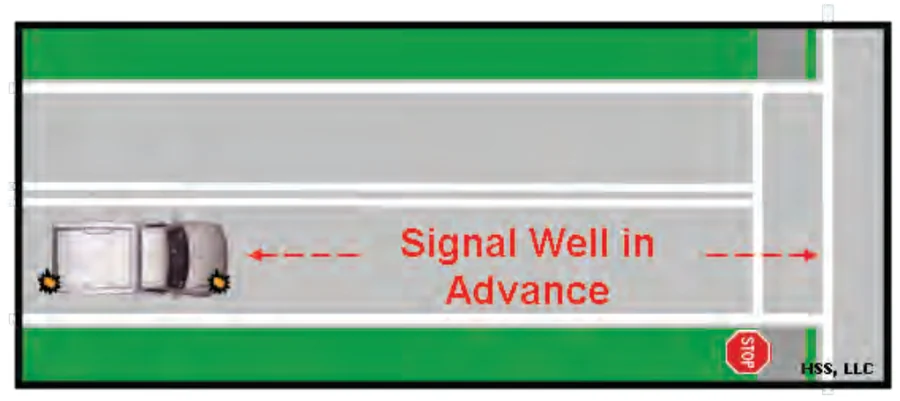
Signal well in advance of turning
Signal well in advance

Know the rule

Headlights (at least 2 lighted front lamps; 1 on a motorcycle) are required from ½ hour after sunset to ½ hour before sunrise, and whenever rain, snow or fog keeps you from clearly seeing people and vehicles 1000 feet ahead.

Handbook p. 22 ↗
1000 feet

Visibility distance that triggers the headlight law in rain, snow or fog

Handbook p. 22 ↗

Know the rule

Use the horn only when needed to communicate; a light tap is usually enough. Don't use it near blind pedestrians or near a horse.

Handbook p. 23 ↗

A light tap of the horn may help when:

  • Pedestrians or bicyclists start moving into your lane
  • A driver you're passing starts to turn into your lane
  • An oncoming driver crosses the center into your lane
  • A driver is unaware of you or may have trouble seeing when backing up
Handbook p. 23 ↗

Put it into practice

Sunset is at 7:10 pm. Your headlights must be on by 7:40, half an hour after sunset. And if fog means you can't clearly see cars 1000 feet ahead, lights go on even at noon.

Check your understanding

Read the question, decide on an answer, then open it to check the explanation. These are Roadwise study questions based on the source handbook.

How far before a turn should a driver signal their intention?
  1. At least 100 feet
  2. At least 25 feet
  3. At least 50 feet
  4. At least 500 feet

Answer: At least 100 feet

Drivers should signal at least 100 feet before a turn.
Handbook p. 22 ↗
On the highway, how far before changing lanes or exiting should a driver signal?
  1. At least 1,000 feet
  2. At least 500 feet
  3. At least 100 feet
  4. At least 200 feet

Answer: At least 500 feet

On the highway, drivers should signal at least 500 feet before changing lanes or exiting.

Handbook p. 22 ↗
Headlights are required when rain, snow, or fog keeps persons and vehicles from being clearly seen at what distance ahead?
  1. 2,000 feet
  2. 300 feet
  3. 500 feet
  4. 1,000 feet

Answer: 1,000 feet

Headlights are required when rain, snow, or fog reduce visibility to less than 1,000 feet.

Handbook p. 22 ↗
New Hampshire law requires headlights to be on from half an hour after sunset until when?
  1. Sunrise exactly
  2. Fifteen minutes before sunrise
  3. One hour before sunrise
  4. Half an hour before sunrise

Answer: Half an hour before sunrise

Headlights are required from 1/2 hour after sunset to 1/2 hour before sunrise.

Handbook p. 22 ↗
Near which of these should a driver avoid using the horn?
  1. A driver backing out who hasn't seen you
  2. A horse on the roadside
  3. An oncoming car drifting over the center line
  4. A pedestrian stepping into your lane

Answer: A horse on the roadside

The horn may frighten a horse and cause a crash; the other situations are ones where a light tap is appropriate.

Handbook p. 23 ↗
Take the lesson checkpoint in the app

More in Basic Driving