roadwise.Open study app

New Hampshire driving lesson · Sharing the Road

Motorcycles and slow-moving vehicles

A 3-minute lesson from the New Hampshire course. Read the rules and examples, follow the handbook page references, and check your understanding before you move on.

Read time
3 minutes
Course unit
Sharing the Road
Checkpoint questions
6
Source pages
44, 45

Motorcycles have the same rights as cars, but at about two feet wide they're easy to lose in traffic or in a blind spot, and their speed is hard to judge. Farm equipment, buggies and horses move much slower than you and need patience.

About 2 feet

Width of most motorcycles, why they hide in blind spots

Handbook p. 44 ↗

Around motorcycles:

  • Never share a lane; motorcycles are entitled to the full lane width
  • Before a left turn, check oncoming traffic for motorcycles and know their speed
  • Allow at least 4 seconds following distance behind a motorcycle
  • Most motorcycle turn signals don't cancel automatically; be sure the rider is really turning
Handbook p. 44 ↗
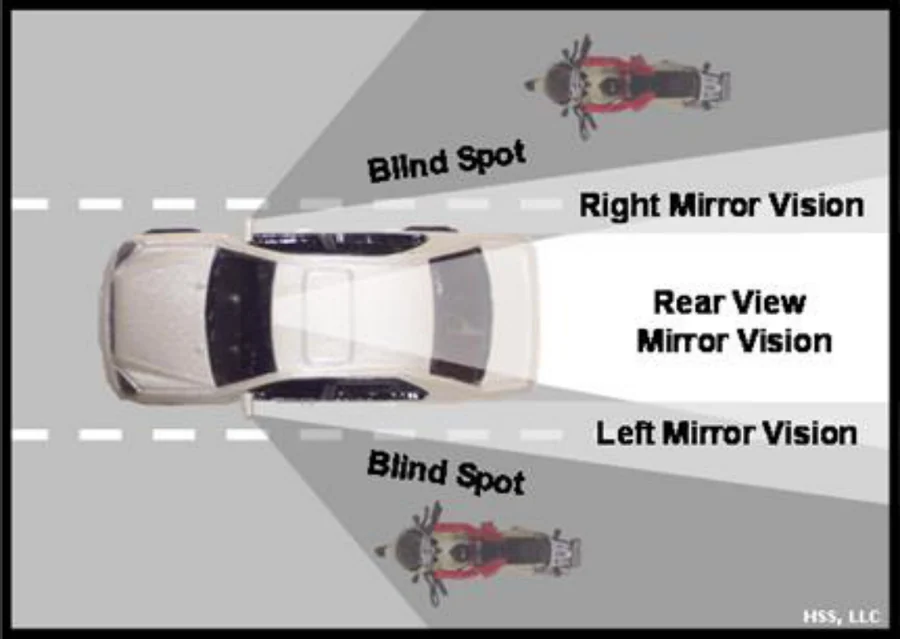
Blind spots and mirror vision zones
A motorcycle can hide in your blind spot

Why a rider may slow or change direction

Why a rider may slow or change direction
ConditionEffect
Bad weather, slippery surfacesRain, wind, dust, fog hurt vision; wet roads glare
Cross windsCan push a bike from its lane: open highway, bridges
Large trucksWind blasts can startle or move a cyclist
Road surfacesUneven, gravel, debris, seams, grooves, manholes
Metal or grated bridgesWobbling sensation
Handbook p. 45 ↗

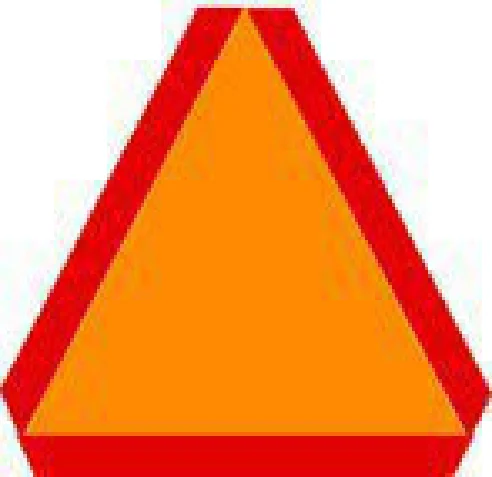
Slow-moving vehicle emblem

A fluorescent or reflective orange and red triangle on the rear of animal-drawn, farm or construction vehicles. It means the vehicle travels less than 25 mph.

Handbook p. 45 ↗
Slow-moving vehicle emblem

Know the rule

Farm machinery: pass with caution and only when safe; the operator cannot hear approaching vehicles.

Handbook p. 45 ↗

Know the rule

Animal-drawn vehicles and horseback riders have the same right to use the road and must follow the same rules.

Handbook p. 45 ↗

Know the rule

Take every precaution not to frighten a horse: slow down, pass with caution, and never use the horn or rev the engine.

Handbook p. 45 ↗
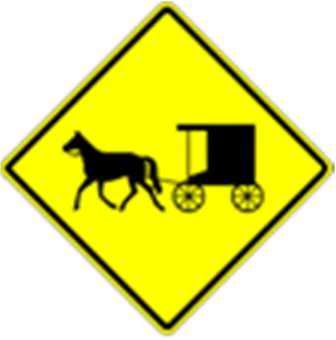
Horse-drawn vehicle
Horse-drawn vehicle warning sign

Put it into practice

A motorcycle's right signal is blinking as it nears the side road where you're waiting. Don't pull out yet; motorcycle signals often don't self-cancel. Wait until the rider is clearly turning.

Check your understanding

Read the question, decide on an answer, then open it to check the explanation. These are Roadwise study questions based on the source handbook.

About how wide are most motorcycles, making them harder to see in traffic?
  1. About four feet wide
  2. About one foot wide
  3. About two feet wide
  4. About six feet wide

Answer: About two feet wide

Most motorcycles are only about two feet wide, making them easy to lose in traffic.
Handbook p. 44 ↗
Why should a driver never attempt to share a lane with a motorcycle?
  1. Sharing a lane is only illegal on highways
  2. Motorcycles are too fast to share a lane safely
  3. Motorcycles are entitled to the full lane width
  4. It's only dangerous at night

Answer: Motorcycles are entitled to the full lane width

Motorcycles have the same right to a full lane as any other vehicle.

Handbook p. 44 ↗
What following distance should a driver maintain behind a motorcycle?
  1. At least four seconds
  2. At least two seconds
  3. At least three seconds
  4. At least one second

Answer: At least four seconds

Drivers should allow at least four seconds following distance behind a motorcycle.

Handbook p. 44 ↗
Why should a driver be cautious before turning in front of a motorcycle with its signal on?
  1. Most motorcycle signals don't cancel automatically
  2. Motorcycles may brake without brake lights
  3. Motorcycle signals are hard to see in daylight
  4. Riders signal only after starting a turn

Answer: Most motorcycle signals don't cancel automatically

Since most motorcycles lack automatic turn-signal cancellation, the rider may not actually be turning.

Handbook p. 44 ↗
A fluorescent orange and red triangle on the back of a vehicle indicates what?
  1. The vehicle is traveling less than 25 mph
  2. The vehicle is carrying hazardous materials
  3. The vehicle is a school bus
  4. The vehicle is a funeral procession vehicle

Answer: The vehicle is traveling less than 25 mph

The slow-moving vehicle emblem means the vehicle travels under 25 mph.

Handbook p. 45 ↗
What should drivers avoid doing when approaching a horse on the road?
  1. Honking the horn or revving the engine
  2. Reducing speed and assessing the situation
  3. Slowing down before passing
  4. Giving the horse extra room

Answer: Honking the horn or revving the engine

Drivers should never honk or rev the engine near a horse, as it may frighten the animal.

Handbook p. 45 ↗
Take the lesson checkpoint in the app

More in Sharing the Road