Roadwise States New Hampshire Driving lessons Large trucks and No-Zones New Hampshire driving lesson · Sharing the Road
Large trucks and No-Zones A 3-minute lesson from the New Hampshire course. Read the rules and examples, follow the handbook page references, and check your understanding before you move on.
Read time 3 minutes
Course unit Sharing the Road
Checkpoint questions 6
Source pages 45, 46, 47 Over 250,000 car-commercial vehicle crashes happen nationwide each year. Trucks and buses are bigger and less maneuverable, have much larger blind spots, need longer to stop and accelerate, and need more room to turn. Many crashes can be avoided.
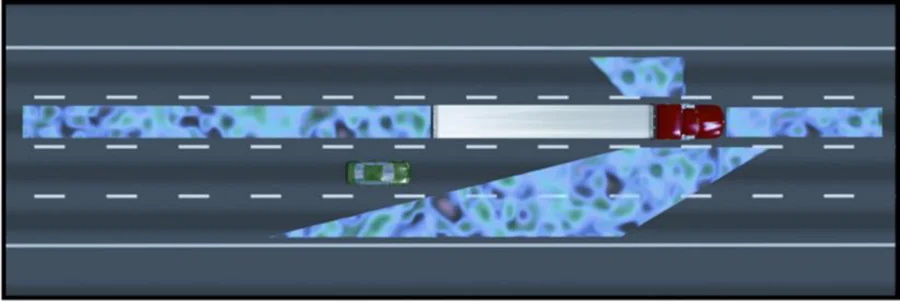
No-Zone The area around a large truck or bus where vehicles disappear from the driver's view into blind spots, on the sides, rear and front.
Handbook p. 45 ↗ Know the rule
Side No-Zones are much larger than a car's blind spots; the right-side one starts behind the cab and can run the truck's length. If you can't see the driver's face in the side mirror, the driver can't see you.
Handbook p. 46 ↗ Side No-Zones Know the rule
Don't drive alongside a large vehicle any longer than required.
Handbook p. 46 ↗ 335 feet Minimum stopping distance for a loaded truck at 55 mph, ideal conditions
Handbook p. 46 ↗ Know the rule
A truck needs more than 1½ times a car's stopping distance. Don't pull out or change lanes in front of one; after passing, see its whole front in your mirror before moving in, and keep your speed.
Handbook p. 46 ↗ Know the rule
Don't follow too closely; stay where the truck driver can see you in the side mirrors.
Handbook p. 46 ↗ Know the rule
Avoid the right lane on steep hills and near weigh stations, where slow trucks travel and re-enter traffic.
Handbook p. 46 ↗ Know the rule
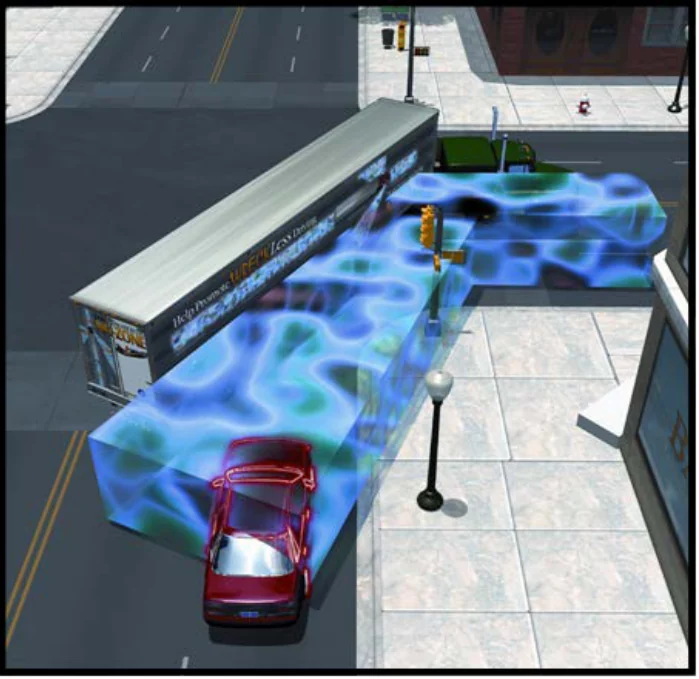
Trucks and buses may swing wide left to turn right. Don't squeeze between them and the curb; wait until they finish turning.
Handbook p. 46 ↗ Don't get squeezed by a wide right turn Also: Meeting an oncoming truck, keep far right to avoid a sideswipe and reduce wind turbulence If unsure of an oncoming truck's speed, don't turn left in its path Always stop behind stop lines; they give large vehicles turning room Don't cut off a truck to reach an exit or beat it into a one-lane construction zone Handbook p. 47 ↗ Put it into practice
A tractor-trailer signals right and swings left to make the turn. Don't slip into the gap on its right; stay back until it has completed the turn.
Check your understanding Read the question, decide on an answer, then open it to check the explanation. These are Roadwise study questions based on the source handbook.
What is the 'No-Zone' around a large truck or bus? A special lane reserved for trucks only An area only used for emergency stops Blind spots on a truck's sides, rear, and front A designated no-passing lane painted on highways Answer: Blind spots on a truck's sides, rear, and front
The No-Zone is the area around a large truck or bus where vehicles disappear into blind spots on its sides, rear and front.
Handbook p. 45 ↗ How can a driver tell if a truck driver can see them in the truck's side mirror? If their headlights are visible in the mirror If they can hear the truck's engine clearly If the driver can see the truck driver's face in the mirror If they are within one car length of the truck Answer: If the driver can see the truck driver's face in the mirror
If the truck driver's face isn't visible in the mirror, they can't see the other vehicle.
Handbook p. 46 ↗ At 55 mph, about how many feet does a loaded truck with good tires and brakes need to come to a complete stop? A minimum of 500 feet A minimum of 200 feet A minimum of 335 feet A minimum of 158 feet Answer: A minimum of 335 feet
A loaded truck at 55 mph needs a minimum of 335 feet to stop, over 1.5 times a car's distance.
Handbook p. 46 ↗ How far can the rear blind spot behind a large truck or bus extend? Up to 200 feet Up to 50 feet Up to 100 feet Up to 500 feet Answer: Up to 200 feet
Rear No-Zones behind large vehicles can extend up to 200 feet.
Handbook p. 46 ↗ Why might a truck or bus swing wide to the left before turning right? To let cars pass on the right To safely clear the corner of a curb or obstruction Because right turns are prohibited for trucks Because their turn signals are unreliable Answer: To safely clear the corner of a curb or obstruction
Trucks and buses may swing wide left to safely clear the corner when turning right.
Handbook p. 46 ↗ What should a driver do when uncertain about the speed of an oncoming truck before making a left turn? Turn quickly before the truck arrives Proceed since trucks must always yield Not turn left in its path Estimate based on the truck's size alone Answer: Not turn left in its path
When in doubt about a truck's speed, drivers should not turn left in its path.
Handbook p. 47 ↗ Previous lesson Motorcycles and slow-moving vehicles Next lesson Emergency vehicles, Move Over, and police stops About the source Roadwise’s New Hampshire course uses the driver handbook edition supplied with this study pack. This lesson cites source pages 45, 46, 47. The linked PDF is a third-party mirror of the handbook, rather than a government-hosted page.
Open the handbook source PDF · View the source edition
For current application requirements, fees, appointments, and the format that applies to your age or license type, check New Hampshire’s DMV. Roadwise provides study material and does not issue permits or licenses.