A 3-minute lesson from the Nevada course. Read the rules and examples, follow the handbook page references, and check your understanding before you move on.
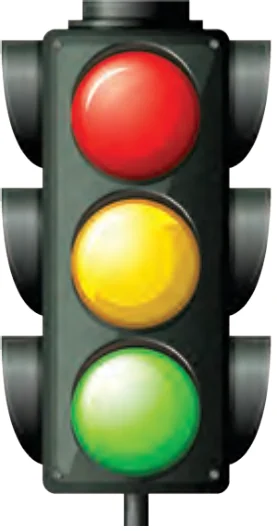
Traffic signals control intersections with steady lights, flashing lights and arrows. Each has a precise meaning, and a signal that's completely dark has a rule of its own.
Traffic signal
Steady lights
Steady lights
Light
What to do
Red
Stop behind the line or crosswalk; stay stopped until green
Yellow
Turning red: stop if not yet in; if already in, clear it
Green
Go straight, right or left unless a sign forbids the turn
Left on red: only from a one-way street onto another one-way street with traffic moving left. Signal, stop completely and yield — unless a sign, arrow signal or police officer says not to.
Traffic lights not working? Come to a full stop, yield to pedestrians and to vehicles already stopped or in the intersection, then proceed with caution.
You're on a one-way street in downtown Reno, stopped at a red light, and want to turn left onto a one-way street whose traffic flows left. No sign prohibits it, so after a complete stop and yielding to pedestrians and traffic, you may turn.
Check your understanding
Read the question, decide on an answer, then open it to check the explanation. These are Roadwise study questions based on the source handbook.
What does a steady red traffic light mean?
Yield then proceed
Proceed with caution
Stop
Stop only if other traffic present
Answer: Stop
A red light means drivers must come to a complete stop.