roadwise.Open study app

Nevada driving lesson · Signs, Signals & Markings

Pavement markings

A 3-minute lesson from the Nevada course. Read the rules and examples, follow the handbook page references, and check your understanding before you move on.

Read time
3 minutes
Course unit
Signs, Signals & Markings
Checkpoint questions
6
Source pages
32

Lines on the road are signs painted on the pavement. White lines separate traffic going your way; yellow lines separate traffic going opposite ways. Solid generally means stay put; broken means you may cross when safe.

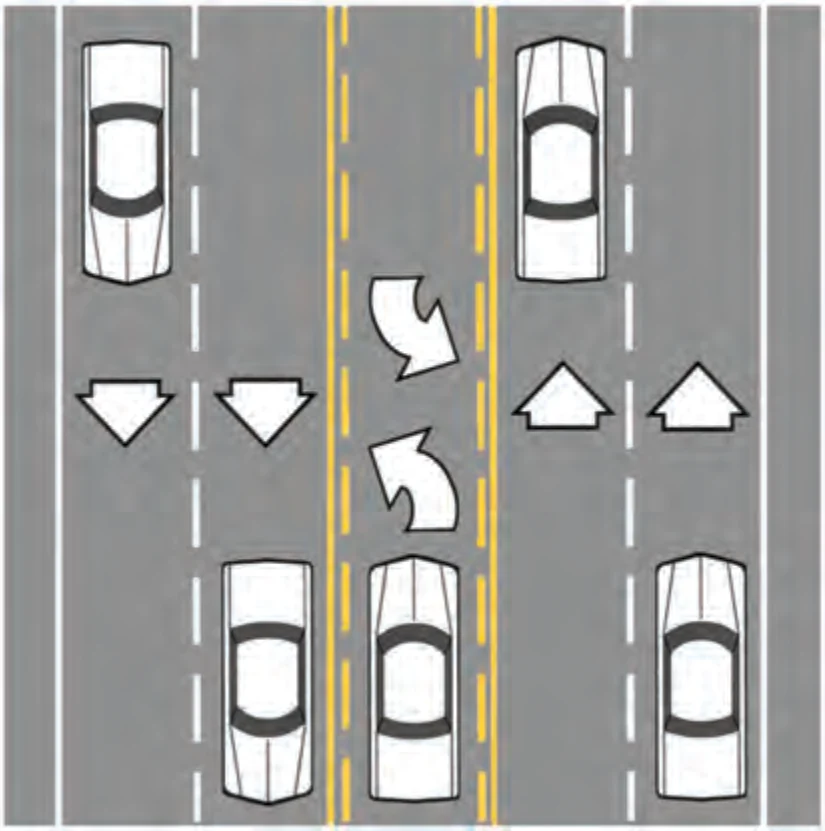
Center turn lane: correct vs incorrect use
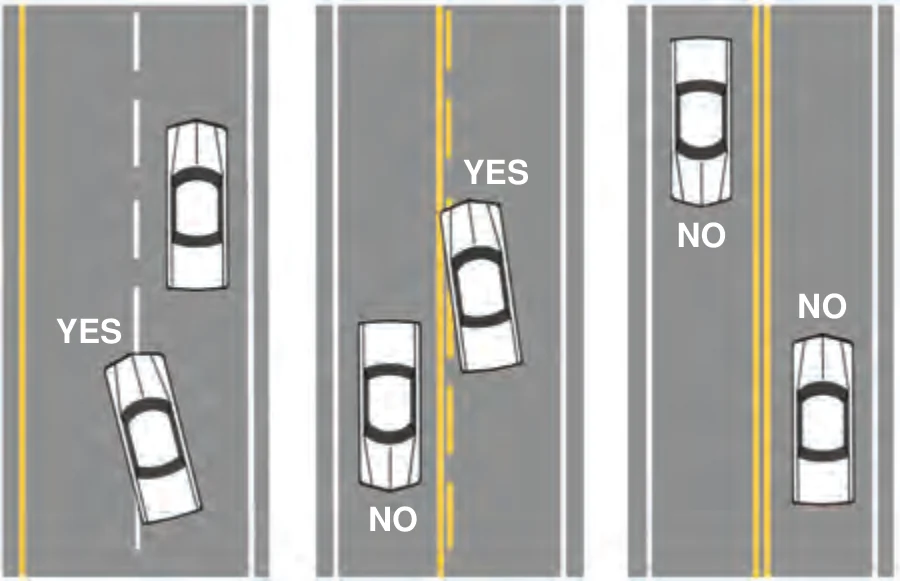
Lane lines: (A) broken white, (B) broken yellow, (C) double yellow

Line meanings

Line meanings
MarkingMeaning
Broken whiteLanes going the same way; passing allowed when safe
Solid whiteSame direction: no lane change or pass; also road edge
YellowSeparates traffic moving in opposite directions
Broken yellowYou may pass when it is safe
Solid yellowDon't cross or pass; also left edge of divided highways
Double yellowNo passing if the line on your side is solid
Dotted whiteLane line through an intersection, or exit-only lane
Handbook p. 32 ↗

Know the rule

Drive within your lane — don't straddle lane lines. Solid white lines also mark the boundary between a travel lane and the shoulder.

Handbook p. 32 ↗

Know the rule

Crosswalks are marked by solid white lines or various patterns; always stop before the crosswalk. Where crosswalks aren't marked (often in small towns or residential areas), you must still yield to pedestrians in the intersection.

Handbook p. 32 ↗

Stop line

A wide white line painted across a lane where you must stop before entering the intersection; from it you should be able to see traffic coming from all directions.

Handbook p. 32 ↗

Center turn lane

A middle lane marked on each side by solid and broken yellow lines. Cross into it only to turn left onto or from the road; it is not a travel or passing lane.

Handbook p. 32 ↗
Lane use arrows and diamonds
Center left-turn lane
200 feet

Most you may travel in a center turn lane before making your left turn

Handbook p. 32 ↗
50 feet

Most you may travel in the center lane after turning left onto the highway, before merging (NRS 484B.223)

Handbook p. 32 ↗

Put it into practice

You need to turn left into a shopping center 400 feet ahead. Stay in your travel lane until you're within 200 feet, then move into the center turn lane, signal and wait for a gap.

Check your understanding

Read the question, decide on an answer, then open it to check the explanation. These are Roadwise study questions based on the source handbook.

What do broken white lines on a road indicate?
  1. No lane changes allowed
  2. The edge of the highway
  3. Same-direction lanes; pass when safe
  4. Opposing traffic lanes

Answer: Same-direction lanes; pass when safe

Broken white lines mark lanes moving the same direction; passing is allowed when safe.
Handbook p. 32 ↗
What do solid yellow lines mean?
  1. You may pass if it's safe
  2. The lane is for turning only
  3. The road is one-way
  4. You may not cross over or pass

Answer: You may not cross over or pass

Solid yellow lines mean you may not cross over or pass.

Handbook p. 32 ↗
Double yellow lines with a solid line on your side mean:
  1. You cannot pass
  2. You can pass if the broken line is on the other side
  3. Passing is always allowed with caution
  4. You may pass if no one is coming

Answer: You cannot pass

Double yellow lines mean you cannot pass if the line on your side is solid.

Handbook p. 32 ↗
How far may you travel in a center left-turn lane before making your left turn?
  1. No more than 50 feet
  2. No more than 200 feet
  3. No more than 500 feet
  4. There is no limit

Answer: No more than 200 feet

Drivers may not travel more than 200 feet in a center turn lane before turning left, per NRS 484B.223(3).

Handbook p. 32 ↗
After making a left turn onto the highway from a center left-turn lane, how far may you travel in it before merging?
  1. No more than 200 feet
  2. No more than 100 feet
  3. No more than 50 feet
  4. There is no limit

Answer: No more than 50 feet

Drivers may not travel more than 50 feet in a center lane after turning before merging with traffic.

Handbook p. 32 ↗
Solid white lines mark the boundary between a travel lane and the highway shoulder.
  1. True
  2. False

Answer: True

A solid white line marks the edge of the highway and the boundary with the shoulder.

Handbook p. 32 ↗
Take the lesson checkpoint in the app

More in Signs, Signals & Markings