roadwise.Open study app

Montana driving lesson · Driving Rules

Turning and turning around

A 3-minute lesson from the Montana course. Read the rules and examples, follow the handbook page references, and check your understanding before you move on.

Read time
3 minutes
Course unit
Driving Rules
Checkpoint questions
6
Source pages
48, 49, 68

Good turns are predictable turns: signal early, turn from the correct lane, and finish in the lane that crosses the fewest other lanes. Turning around has its own strict limits.

Know the rule

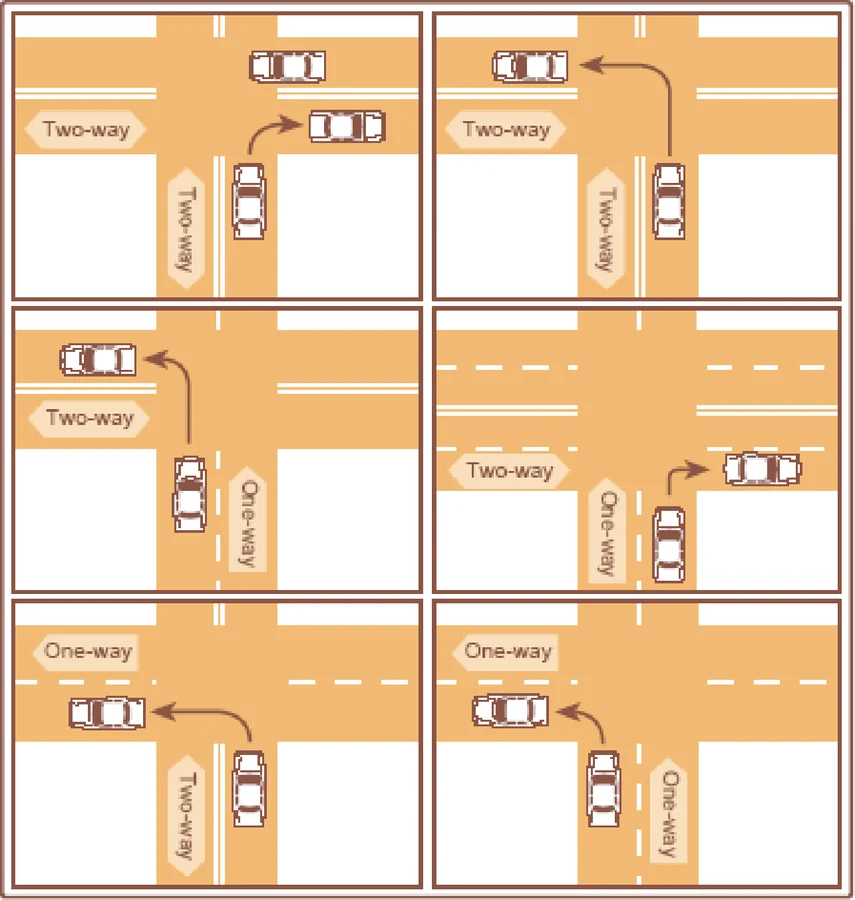
With no signs or markings, turn from the lane closest to the direction you want to go into the lane closest to the one you came from. Go lane to lane directly; change lanes after the turn if needed.

Handbook p. 48 ↗

Know the rule

On right turns, don't swing wide to the left first — the driver behind may think you're turning left and pass on your right — or swing wide as you finish.

Handbook p. 48 ↗

Know the rule

On left turns, don't cut the corner so sharply that you hit someone approaching from the left, but leave room for oncoming vehicles to turn left in front of you.

Handbook p. 48 ↗
Pedestrian crossing at various intersection types
Turning from and into the correct lanes

Left turn, step by step

  • Well ahead, check behind, signal, and move close to the center line
  • Signal 100 feet (1/3 city block) ahead, or 300 feet in rural areas, and start slowing
  • Look, and yield to oncoming traffic
  • While waiting, keep your wheels pointed straight ahead
  • Enter the street just right of center — don't cut corners
  • Move to the center of your lane and make sure the signal canceled
Handbook p. 68 ↗

Know the rule

Keep your wheels straight while waiting to turn left: if you're struck from behind, you won't be pushed into oncoming traffic.

Handbook p. 68 ↗

Right turn, step by step

  • Get into the proper lane well before the turn
  • Signal for 100 feet (1/3 city block), or 300 feet in rural areas, and slow down
  • Turn as close as practical to the right curb or edge
  • Don't make a wide, sweeping turn or cross into the left lane
Handbook p. 68 ↗
500 ft

Unobstructed view needed in both directions to turn around

Handbook p. 49 ↗

Know the rule

Never turn around on a busy street or near a curve or hill — it's illegal and dangerous. You may turn around only with 500 feet (almost two city blocks) of clear view both ways and no vehicles approaching.

Handbook p. 49 ↗

Know the rule

Most city ordinances prohibit U-turns in the middle of a block, and some ban them entirely. Never turn unless you're in the proper lane and it's safe.

Handbook p. 49 ↗

Put it into practice

You want to turn around on a rural highway, but a hill crests about 300 feet ahead. Keep going until you find a spot with 500 feet of clear view in both directions and no traffic coming.

Check your understanding

Read the question, decide on an answer, then open it to check the explanation. These are Roadwise study questions based on the source handbook.

When making a right turn, where should you position your vehicle as you complete the turn?
  1. In the center of the intersection
  2. Swung wide into the left lane first
  3. As close as practical to the right edge
  4. Wherever there is the least traffic

Answer: As close as practical to the right edge

Right turns should be made as close as practical to the right edge of the curb or roadway, without swinging wide.
Handbook p. 68 ↗
Why is swinging wide to the left before making a right turn dangerous?
  1. It can make you hit the curb
  2. It slows traffic in the opposite lane
  3. Pedestrians may think you are stopping
  4. A trailing driver may pass on your right

Answer: A trailing driver may pass on your right

Swinging wide before a right turn can mislead following drivers into thinking you're turning left, prompting them to try to pass on your right.

Handbook p. 48 ↗
When making a left turn, what should you avoid?
  1. Leaving room for oncoming left-turners
  2. Yielding to oncoming traffic
  3. Cutting the corner into oncoming traffic
  4. Waiting for a safe gap

Answer: Cutting the corner into oncoming traffic

When turning left, avoid cutting the corner sharply enough to run into a vehicle approaching from the left.

Handbook p. 48 ↗
You want to turn around on a roadway with no signs or signals restricting it. How much unobstructed view is required in both directions?
  1. 300 feet
  2. 100 feet
  3. 1,000 feet
  4. 500 feet

Answer: 500 feet

A U-turn requires 500 feet of unobstructed view in both directions and no approaching vehicles.

Handbook p. 49 ↗
Where does the handbook say it is illegal and dangerous to try turning around?
  1. On a busy street, curve, or hill
  2. On any residential street
  3. On roads posted above 45 mph
  4. Only within school zones

Answer: On a busy street, curve, or hill

Turning around on a busy street, or near a curve or hill, is described as both illegal and dangerous.

Handbook p. 49 ↗
You misjudge a left turn and briefly need to wait mid-intersection for oncoming traffic. Where should your front wheels point while waiting?
  1. Toward the direction you intend to turn
  2. Toward the curb on your right
  3. Slightly toward the center line
  4. Straight ahead

Answer: Straight ahead

Keep your wheels pointed straight while waiting to turn left; if struck from behind, you won't be pushed into oncoming traffic.

Handbook p. 68 ↗
Take the lesson checkpoint in the app

More in Driving Rules