roadwise.Open study app

Montana driving lesson · Driving Rules

Sharing the road with bicycles

A 3-minute lesson from the Montana course. Read the rules and examples, follow the handbook page references, and check your understanding before you move on.

Read time
3 minutes
Course unit
Driving Rules
Checkpoint questions
6
Source pages
52, 53, 54

Under Montana law, bicycles are vehicles with the same rights and the traffic laws that reasonably apply. They're slower and much more vulnerable, so pass a cyclist the way you'd pass a farm tractor.

Know the rule

Bicycles are considered vehicles and are governed by the same traffic laws that reasonably apply to them.

Handbook p. 52 ↗

Montana law says motorists must

  • Grant bicyclists the same rights as operators of any other vehicle
  • Not intentionally interfere with a person lawfully riding a bicycle
  • Pass a cyclist only when it won't endanger the rider or people in nearby vehicles
  • Yield the right-of-way to a cyclist in a designated bicycle lane
Handbook p. 53 ↗

Know the rule

On a high-speed two-lane road, if there's no oncoming traffic, carefully cross the center line to give the cyclist about five feet. If there is oncoming traffic, slow to the cyclist's speed and wait.

Handbook p. 53 ↗
5 feet

Recommended space between your vehicle and a cyclist you're passing

Handbook p. 53 ↗

Know the rule

Don't assume a cyclist is on the shoulder or riding alone — groups ride single file and take more time to pass safely.

Handbook p. 53 ↗
18–24 inches

How far into the lane some cyclists ride to discourage a dangerous in-lane pass

Handbook p. 53 ↗

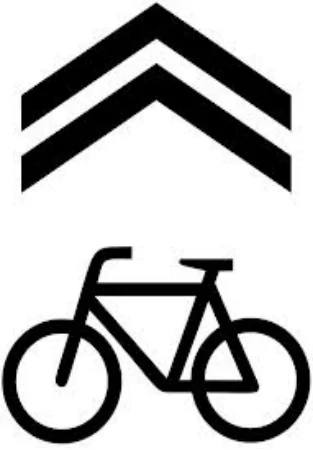
Sharrow (shared lane marking)

Two arrows over a bicycle, showing cyclists where to ride in a lane shared with cars. Watch for bikes and give room; it's not the symbol for a bike lane.

Handbook p. 53 ↗
Share the road with bicycles icon
Shared lane marking (sharrow)

Dooring

When someone in a parked car opens the door into an approaching cyclist without checking. Cyclists often ride farther from parked cars — even outside a bike lane — to avoid it.

Handbook p. 53 ↗

Know the rule

Most bicycles have no mirrors, so a cyclist may not know you're behind. Assume the rider doesn't hear or see you.

Handbook p. 53 ↗

Also remember

  • Before a right turn, let a cyclist in your lane stop or pass you first
  • Bicycles aren't required to have lights in daytime, unlike motorcycles
  • Many cyclists are under 15 and may not know the rules of the road
  • Never honk, yell at or swerve toward a cyclist — it can cause a serious crash
  • Watch for children on bikes darting out between parked cars or hedges
Handbook p. 54 ↗

Put it into practice

On a two-lane highway you come up behind a cyclist while a truck approaches from the other direction. Slow to the cyclist's speed and wait. Once the oncoming lane is clear, cross the center line and give about five feet.

Check your understanding

Read the question, decide on an answer, then open it to check the explanation. These are Roadwise study questions based on the source handbook.

Under Montana law, how are bicycles classified on the roadway?
  1. As pedestrians with wheels
  2. As slow-moving vehicles needing an emblem
  3. As vehicles, under the same traffic laws
  4. As motorized vehicles requiring registration

Answer: As vehicles, under the same traffic laws

Montana law treats bicycles as vehicles subject to the traffic laws that reasonably apply to their operation.
Handbook p. 52 ↗
What is the recommended passing distance when overtaking a cyclist on a two-lane road with no oncoming traffic?
  1. Two feet
  2. Ten feet
  3. One foot
  4. 5 feet

Answer: 5 feet

The handbook recommends a five-foot distance between your vehicle and a cyclist when passing.

Handbook p. 53 ↗
About how far into the lane might a bicyclist ride to discourage an unsafe in-lane pass?
  1. 18 to 24 inches
  2. 6 to 12 inches
  3. 3 to 4 feet
  4. To the center of the lane

Answer: 18 to 24 inches

Bicyclists may ride 18-24 inches into the lane to discourage motorists from attempting a dangerous in-lane pass.

Handbook p. 53 ↗
What is 'dooring,' a hazard bicyclists try to avoid near parked cars?
  1. A bicycle wheel getting stuck in a storm drain
  2. A cyclist being struck from behind
  3. A cyclist entering a one-way street
  4. A parked car's door opening on a cyclist

Answer: A parked car's door opening on a cyclist

'Dooring' happens when someone in a parked vehicle opens their door without checking for an approaching cyclist.

Handbook p. 53 ↗
You need to make a right turn but a bicyclist is riding in your lane ahead of you. What should you do?
  1. Turn as usual; bicycles must yield to turning cars
  2. Confirm the bicyclist has stopped or passed
  3. Honk to signal your intent to turn
  4. Pass the bicyclist quickly before turning

Answer: Confirm the bicyclist has stopped or passed

Before turning right across a bicyclist's path, confirm they've stopped to let you turn or have passed you safely.

Handbook p. 54 ↗
Motorists may not intentionally interfere with a person lawfully riding a bicycle.
  1. True
  2. False

Answer: True

Montana law prohibits motorists from intentionally interfering with the lawful operation of a bicycle.

Handbook p. 53 ↗
Take the lesson checkpoint in the app

More in Driving Rules