Montana driving lesson · Speed, Space & Road Conditions
Space to the side, to merge and to cross
A 3-minute lesson from the Montana course. Read the rules and examples, follow the handbook page references, and check your understanding before you move on.
You need room on both sides to turn or change lanes, and a gap big enough to merge or cross without stopping. Never count on another driver to make space for you.
Keep space to the side
Don't drive right beside others on multi-lane roads — move ahead or drop back
On a two-lane road, don't crowd the center line; the center of your lane is safest
Make room for entering vehicles: if no one is beside you, move over a lane
Leave extra space for parked vehicles — doors open and cars pull out
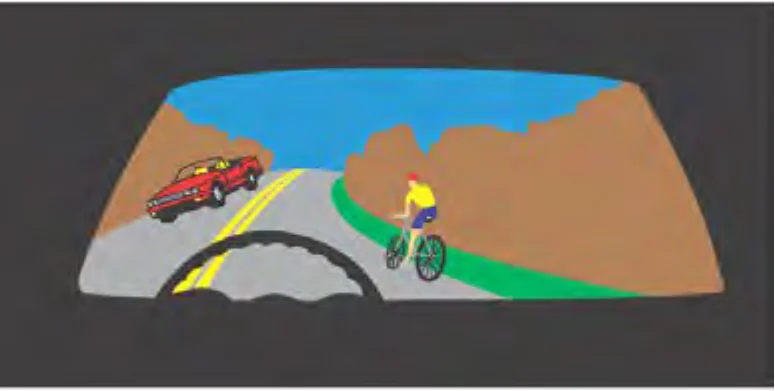
Steer a middle course between two hazards, such as oncoming and parked cars. If one is more dangerous, like a tractor-trailer, leave a little more room on that side.
To cross traffic, you need a gap big enough to get all the way across without stopping. Stop halfway only in a median large enough to hold your whole car.
Don't turn in front of someone just because their turn signal is on; wait until they actually start to turn. Motorcycle signals often don't cancel by themselves.
You're driving between a row of parked cars and an oncoming tractor-trailer. Split the difference, but give the bigger danger more room: ease a little toward the parked cars as the truck passes.
Check your understanding
Read the question, decide on an answer, then open it to check the explanation. These are Roadwise study questions based on the source handbook.
About how big a gap do you need to safely merge into traffic?
About 4 seconds
About one second
About ten seconds
About two seconds
Answer: About 4 seconds
You need roughly a four-second gap to safely merge, change lanes, or enter a roadway.
You're waiting to pull onto a road, and an approaching motorcycle has its turn signal on. When is it safe to pull out in front of it?
Right away; the signal means it will turn
Once it has also slowed down
Not until it actually starts to turn
After you flash your headlights at it
Answer: Not until it actually starts to turn
Don't turn just because an approaching vehicle has a signal on; motorcycle signals often don't cancel by themselves, so wait until it actually starts to turn.
You need to merge across three lanes of traffic to reach an exit. What is the safest approach?
Wait until all three lanes are clear, then cross at once
Cross one lane at a time, checking each gap separately
Cross diagonally through all lanes in one motion
Cross two lanes, then check the third
Answer: Cross one lane at a time, checking each gap separately
It's safest to cross multiple lanes one at a time rather than waiting for all lanes to clear simultaneously, which can be hard to judge and cause delay.