Montana driving lesson · Speed, Space & Road Conditions
Seeing far enough to stop
A 3-minute lesson from the Montana course. Read the rules and examples, follow the handbook page references, and check your understanding before you move on.
If something is in your path, you must see it in time to stop — and stopping takes longer than most people think. Nine out of ten crashes come from errors in human judgment, so match your speed to how far you can see.
Distance to react and stop (dry road, good tires and brakes)
Distance to react and stop (dry road, good tires and brakes)
In very heavy rain, snow or thick fog you may see only about 200 feet ahead; then you can't safely drive faster than 30 mph. Keep headlights on, and in a heavy downpour pull off safely and wait.
Give parked vehicles as much room as you can — people may step out. Most crashes between parallel-parked cars and moving cars are caused by the driver pulling away from the curb.
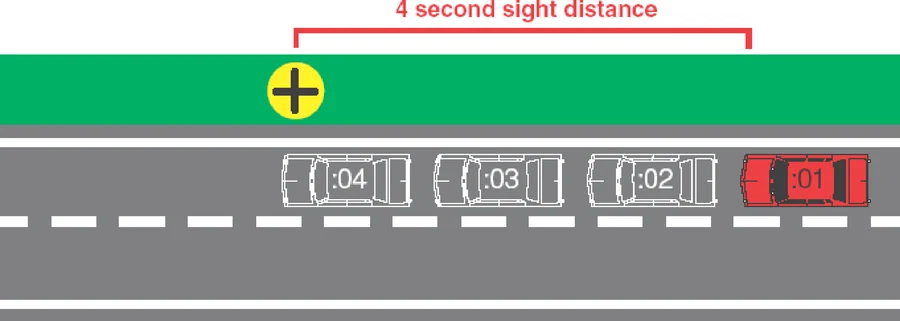
Pick a fixed object as far ahead as you can clearly see and count four seconds. If you reach it first, you're driving too fast for your sight distance. It works at night too.
Speed limits are set for ideal conditions. If the road is wet or icy, you can't see well, or traffic is heavy, slow down — you can be ticketed for driving too fast for conditions even below the limit.
Snow is falling and you can see only about 200 feet ahead. Even though the posted limit is 70, drive no faster than about 30 mph so you can stop for anything that appears.
Check your understanding
Read the question, decide on an answer, then open it to check the explanation. These are Roadwise study questions based on the source handbook.
Roughly how many feet does it take to stop at 50 mph on dry pavement with good tires and brakes?
About 400 feet
About 200 feet
About 100 feet
About 600 feet
Answer: About 400 feet
At 50 mph, it can take about 400 feet to react and bring your vehicle to a stop.