roadwise.Open study app

Montana driving lesson · Speed, Space & Road Conditions

Hydroplaning, skids and wildlife

A 3-minute lesson from the Montana course. Read the rules and examples, follow the handbook page references, and check your understanding before you move on.

Read time
3 minutes
Course unit
Speed, Space & Road Conditions
Checkpoint questions
6
Source pages
70, 71

When tires can't grip — on water, snow or ice, or at too high a speed — you can hydroplane or skid. Knowing the recovery steps lets you react calmly. Montana roads also bring large animals into your path.

Hydroplaning

When your tires ride up on a film of water instead of gripping the road.

Handbook p. 70 ↗

Traction on wet roads

Traction on wet roads
ConditionWhat happens
Wet roadMost tires grip well up to about 35 mph
Heavy rainTires can lose all traction at about 50 mph
Bald or badly worn tiresLose traction at much lower speeds
Handbook p. 70 ↗

Know the rule

The best way to keep from hydroplaning is to slow down in the rain or whenever the road is wet.

Handbook p. 70 ↗

If your tires lose traction on water

  • Ease your foot off the gas pedal
  • Keep the wheel straight; turn only in an emergency, and slowly
  • Don't try to stop or turn until the tires grip the road again
Handbook p. 70 ↗

Know the rule

The best skid control is prevention. Most skids come from driving too fast for conditions; know where skids happen, such as on curves and bridges.

Handbook p. 70 ↗

If your vehicle begins to slide

  • Stay off the brake until the vehicle slows
  • Take your foot off the accelerator and look where you want to go
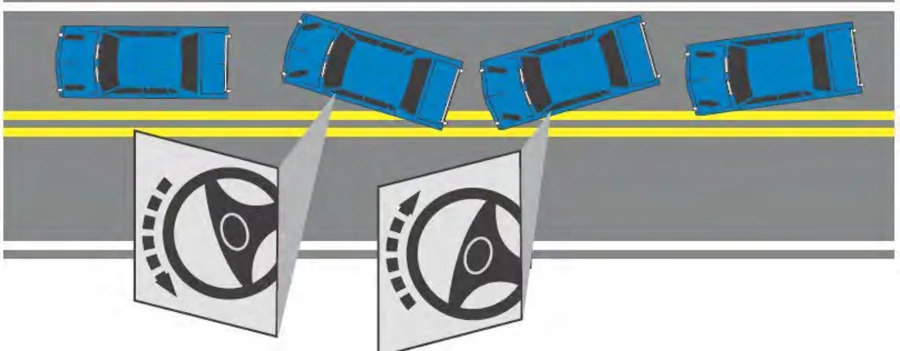
  • Steer quickly, hand over hand, in the direction you want to go
  • As the vehicle straightens, turn the wheel back the other way
  • Keep correcting left and right until you're back in control
Handbook p. 70 ↗
Skid correction steering diagram
Skid recovery: steer where you want to go
200 deaths

Yearly deaths (plus 26,000 injuries) from hitting or swerving to avoid animals (CDC)

Handbook p. 71 ↗

Know the rule

Watch for animals, especially at sunrise and sunset. If you see one, slow down and be prepared to stop.

Handbook p. 71 ↗

Know the rule

If there isn't time to stop or avoid an animal, don't swerve sharply. You're less likely to be seriously hurt hitting it than swerving into oncoming traffic or rolling into a ditch.

Handbook p. 71 ↗

Know the rule

Deer, elk and similar wildlife travel in herds — if you see one, look for more.

Handbook p. 71 ↗

Put it into practice

At dusk a deer bolts onto the highway too close to stop. Brake and hold your lane instead of jerking the wheel — swerving risks a head-on crash or a rollover. Then watch for more deer following it.

Check your understanding

Read the question, decide on an answer, then open it to check the explanation. These are Roadwise study questions based on the source handbook.

In heavy rain, at about what speed can tires lose all traction with the road (hydroplane)?
  1. About 20 mph
  2. About 65 mph
  3. About 50 mph
  4. About 35 mph

Answer: About 50 mph

In heavy rain, tires can lose all traction and hydroplane at around 50 mph; worn tires lose traction even sooner.
Handbook p. 70 ↗
If your vehicle begins to slide in a skid, what is the first thing you should do?
  1. Brake hard immediately
  2. Accelerate to regain traction
  3. Turn the wheel sharply away from the skid
  4. Stay off the brake and let it slow

Answer: Stay off the brake and let it slow

Braking during a skid won't work well and can worsen it; stay off the brake, ease off the gas, and steer where you want to go.

Handbook p. 70 ↗
If your vehicle begins to skid, what should you do with the steering wheel?
  1. Keep the wheel perfectly straight no matter what
  2. Steer where you want the vehicle to go
  3. Turn it as far as possible in one direction
  4. Let go of the wheel completely

Answer: Steer where you want the vehicle to go

Use quick hand-over-hand steering in the direction you want to go, then correct back as the vehicle straightens.

Handbook p. 70 ↗
On a wet road, most tires keep good traction up to about what speed?
  1. 50 mph
  2. 25 mph
  3. 35 mph
  4. 45 mph

Answer: 35 mph

Most tires grip a wet road well up to about 35 mph; in heavy rain they can lose all traction at about 50 mph.

Handbook p. 70 ↗
If a deer suddenly appears too close to stop, swerving sharply is safer than hitting it.
  1. True
  2. False

Answer: False

Don't swerve sharply: you're less likely to be seriously hurt hitting the animal than swerving into oncoming traffic or rolling into a ditch.

Handbook p. 71 ↗
A deer crosses the highway just ahead of you at dusk. What should you do next?
  1. Look for more animals nearby
  2. Speed up to clear the area
  3. Assume it was traveling alone
  4. Switch to your high beams

Answer: Look for more animals nearby

Deer, elk and similar wildlife travel in herds, so if you see one, look for more.

Handbook p. 71 ↗
Take the lesson checkpoint in the app

More in Speed, Space & Road Conditions