roadwise.Open study app

Mississippi driving lesson · Traffic Signs

Work zones & slow-moving vehicles

A 3-minute lesson from the Mississippi course. Read the rules and examples, follow the handbook page references, and check your understanding before you move on.

Read time
3 minutes
Course unit
Traffic Signs
Checkpoint questions
6
Source pages
33, 34

Work zones put people and equipment right beside traffic. Orange signs mean construction or maintenance: slow down, don't tailgate and be ready to stop. On rural roads, watch for vehicles that can't keep up with traffic.

Know the rule

Give construction workers a 'brake': reduce your speed in work zones, be prepared to stop suddenly, and don't tailgate.

Handbook p. 33 ↗

Know the rule

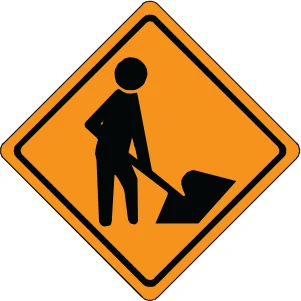
Work zone signs are generally diamond or rectangular, orange with black letters or symbols. They warn of workers ahead, reduced speed, detours, slow-moving construction equipment, and poor or suddenly changing surfaces.

Handbook p. 33 ↗
Workers ahead
Workers ahead
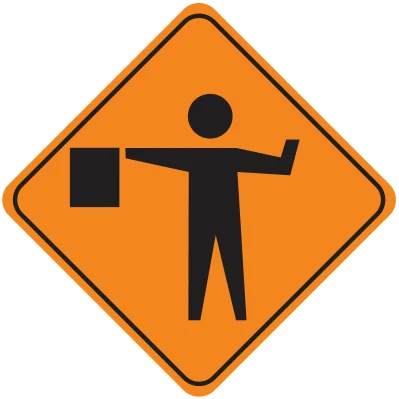
Flagger ahead
Flagger ahead

Know the rule

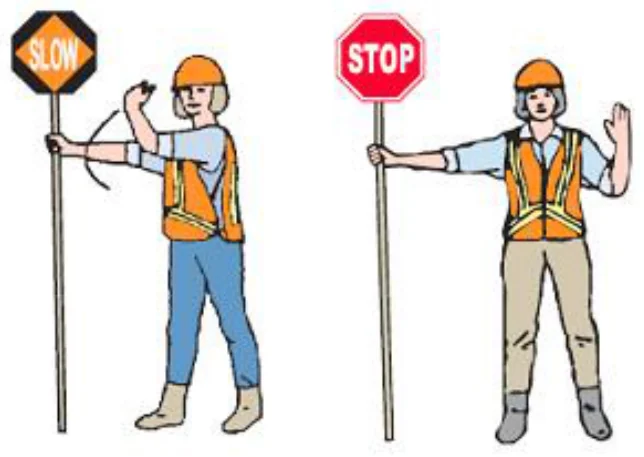
In work zones, a person with a sign or flag may tell you which direction to travel, or to slow down or stop. You must follow their instructions.

Handbook p. 33 ↗
Flagger stop and slow paddles
Flaggers use SLOW and STOP paddles

Know the rule

Barriers such as drums, cones and tubes (panels) keep traffic out of hazardous work zones and closed roads and, with signs and markings, guide you through.

Handbook p. 33 ↗

Know the rule

Temporary traffic signals may be used in work zones, and a warning sign may show a traffic-signal symbol. Stop at the white line, if present.

Handbook p. 33 ↗
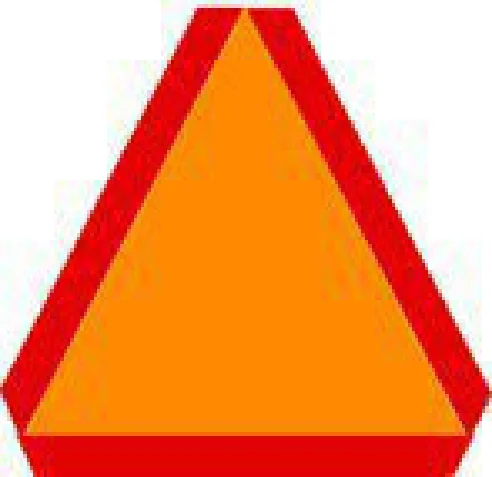
Slow-moving vehicle emblem

Know the rule

A fluorescent or reflective orange-and-red triangle on the rear of an animal-drawn vehicle, farm equipment or construction equipment marks a SLOW-MOVING VEHICLE. Watch for them day and night.

Handbook p. 34 ↗
25 mph

Slow-moving vehicles travel at this speed or less

Handbook p. 34 ↗

Know the rule

Watch for tractors, combines and other farm equipment crossing the road or traveling on state highways in rural areas. Pass with caution: the operator may not hear approaching vehicles.

Handbook p. 34 ↗

Know the rule

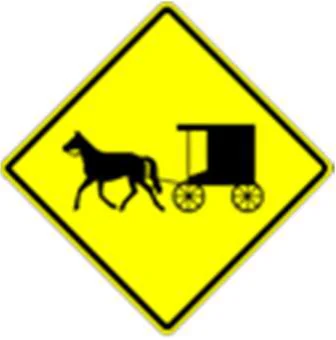
Animal-drawn vehicles and horseback riders have the same right to use the road and must follow the same rules. Pass with caution, don't honk or rev your engine (it may scare the horse), and expect left turns into fields and driveways.

Handbook p. 34 ↗
Horse-drawn vehicle
Horse-drawn vehicle warning sign

Put it into practice

Topping a rural hill, you come up on a buggy with an orange triangle on the back. Slow down well behind it, don't honk, and pass only where it's safe and legal, watching for it to turn left into a field.

Check your understanding

Read the question, decide on an answer, then open it to check the explanation. These are Roadwise study questions based on the source handbook.

In a work zone, a flagger signals you to slow down using a hand-held sign. What should you do?
  1. Proceed at the normal posted speed
  2. Ignore the flagger and follow posted signs only
  3. Stop only if a police officer is also present
  4. Follow the flagger's instructions

Answer: Follow the flagger's instructions

You must follow the instructions of a person directing traffic with a sign or flag in a work zone.
Handbook p. 33 ↗
What does the orange-and-red triangle emblem on the rear of a vehicle identify?
  1. A vehicle carrying hazardous materials
  2. A slow-moving vehicle
  3. An oversized load
  4. A vehicle driven by a student

Answer: A slow-moving vehicle

The fluorescent or reflective orange and red triangle identifies slow-moving vehicles such as farm or construction equipment.

Handbook p. 34 ↗
Why should you avoid honking or revving your engine near a horse pulling a wagon on a rural road?
  1. It is the required way to warn them you are passing
  2. It may scare the horse and cause a crash
  3. It is illegal to use a horn near any animal
  4. It is only a courtesy; there is no safety risk

Answer: It may scare the horse and cause a crash

Honking or revving near an animal-drawn vehicle may startle the animal and cause a crash.

Handbook p. 34 ↗
What are barrels, cones, and tubes used for in a work zone?
  1. To replace the need for warning signs
  2. To mark where speed limits increase
  3. To keep traffic out of hazardous areas and guide drivers through
  4. To mark lanes open only to construction vehicles

Answer: To keep traffic out of hazardous areas and guide drivers through

Barriers such as drums, cones, and tubes are used to keep traffic out of hazardous work zones and guide drivers through safely.

Handbook p. 33 ↗
How should you drive through a work zone?
  1. Keep your speed so you clear the zone quickly
  2. Reduce speed and be prepared to stop suddenly
  3. Follow closely so traffic keeps moving
  4. Use a closed lane if no workers are visible

Answer: Reduce speed and be prepared to stop suddenly

Reduce your speed in work zones, be prepared to stop suddenly, and do not tailgate.

Handbook p. 33 ↗
Farm machinery and other slow-moving vehicles are rare on state highways, so drivers rarely need to watch for them.
  1. True
  2. False

Answer: False

The handbook warns drivers to be alert for slow-moving vehicles, especially in rural areas, because they are common there.

Handbook p. 34 ↗
Take the lesson checkpoint in the app

More in Traffic Signs