roadwise.Open study app

Mississippi driving lesson · Railroad Crossings & Traffic Signals

Railroad crossings: signs & stopping rules

A 4-minute lesson from the Mississippi course. Read the rules and examples, follow the handbook page references, and check your understanding before you move on.

Read time
4 minutes
Course unit
Railroad Crossings & Traffic Signals
Checkpoint questions
6
Source pages
35, 36

A train can't stop or swerve for you, so crossings are marked in layers: an advance warning sign and pavement markings, then crossbucks, lights and gates at the tracks. Know what each one means and exactly where to stop.

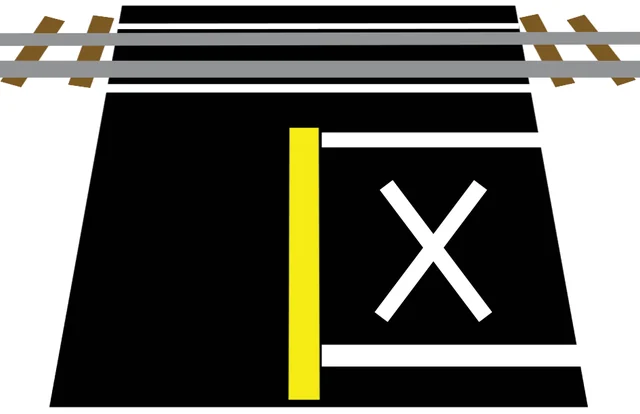
Railroad crossing pavement marking
Pavement markings: a large X and two R's

Know the rule

Before a crossing, the pavement is marked with a large X and two R's. A solid yellow line prevents passing on the approach, and a white line is painted on each side of the track.

Handbook p. 35 ↗
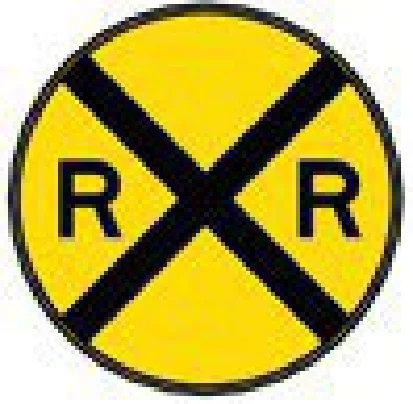
Railroad crossing ahead
Round advance warning sign

Know the rule

The round yellow sign with a black crossbuck and two R's means a railroad crossing is ahead. Look, listen and slow down, because you may have to stop.

Handbook p. 35 ↗
500 to 900 feet

Where the round warning sign is normally posted before the tracks in rural areas

Handbook p. 35 ↗
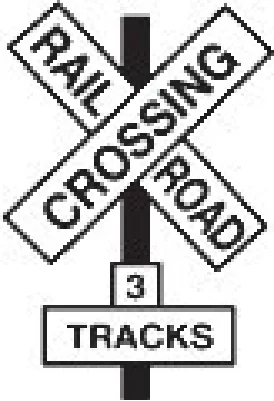
Railroad crossbuck (multiple tracks)
Crossbuck with the number of tracks below

Know the rule

A white crossbuck is posted at most crossings. If there's more than one track, a sign below the crossbuck shows the number of tracks.

Handbook p. 35 ↗

Know the rule

ALWAYS STOP when crossing lights begin to flash: a train is coming. At gates, stop when the lights flash, before the gates lower across your side, and stay stopped until the gates are raised and the lights stop flashing.

Handbook p. 35 ↗

These must stop at ALL railroad crossings, regardless of signs or lights:

  • A school bus carrying even one child
  • A vehicle for hire carrying passengers
  • A vehicle carrying explosives or flammable liquids
Handbook p. 35 ↗
50 to 10 feet

From the outer rail: where you stop at a railroad crossing

Handbook p. 36 ↗

ALL drivers must stop within 50 to 10 feet of the outer rail for:

  • A lowered crossing gate
  • A flashing electric signal
  • A posted STOP sign
  • A flag person giving you a signal
  • A rapidly approaching train
Handbook p. 36 ↗

Know the rule

You MUST stop even if you don't see a train, and stay stopped until all tracks are clear, any gates are raised and the lights no longer flash. Driving around lowered gates is against the law.

Handbook p. 36 ↗

Common sense at the tracks:

  • Watch for vehicles that must stop whether or not a train is coming
  • Don't shift gears as you drive across the tracks
  • Check carefully for a second train following close behind the first
  • Never try to 'beat' a train
  • If a traffic officer directs you across, follow the order immediately
Handbook p. 36 ↗

Put it into practice

The crossing lights start flashing as you approach, but the gate is still up and you see no train. Stop within 50 to 10 feet of the outer rail anyway, and wait until the lights stop flashing and all tracks are clear.

Check your understanding

Read the question, decide on an answer, then open it to check the explanation. These are Roadwise study questions based on the source handbook.

In rural areas, how far in front of the tracks is the round yellow railroad crossing warning sign normally posted?
  1. 1,000 to 1,500 feet
  2. 50 to 100 feet
  3. 100 to 200 feet
  4. 500 to 900 feet

Answer: 500 to 900 feet

The round yellow crossbuck warning sign is normally posted 500 to 900 feet before the tracks in rural areas.
Handbook p. 35 ↗
A vehicle required to stop at a railroad crossing must stop within what distance of the outer rail?
  1. Fifty to ten feet
  2. Twenty-five to fifteen feet
  3. One hundred to fifty feet
  4. Fifteen to five feet

Answer: Fifty to ten feet

Vehicles that must stop at a crossing are required to stop within fifty to ten feet of the outer rail.

Handbook p. 35 ↗
A school bus with one child aboard approaches a railroad crossing with no flashing lights and no visible train. What must the driver do?
  1. Stop only if the bus has more than five children aboard
  2. Slow down but not fully stop
  3. Stop anyway
  4. Proceed without stopping since no train is visible

Answer: Stop anyway

A school bus carrying even one child must stop at ALL railroad crossings regardless of signals.

Handbook p. 35 ↗
What does the white cross-buck sign posted at most railroad crossings indicate if there is more than one track?
  1. The number of tracks, on a sign below the cross buck
  2. The speed limit for trains at that crossing
  3. The distance to the next crossing
  4. The direction trains usually travel

Answer: The number of tracks, on a sign below the cross buck

If there's more than one track, the number of tracks is shown on a sign posted below the white cross buck.

Handbook p. 35 ↗
What should you do if gates are lowering at a railroad crossing as flashing lights begin?
  1. Wait beside the tracks until a train passes, then proceed
  2. Reverse away from the crossing
  3. Stop before the gates lower across your lane and remain stopped
  4. Drive around the gate quickly before it fully lowers

Answer: Stop before the gates lower across your lane and remain stopped

You must stop when the lights begin flashing, before the gates lower, and remain stopped until they raise.

Handbook p. 35 ↗
Once you're stopped at a flashing railroad crossing signal, you may proceed as soon as you no longer see a train.
  1. True
  2. False

Answer: False

You must remain stopped until the lights stop flashing entirely, not just until a train is no longer visible.

Handbook p. 35 ↗
Take the lesson checkpoint in the app

More in Railroad Crossings & Traffic Signals