roadwise.Open study app

Mississippi driving lesson · Railroad Crossings & Traffic Signals

Flashing & dark signals, lane signals, officers

A 3-minute lesson from the Mississippi course. Read the rules and examples, follow the handbook page references, and check your understanding before you move on.

Read time
3 minutes
Course unit
Railroad Crossings & Traffic Signals
Checkpoint questions
6
Source pages
39, 40

Not every signal cycles through red, yellow and green. Flashing lights, dark signals, lane-control lights, police officers and pedestrian signals each have their own rules, and an officer's directions override everything else.

Flashing red light
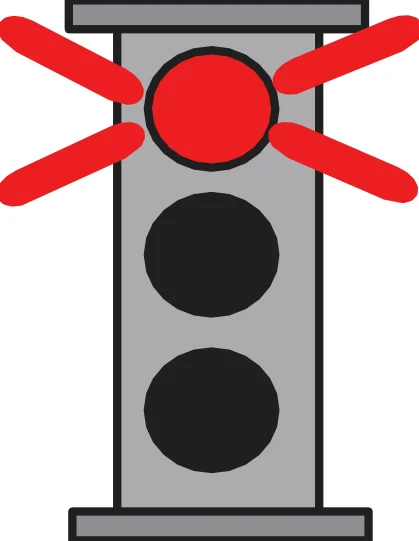
Flashing red light

Know the rule

Flashing red: STOP completely, then proceed with caution, yielding the right-of-way at intersections.

Handbook p. 39 ↗
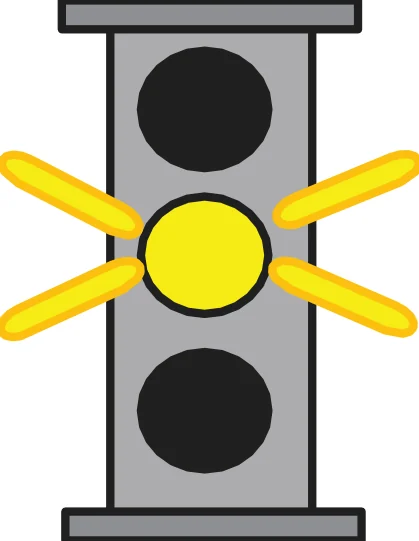
Flashing yellow light

Know the rule

Flashing yellow: SLOW DOWN and exercise caution.

Handbook p. 39 ↗

Know the rule

A malfunctioning light flashing yellow: slow down and exercise caution before crossing the intersection.

Handbook p. 39 ↗

Know the rule

A malfunctioning light with no functioning lights: STOP completely, then proceed with caution, following right-of-way rules at intersections.

Handbook p. 39 ↗
Lane control signal - steady red X (lane closed)
Lane-control signal: lane closed

Know the rule

Where lane-control signals are in use, travel ONLY in a lane marked by a green light. NEVER travel in a lane marked with a red light.

Handbook p. 40 ↗

Know the rule

Follow signs and signals UNLESS an officer is directing traffic. Then you MUST follow the officer's directions.

Handbook p. 40 ↗

How officers signal:

  • Stop: one hand held up, palm toward you, then a long blast on the whistle
  • Start or continue: a motion with one hand and a series of short whistle blasts
  • At night: the officer may signal with a flashlight
Handbook p. 40 ↗
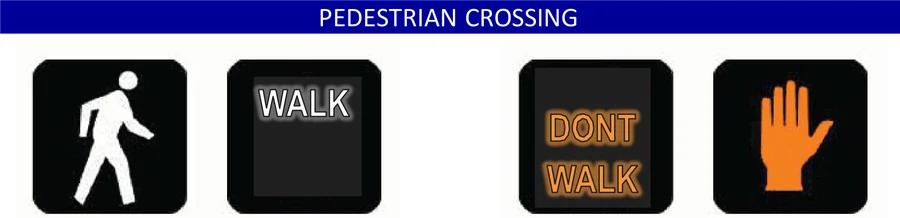
Pedestrian crossing signal reference (walk/don't walk)
Pedestrian signals: walk and don't walk

Know the rule

A WALK (walking person) signal means pedestrians may leave the curb; a DON'T WALK (hand) signal means they may NOT. If it's flashing, pedestrians must not leave the curb, but anyone already crossing should continue.

Handbook p. 40 ↗

Put it into practice

A storm has knocked out the traffic light at a busy intersection and it's completely dark. Come to a complete stop, then proceed with caution, following right-of-way rules as you would at a stop sign intersection.

Check your understanding

Read the question, decide on an answer, then open it to check the explanation. These are Roadwise study questions based on the source handbook.

What is the correct response to a flashing red light at an intersection?
  1. Slow down without stopping and proceed
  2. Stop completely
  3. Stop only if cross traffic is present
  4. Yield without stopping

Answer: Stop completely

A flashing red light requires a complete stop, then proceeding with caution while yielding right-of-way.
Handbook p. 39 ↗
What is the correct response to a flashing yellow light at an intersection?
  1. Slow down and proceed with caution, no stop required
  2. Stop only if other vehicles are visible
  3. Treat it as a four-way stop
  4. Come to a complete stop, just like a flashing red light

Answer: Slow down and proceed with caution, no stop required

A flashing yellow light means slow down and exercise caution; a full stop is not required.

Handbook p. 39 ↗
You approach an intersection where the traffic signal is completely dark due to a malfunction. What should you do?
  1. Stop completely and follow right-of-way rules as if there were no signal
  2. Wait for a police officer before proceeding
  3. Proceed at normal speed since no signal is displayed
  4. Treat it as a flashing yellow light

Answer: Stop completely and follow right-of-way rules as if there were no signal

A fully dark, malfunctioning signal requires a complete stop and following normal right-of-way rules.

Handbook p. 39 ↗
On a highway with overhead lane control signals, which lane may you travel in?
  1. Only a lane marked with a green light
  2. Whichever lane has the fewest vehicles
  3. Any lane, as long as you avoid a lane with a flashing light
  4. A lane marked with a red light, if traffic is light

Answer: Only a lane marked with a green light

You may travel only in lanes marked by a green light and must never enter a lane marked with a red light.

Handbook p. 40 ↗
How does an officer typically signal drivers to stop when directing traffic?
  1. Waving both arms overhead
  2. Holding up one hand, palm toward you
  3. Flashing a red flag
  4. Giving a series of short whistle blasts

Answer: Holding up one hand, palm toward you

An officer usually signals a stop by holding up one hand, palm toward you, with a long whistle blast.

Handbook p. 40 ↗
If a pedestrian signal begins flashing DON'T WALK while you are already in the crosswalk, you must immediately turn back to the curb you came from.
  1. True
  2. False

Answer: False

Pedestrians who began crossing before the signal changed to flashing should continue crossing, not turn back.

Handbook p. 40 ↗
Take the lesson checkpoint in the app

More in Railroad Crossings & Traffic Signals