roadwise.Open study app

Mississippi driving lesson · Traffic Signs

Warning signs

A 2-minute lesson from the Mississippi course. Read the rules and examples, follow the handbook page references, and check your understanding before you move on.

Read time
2 minutes
Course unit
Traffic Signs
Checkpoint questions
5
Source pages
30, 31

Yellow diamond warning signs tell you what's ahead so you can slow down and get ready: a signal, a merge, a curve, a slippery road. They don't order you to stop; they buy you time to react.

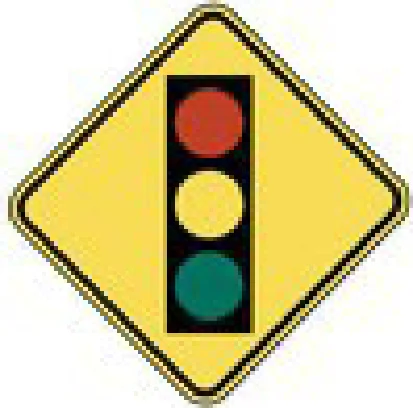
Signal ahead
Traffic signal ahead

Intersections and controls ahead:

  • Traffic signal ahead
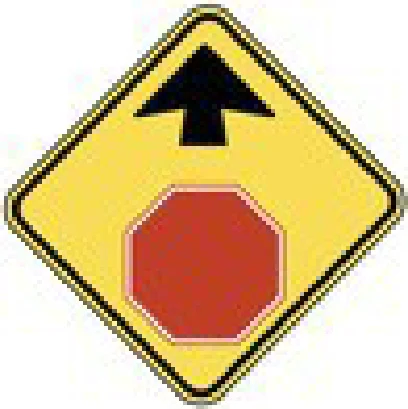
  • STOP ahead
  • YIELD ahead
  • Intersection / crossroads ahead
  • 'T' intersection ahead
  • Side road ahead (on right); side road enters from an angle ahead
  • Railroad crossing ahead
  • Traffic circle / roundabout ahead
Handbook p. 30 ↗
Stop ahead
STOP ahead

Lanes and traffic flow:

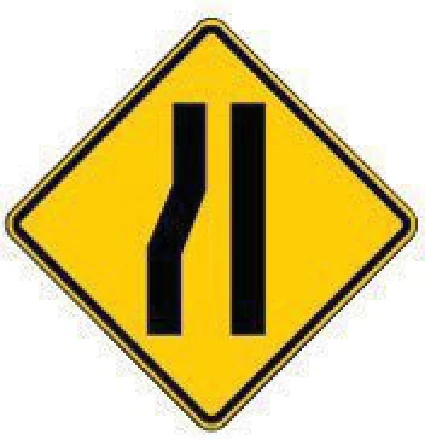
  • Right lane ends: merge to the left
  • Left lane ends: merge to the right
  • Access lane/ramp merges into roadway (from right)
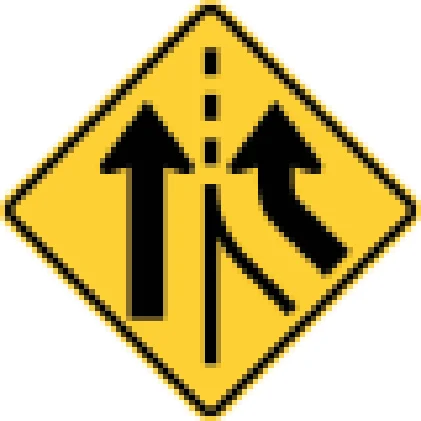
  • New lane enters roadway: no merging necessary
  • Two-way traffic
  • Divided highway ahead
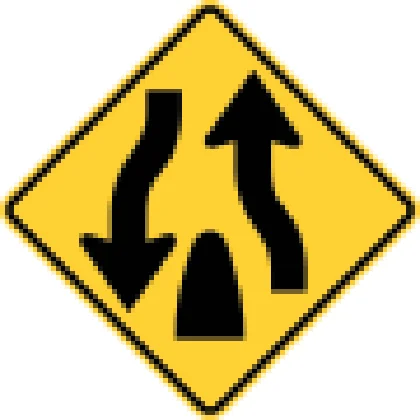
  • Divided highway ends: two-way traffic ahead
Handbook p. 30 ↗
Right lane ends
Lane reduction: a lane ends ahead
Added lane
New lane enters roadway (no merging necessary)
Divided highway ends
Divided highway ends; two-way traffic ahead

Curves and road conditions:

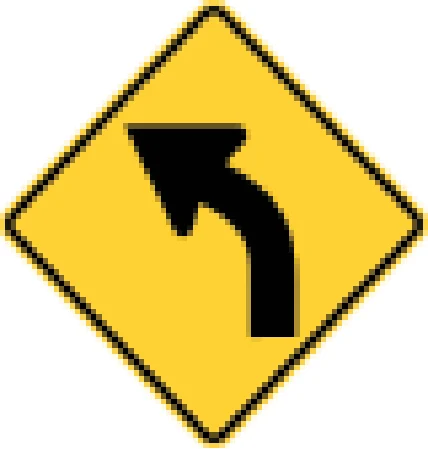
  • Sharp turn (left) ahead
  • Curve (left) ahead
  • Winding road ahead
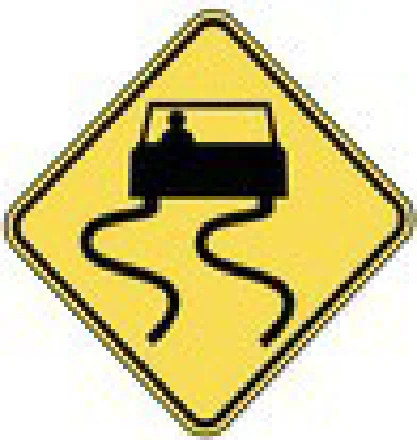
  • Slippery when wet
Handbook p. 31 ↗
Curve left
Sharp turn (left) ahead
Slippery when wet
Slippery when wet

Put it into practice

A diamond sign says RIGHT LANE ENDS. If you're in the right lane, signal and merge left before your lane ends. If the sign instead shows a NEW LANE ENTERS ROADWAY, no merge is needed.

Check your understanding

Read the question, decide on an answer, then open it to check the explanation. These are Roadwise study questions based on the source handbook.

A diamond-shaped sign shows a curving arrow labeled "SHARP TURN." What should you do as you approach?
  1. Maintain your current speed, since it's only a suggestion
  2. Slow down in advance to safely negotiate the sharp turn ahead
  3. Switch to your high-beam headlights
  4. Speed up to clear the turn quickly

Answer: Slow down in advance to safely negotiate the sharp turn ahead

A SHARP TURN warning sign tells you to reduce speed in advance of a sharp curve ahead.
Handbook p. 31 ↗
What does a diamond-shaped sign reading "SLIPPERY WHEN WET" warn you about?
  1. The road may be slick in wet conditions
  2. The road is closed during rain
  3. The road has no shoulder
  4. Rain is expected in the area

Answer: The road may be slick in wet conditions

This sign warns that the road becomes slippery when wet, so you should adjust your driving accordingly.

Handbook p. 31 ↗
A yellow diamond sign reads RIGHT LANE ENDS. If you are in the right lane, what should you do?
  1. Merge to the left
  2. Merge to the right
  3. Stop where the lane ends
  4. Continue on the shoulder

Answer: Merge to the left

RIGHT LANE ENDS means the right lane is ending, so traffic in it must merge to the left.

Handbook p. 30 ↗
A warning sign shows NEW LANE ENTERS ROADWAY. What does this mean for traffic already on the road?
  1. No merging is necessary
  2. Traffic must merge to the left
  3. The road narrows to one lane
  4. A divided highway ends ahead

Answer: No merging is necessary

The NEW LANE ENTERS ROADWAY sign means a lane is added, so no merging is necessary.

Handbook p. 30 ↗
A diamond warning sign says DIVIDED HIGHWAY ENDS. What should you expect ahead?
  1. Two-way traffic
  2. A four-way stop
  3. A one-way street
  4. A center turn lane

Answer: Two-way traffic

The DIVIDED HIGHWAY ENDS sign warns of two-way traffic ahead.

Handbook p. 30 ↗
Take the lesson checkpoint in the app

More in Traffic Signs