roadwise.Open study app

Mississippi driving lesson · Passing, Turning & Right-of-Way

Turn lanes, one-way streets & opposing left turns

A 2-minute lesson from the Mississippi course. Read the rules and examples, follow the handbook page references, and check your understanding before you move on.

Read time
2 minutes
Course unit
Passing, Turning & Right-of-Way
Checkpoint questions
6
Source pages
53, 54

Busy intersections may let several lanes turn at once, or let one lane either go straight or turn. One-way streets add another danger: turning the wrong way into oncoming traffic.

Know the rule

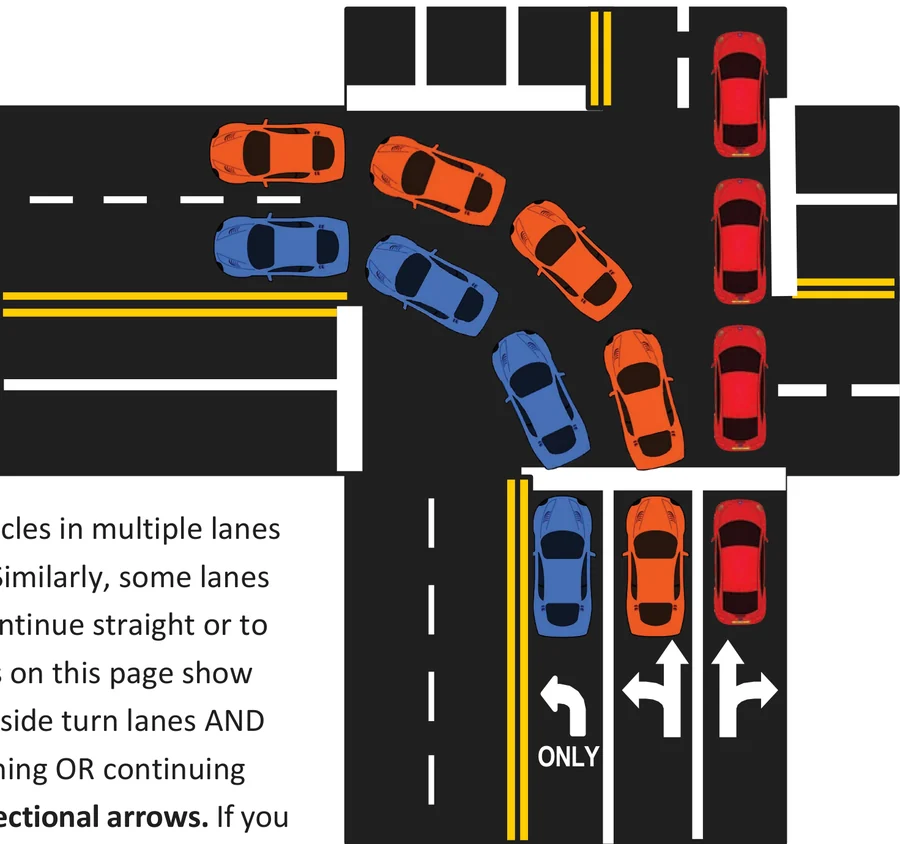
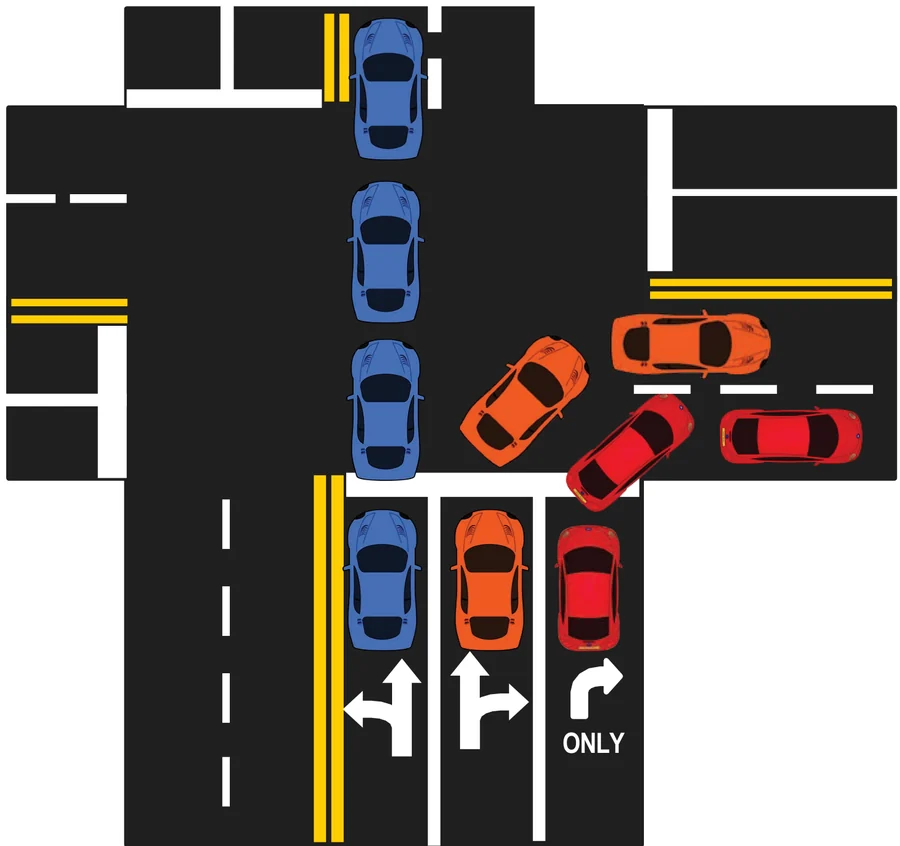
Some roadways allow vehicles in multiple lanes to turn at the same time, and some lanes let drivers either continue straight or turn. Always follow the directional arrows.

Handbook p. 53 ↗

Know the rule

If you turn from side-by-side turn lanes, be certain to stay in your lane through the turn.

Handbook p. 53 ↗
Multiple turn lanes and lane options at an intersection
Side-by-side turn lanes

Know the rule

When two drivers approach an intersection and both want to turn left, each driver should turn to the left of the other: leave from the left lane and enter the left lane.

Handbook p. 54 ↗

Know the rule

On a one-way street, a good rule is to turn from the lane nearest the curb. Pavement markings or signs may permit turning from additional lanes.

Handbook p. 54 ↗

Know the rule

Be careful not to turn the wrong way onto a one-way street.

Handbook p. 54 ↗

Know the rule

Where two one-way streets cross, right turns may be permitted from one street but not the other, and the same for left turns. These limits keep drivers from traveling the wrong way on a one-way street.

Handbook p. 54 ↗
Turn lane positioning (stay in your lane)
Lanes that permit turning OR continuing straight

Put it into practice

You're on a one-way street planning to turn left onto another one-way street. Turn from the lane nearest the left curb (unless markings allow other lanes), and check the ONE WAY sign so you don't turn against traffic.

Check your understanding

Read the question, decide on an answer, then open it to check the explanation. These are Roadwise study questions based on the source handbook.

Two drivers approach an intersection from opposite directions and both want to turn left. How should they turn?
  1. Whichever driver arrived first turns first
  2. They should both wait for a green arrow
  3. Each should turn to the left of the other
  4. The driver on the right always goes first

Answer: Each should turn to the left of the other

When both drivers want to turn left, each should turn to the left of the other, entering the left lane.
Handbook p. 54 ↗
On a one-way street with no special markings, which lane should you generally turn from?
  1. The center lane
  2. Any lane you choose
  3. The lane farthest from the curb
  4. The lane nearest the curb

Answer: The lane nearest the curb

A good rule on one-way streets is to turn from the lane nearest the curb unless markings allow otherwise.

Handbook p. 54 ↗
Why might turning right be permitted from one one-way street at an intersection but not from the crossing one-way street?
  1. To prevent drivers from traveling the wrong way on a one-way street
  2. To reduce the number of turning lanes
  3. Because left-lane turns are always prohibited
  4. Because one-way streets have lower speed limits

Answer: To prevent drivers from traveling the wrong way on a one-way street

These restrictions exist specifically to keep drivers from turning the wrong way onto a one-way street.

Handbook p. 54 ↗
Which of the following about one-way streets is TRUE, according to the handbook?
  1. Markings or signage may permit turning from other lanes
  2. Left turns are always prohibited on one-way streets
  3. Turning from any lane is always allowed
  4. You must never turn from the lane nearest the curb

Answer: Markings or signage may permit turning from other lanes

While the general rule is to turn from the lane nearest the curb, markings or signage may permit turning from additional lanes.

Handbook p. 54 ↗
When two drivers both intend to turn left at the same intersection, they should pass in front of each other, each turning to the right of the other.
  1. True
  2. False

Answer: False

They should each turn to the left of the other, not the right.

Handbook p. 54 ↗
Pavement markings or signage may sometimes permit turning from lanes other than the one nearest the curb on a one-way street.
  1. True
  2. False

Answer: True

The handbook notes markings or signage may permit turning from additional lanes on a one-way street.

Handbook p. 54 ↗
Take the lesson checkpoint in the app

More in Passing, Turning & Right-of-Way