roadwise.Open study app

Mississippi driving lesson · Passing, Turning & Right-of-Way

Right-of-way at intersections

A 3-minute lesson from the Mississippi course. Read the rules and examples, follow the handbook page references, and check your understanding before you move on.

Read time
3 minutes
Course unit
Passing, Turning & Right-of-Way
Checkpoint questions
6
Source pages
55, 56

The most dangerous place on a highway is an intersection. Right-of-way rules decide who goes first, but the first rule is common sense: your right of way is important, but it's not worth an accident.

Right of way

The privilege of immediate use of the highway. The person who has it may move ahead; the person who doesn't must yield and wait.

Handbook p. 55 ↗

Approaching and crossing intersections:

  • Always approach any cross street or road with extreme caution
  • Can't see the whole intersection? Slow down, proceed cautiously and look both ways
  • Traffic blocked? Stop before you reach the crosswalk and wait for traffic to move
  • Slow down approaching (stop if required); speed up gradually as you clear it
  • Drive defensively: don't assume others understand your intentions
Handbook p. 55 ↗

Know the rule

Determine your right of way before you enter an intersection. If another driver yields to you, proceed immediately. If not, slow or stop and let them go.

Handbook p. 55 ↗

Always yield to:

  • Pedestrians in crosswalks, whether the crosswalk is marked or not
  • Vehicles already inside the intersection
  • Bicycles, exactly as you would to any other vehicle
Handbook p. 55 ↗

Know the rule

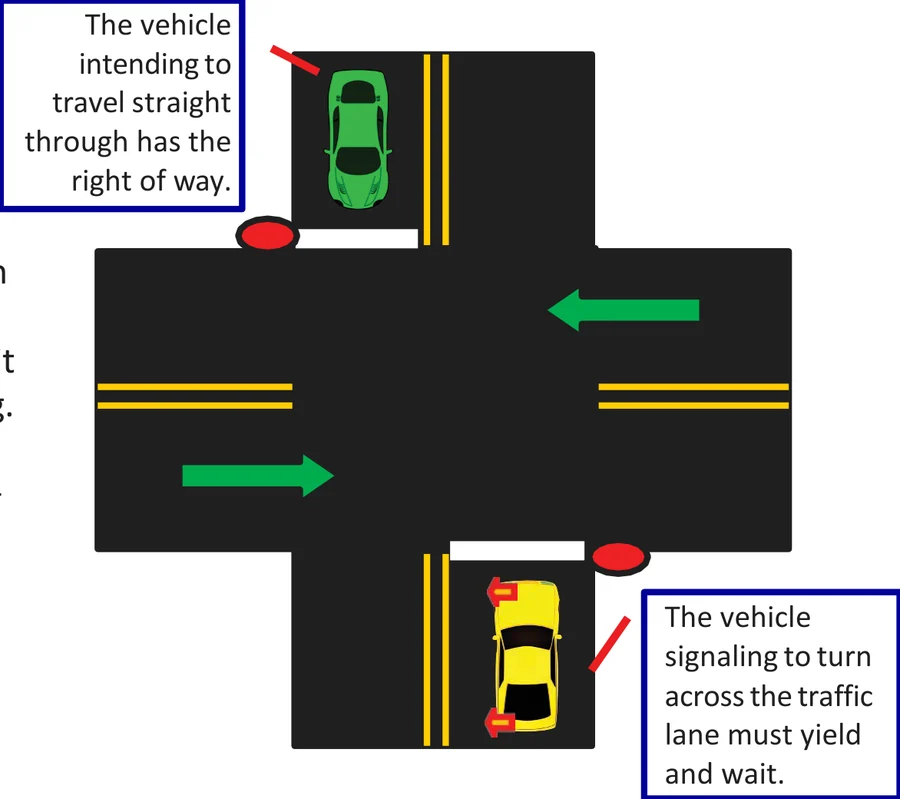
A vehicle signaling to turn across the traffic lane must yield and wait. The vehicle going straight through has the right of way.

Handbook p. 56 ↗

Know the rule

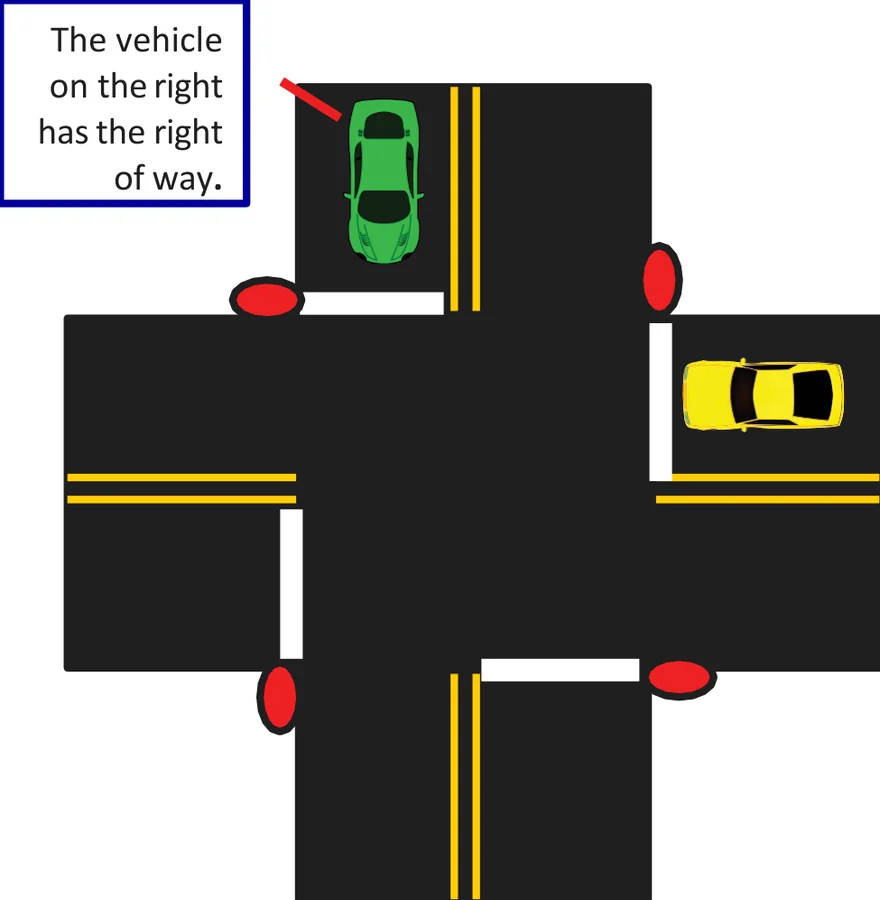
Four-way stop: the first vehicle to arrive has the right of way. If vehicles arrive at the same time, the vehicle on the right goes first. Don't slam on your brakes to 'stop first.'

Handbook p. 56 ↗

Know the rule

Two-way stop: cross traffic with no stop signs has the right of way. Vehicles at the stop signs wait until the way is clear; then the first one to arrive goes first.

Handbook p. 56 ↗

Know the rule

At a two-way stop, if two vehicles arrive at the same time, the one going straight across goes first; the one turning across the traffic lane yields. The vehicle on the right has the right of way.

Handbook p. 56 ↗

Know the rule

At a stop sign or signal, bring your vehicle to a COMPLETE STOP at the crosswalk and yield to any vehicle or pedestrian in the intersection. Proceed carefully only when your way is completely clear.

Handbook p. 56 ↗
Four-way stop right-of-way (vehicle on the right)
Arriving together at a four-way stop: the vehicle on the right goes first
Two-way stop right-of-way (straight vs turning vehicle)
The vehicle turning across traffic yields to the vehicle going straight

Put it into practice

You and another car stop at a four-way stop at the same moment, and it's on your right. Let it go first. If you had clearly arrived first, you'd have the right of way, with no need to brake hard to get there.

Check your understanding

Read the question, decide on an answer, then open it to check the explanation. These are Roadwise study questions based on the source handbook.

At a four-way stop, two vehicles arrive at the same moment from different directions. Who has the right of way?
  1. The vehicle on the left
  2. The larger vehicle
  3. Whichever vehicle has its signal on
  4. The vehicle on the right

Answer: The vehicle on the right

If multiple vehicles arrive at a four-way stop at the same time, the vehicle on the right has the right of way.
Handbook p. 56 ↗
At a two-way stop where the cross street has no stop sign, who has the right of way?
  1. The larger of the two vehicles
  2. The cross traffic with no stop sign
  3. The vehicle on the right at the stop signs
  4. Whichever driver arrives first at the stop sign

Answer: The cross traffic with no stop sign

At a two-way stop, cross-traffic that has no stop sign has the right of way over vehicles stopped at the signs.

Handbook p. 56 ↗
Two vehicles arrive together at a two-way stop; one intends to go straight and the other intends to turn left across traffic. Who must yield?
  1. The vehicle going straight
  2. Neither; they proceed simultaneously
  3. The vehicle turning left across traffic
  4. Whichever vehicle is smaller

Answer: The vehicle turning left across traffic

The vehicle turning across the traffic lane must yield to the vehicle proceeding straight through.

Handbook p. 56 ↗
At an intersection with a stop sign, after your complete stop what must you do before entering?
  1. Flash your headlights to claim the right-of-way
  2. Yield only to vehicles on your left
  3. Yield to any vehicle or pedestrian already in the intersection
  4. Proceed immediately once stopped

Answer: Yield to any vehicle or pedestrian already in the intersection

You must yield the right-of-way to any vehicle or pedestrian in the intersection before proceeding.

Handbook p. 56 ↗
If another driver yields the right of way to you at an intersection, what should you do?
  1. Stop completely again before moving
  2. Proceed immediately
  3. Signal them to go first instead
  4. Wait several seconds regardless

Answer: Proceed immediately

If another driver yields to you, you should proceed immediately rather than hesitating.

Handbook p. 55 ↗
At a four-way stop, you should brake hard to try to "stop first" and claim the right of way.
  1. True
  2. False

Answer: False

The handbook specifically warns not to slam on your brakes to stop first; yield to the driver on the right instead.

Handbook p. 56 ↗
Take the lesson checkpoint in the app

More in Passing, Turning & Right-of-Way