Roadwise States Michigan Driving lessons Where you can never park Michigan driving lesson · Railroad Crossings and Parking
Where you can never park A 3-minute lesson from the Michigan course. Read the rules and examples, follow the handbook page references, and check your understanding before you move on.
Read time 3 minutes
Course unit Railroad Crossings and Parking
Checkpoint questions 6
Source pages 52, 53 Most no-parking rules keep emergency access, sight lines and traffic flow clear. The distances are favorite test questions, so learn the table.
Know the rule
Communities may pass parking ordinances stricter than state law; signs are posted at the city limits.
Handbook p. 52 ↗ Know the rule
The vehicle's owner is responsible for parking tickets. If the vehicle is leased, the person leasing it is responsible.
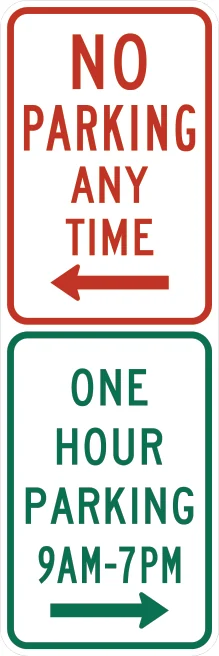
Handbook p. 52 ↗ Never park: Where "no stopping," "no standing" or "no parking" signs are posted In front of a driveway, alley, theater, emergency exit or fire escape Where you block the view of drivers turning at an intersection Against the flow of traffic In a highway lane outside city or village limits when there's a shoulder On or under a bridge (unless posted), on an overpass or in a tunnel Handbook p. 52 ↗ Also never park: On a sidewalk, or in front of a public or private driveway Within an intersection, crosswalk or designated bike lane On the street side of a legally parked vehicle (double parking) Where you block mail delivery to a rural mailbox At a transit stop Handbook p. 53 ↗ No Parking Any Time and time-limited parking signs Put it into practice
You find a spot 25 feet from a stop sign on a quiet street. You can't take it: you must be at least 30 feet from a stop sign, traffic light or flashing beacon.
A useful reminder 15 ft hydrant, 20 ft crosswalk, 30 ft stop sign, 50 ft railroad, 500 ft fire or crash.
Check your understanding Read the question, decide on an answer, then open it to check the explanation. These are Roadwise study questions based on the source handbook.
Who is responsible for a parking ticket on an illegally parked vehicle? Always the person who parked it The owner, even if the vehicle is leased The vehicle's owner, or the lessee if leased The person named on the insurance policy Answer: The vehicle's owner, or the lessee if leased
The owner of an illegally parked vehicle is responsible for tickets; if leased, the person leasing it is responsible.
Handbook p. 52 ↗ How close to a fire hydrant may you legally park? No closer than 50 feet No closer than 25 feet No closer than 15 feet No closer than 5 feet Answer: No closer than 15 feet
You may never park within 15 feet of a fire hydrant.
Handbook p. 52 ↗ How close to a fire station driveway, on the same side of the street, may you park? No closer than 40 feet No closer than 75 feet No closer than 10 feet No closer than 20 feet Answer: No closer than 20 feet
You may never park within 20 feet of a fire station driveway on the same side of the street.
Handbook p. 52 ↗ How close to a marked crosswalk may you legally park? No closer than 50 feet No closer than 10 feet No closer than 20 feet No closer than 30 feet Answer: No closer than 20 feet
You may never park within 20 feet of a marked crosswalk.
Handbook p. 53 ↗ How close to a stop sign, traffic light, or flashing beacon may you legally park? No closer than 30 feet No closer than 20 feet No closer than 15 feet No closer than 50 feet Answer: No closer than 30 feet
You may not park within 30 feet of a stop sign, traffic light, or flashing beacon.
Handbook p. 52 ↗ You want to park near a set of railroad tracks, closer than you would to a fire hydrant. How close to the nearest rail may you legally park? No closer than 100 feet No closer than 30 feet No closer than 50 feet No closer than 15 feet Answer: No closer than 50 feet
You may not park within 50 feet of the nearest rail of a railroad crossing.
Handbook p. 52 ↗ Previous lesson Disability parking Next lesson Sign shapes, colors and route markers More in Railroad Crossings and Parking About the source Roadwise’s Michigan course uses the driver handbook edition supplied with this study pack. This lesson cites source pages 52, 53. The linked PDF is a third-party mirror of the handbook, rather than a government-hosted page.
Open the handbook source PDF · View the source edition
For current application requirements, fees, appointments, and the format that applies to your age or license type, check Michigan’s SOS. Roadwise provides study material and does not issue permits or licenses.