Roadwise States Michigan Driving lessons Railroad crossings Michigan driving lesson · Railroad Crossings and Parking
Railroad crossings A 3-minute lesson from the Michigan course. Read the rules and examples, follow the handbook page references, and check your understanding before you move on.
Read time 3 minutes
Course unit Railroad Crossings and Parking
Checkpoint questions 6
Source pages 49, 50 A train can take a mile or more to stop, and it's closer and faster than it looks. Crossings use either passive warnings (signs only) or active ones (lights, gates, bells). Know what each requires.
Know the rule
When approaching any railroad crossing, slow down and look both ways. Ignoring a signal or trying to beat a train can be fatal.
Handbook p. 49 ↗ Know the rule
On foot, on a bike or in a vehicle, cross tracks only at designated crossings. Never walk down or stop on the tracks — it's illegal and dangerous.
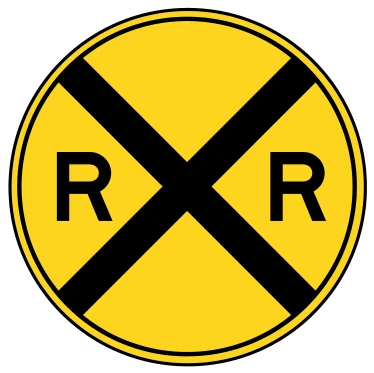
Handbook p. 49 ↗ Railroad crossing advance warning sign Know the rule
If there is a stop sign at the crossing, you must stop whether or not a train is in sight.
Handbook p. 50 ↗ Unless clearly marked otherwise, these must stop and check for trains even with no stop sign or signal: School buses Vehicles carrying passengers for hire Gasoline trucks Other vehicles carrying hazardous materials Handbook p. 50 ↗ Passive control system A crossing with no flashing lights or gates. It uses advance warning signs, pavement markings and crossbucks with yield or stop signs.
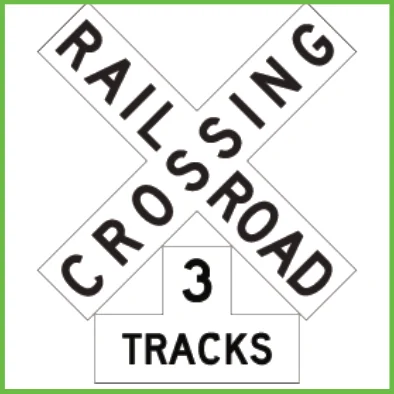
Handbook p. 50 ↗ Crossbuck with a sign showing 3 tracks Know the rule
At a passive crossing, slow down or stop as needed, yield to trains, check both directions, make sure all tracks are clear and never race a train.
Handbook p. 50 ↗ Active control system A crossing that signals a train's presence with gates, flashing lights, message signs, bells or other audible warnings.
Handbook p. 50 ↗ At any active crossing: Stop when bells ring, lights flash, or the gate is down or moving Never drive through, around or under an activated crossing system After the train passes, wait for gates up, lights and bells off and all tracks clear Handbook p. 50 ↗ Put it into practice
A school bus ahead of you stops at a crossing that has no stop sign or signal. That's required — school buses must stop and check for trains unless clearly marked otherwise. Be ready to stop behind it.
Check your understanding Read the question, decide on an answer, then open it to check the explanation. These are Roadwise study questions based on the source handbook.
A train is coming at a railroad crossing. Within what distance range from the tracks must you stop? Between 15 and 50 feet Exactly 25 feet Between 30 and 100 feet Between 5 and 20 feet Answer: Between 15 and 50 feet
If a train is coming, vehicles must stop no more than 50 feet or less than 15 feet from the tracks.
Handbook p. 49 ↗ By how much do trains typically overhang the tracks on each side? At least 10 feet At least 1 foot At least 3 feet At least 6 feet Answer: At least 3 feet
Trains overhang the tracks by at least three feet on each side and may have cargo that extends even farther.
Handbook p. 49 ↗ There's a stop sign at a railroad crossing but no train is visible. Must you still stop? Only if the crossing has flashing lights too Yes, stop even if no train is in sight No, only if a train is coming Only school buses must stop Answer: Yes, stop even if no train is in sight
If there's a stop sign at the crossing, you must stop whether or not a train is in sight.
Handbook p. 50 ↗ Which vehicle type must always stop and check for trains at a crossing, even with no stop sign or signal? A gasoline tanker truck A motorcycle A pickup towing a camper A delivery van Answer: A gasoline tanker truck
Gasoline trucks and other hazmat carriers, along with school buses and vehicles for hire, must stop and check even without a stop sign.
Handbook p. 50 ↗ What does a passive railroad crossing control system use to warn drivers? Bells and electronic message signs A staffed crossing guard Signs, pavement markings and crossbucks Gates and flashing lights Answer: Signs, pavement markings and crossbucks
Passive control systems lack flashing lights or gates, relying instead on warning signs, markings, and crossbuck signs.
Handbook p. 50 ↗ What should you do when an active railroad crossing's gate is down or in motion? Drive around it if no train is visible Wait until you can see around it, then proceed Stop, no matter what Proceed once the bells stop, even if the gate is still down Answer: Stop, no matter what
You must stop when the bells are ringing, lights are flashing, or the gate is down or in motion.
Handbook p. 50 ↗ Previous lesson Roundabouts Next lesson Crossing safety and if you're stuck on the tracks More in Railroad Crossings and Parking About the source Roadwise’s Michigan course uses the driver handbook edition supplied with this study pack. This lesson cites source pages 49, 50. The linked PDF is a third-party mirror of the handbook, rather than a government-hosted page.
Open the handbook source PDF · View the source edition
For current application requirements, fees, appointments, and the format that applies to your age or license type, check Michigan’s SOS. Roadwise provides study material and does not issue permits or licenses.